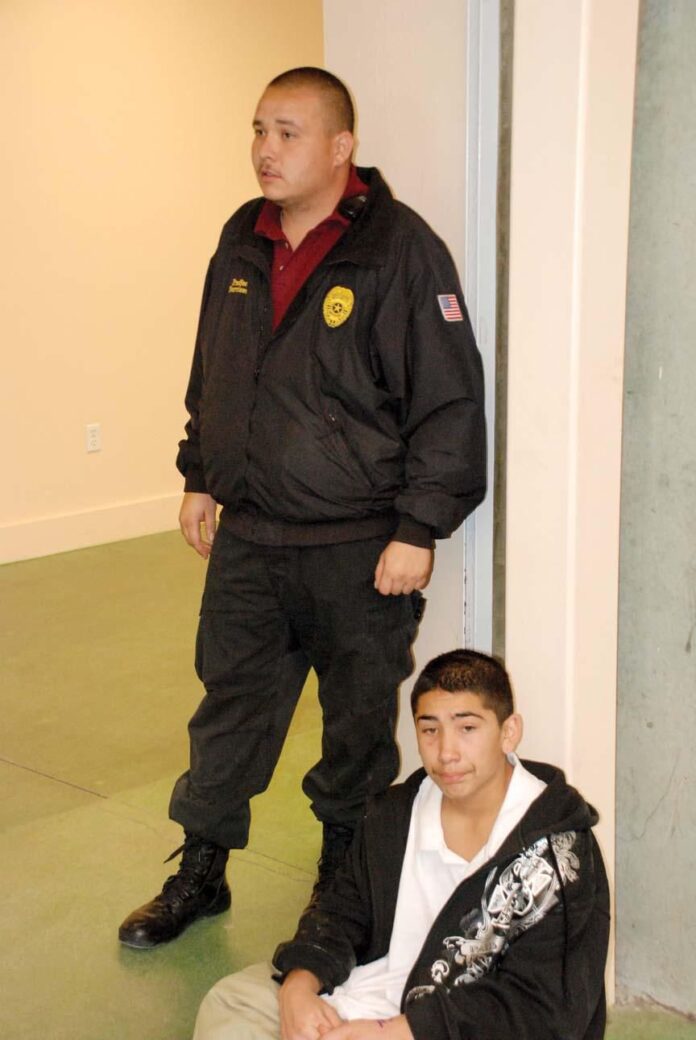
A steady stream of Española Middle School students milled in and out of Assistant Principal Theresa Flores’ office Tuesday morning, and a handful more waited outside, some with dread written on their faces, others talking tough, apparently used to routine visits with the school’s head disciplinarian.
Within a half hour, two students left with in-school suspensions. A third received a reprimand, and another’s parent was called in for a conference.
“We have quite a few students here that are just determined to do whatever they want,” Flores said. “It seems we have quite a few more incidents this year than before.”
Flores is charged with doling out discipline at that school, and Tuesday morning was no different from any other for her. Violence, drug use and all-around misbehavior have spiked sharply in the Española School District’s two secondary schools despite a stepped-up security presence this school year.
Some administrators insist discipline has improved over the first half of the school year.
“(Problems) have gone way down,” Middle School Principal Lewis Johnson said. “From what I can see, we have less issues. And it’s bound to get better in the long run.”
But the numbers suggest otherwise. The number of disciplinary infractions has increased by almost 50 percent at the middle school and more than tripled at the high school since the first month of class, according to statistics provided by ProSec, the District’s private security contractor.
The total number of incidents in November, the most recent month for which statistics were available, amounts to nine infractions for each day of class that month at the middle school and almost seven a day at the high school, according to data.
Of those, almost a third were classified as “major” — such as fights, vandalism and possession of drugs or weapons, all incidents that usually require police action. The remaining incidents include “minor” infractions like truancy and dress code violations.
High school Assistant Principal Dolores Guzman acknowledged discipline problems at that school, which had seen a drop in discipline problems in recent years, and pointed to the District’s restructuring of its secondary schools this summer as a possible reason.
Seventh graders moved from the former Española seventh-grade school to the middle school at the start of this school year, and the ninth grade moved from the middle school to the high school. That means this year, the high school has two classes of students — ninth and 10th grades — adjusting to a new school.
“It’s new rules, new boundaries, new expectations they’re learning and getting used to,” Guzman said.
The move increased the high school’s enrollment by almost 200 students, while enrollment at the middle school stayed roughly the same, according to enrollment statistics. The high school, which currently enrolls about 940 students, had 114 recorded incidents in November. The middle school had 144 incidents, though it enrolls only 565 students.
Parents are frustrated, and some are responding by sending their children to school elsewhere.
“(Flores) says its a lack of manpower,” Violet Coriz, whose seventh-grade daughter was assaulted Jan. 13 by another student, said. “I think they’re just disorganized. That school’s too big. And (administrators) know these little girls are in gangs. They know they like to fight. They know them by name. But they just suspend them for a couple of days and it happens over and over.”
Coriz said she is contemplating sending her daughter to Gonzales Elementary in Santa Fe, which is smaller and enrolls students through the seventh grade.
The parent of another assault victim declined to comment, but not before asking, “It’s not like the situation’s going to change any, so what’s the point of saying anything?”
Students who do well cope by staying away from troublemakers, they said.
“You know, there’s fights, yeah,” senior Evan Cruz said. “But I kinda keep to myself.”
Senior Joseph Madrid was surprised to hear of an increase in disciplinary incidents. For him, the high school’s atmosphere marked a big improvement over the middle school.
“A lot of it’s the younger kids, they haven’t hit that maturity level,” Madrid said. “I actually thought it’s calmed down. I really don’t see it, I kind of distance from it. Who you hang out with is how you’re going to act.”
ProSec’s data provide only a partial view of discipline at the two schools — it records only incidents that were handled by ProSec security guards, but not those handled directly by teachers and administrators.
ProSec plans to release December 2008 disciplinary data later this month, ProSec co-owner and Rio Arriba County Commissioner Elias Coriz said. Meanwhile, police reports illustrate the climate in the two schools over the past two weeks (see related story).
The data suggests discipline at the two schools has also taken a turn for the worse compared with previous school years.
The high school kicked off last school year with an almost identical number of infractions recorded in August 2007 as this year. Rather than increasing over the school year, like it has this year, however, trouble-making had subsided last school year to fewer than 10 incidents on average the last two months of class — a drop of 75 percent over the course of the year.
Middle school infractions had maintained a steady average of 58 incidents a month over the last two years before spiking to 106 in August 2008 and then again to 144 in November.
The worsening conditions come even as the high school beefed up its security force from eight guards to 12 at the beginning of the school year and the middle school increased its force from four guards to six.
The School Board cited the secondary school restructuring when it called for the increased security presence. Five Española Police officers who once patrolled District schools gradually dwindled down to one, and she was removed from the schools at the start of this school year.
ProSec’s contract increased from $344,489 at the beginning of last school year to $470,623 this year after the Board requested additional services, such as the additional guards and more frequent nighttime patrol in certain district schools, last school year and then again in August.
Though ProSec’s contract calls for two additional guards only during the first half of the school year, the guards stayed on the job after classes resumed in January. Board Vice President Floyd Archuleta and member Leonard Valerio said the guards are doing “a good job” and should stay for the remainder of the school year. Board member Andrew Chavez, who heads the District’s safety committee, said the Board would vote on the measure “soon.”
“If they want to keep them, that’s the Board’s prerogative,” District Safety Officer Paul Salas said. “But we need to modify the purchase order, and they have to come up with the money somehow.”
But Flores said additional guards are not the answer to her school’s discipline problems.
“I’m not a firm believer in suspensions, for example,” Flores said. “Some of these students, they’re acting out so they can go home with a suspension. What’s important is getting to the bottom of why they’re acting the way they are.”
Flores is working on an after-school detention program — misbehaving students seeking a suspension may savor staying at home instead of going to class, but they would be less willing to give up their afternoons, she said. Her dream is a community service program that would replace at least some suspensions. For now, Flores has asked teachers to supervise the after-school detention program as volunteers.
“We just don’t have the funding to pay (the teachers),” Flores said. “But until we have those types of programs, we’ll still be facing the issues we have right now.
Middle school teacher Monica Garcia said discipline is largely in teachers’ hands.
“Students that know me, they usually have respect,” Garcia said. “Kids are the same everywhere. Especially at the age level we’re dealing with, they like to push rules, test boundaries. ”