¡Felicidades! Híwon!

Published:

   Española students earn bilingual-biliteracy seal

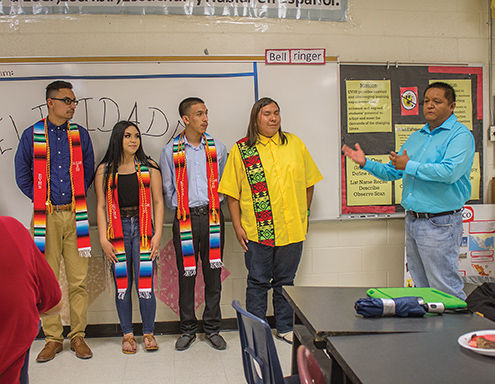
   Five Española Valley High School students graduated this year with distinction for learning or improving their grasp of the Valley’s first languages, Tewa and Spanish.

    The students were honored by their teachers and local school officials during a pizza party, May 22, in one of the Spanish classrooms at Española Valley High School.

    The five students were the first from Española Valley High School to earn a New Mexico Diploma of Excellence Bilingualism-Biliteracy Seal in either the Tewa or Spanish language.

    To get the bilingual certification seal on their diplomas, students had to be recommended by someone for the bilingual program, and have good high enough grades. Once in the college-level program, they had to write a 10-page paper in Spanish, and give a 20-slide presentation based on the paper.

    The students did their presentations in April before panels of judges fluent in either Spanish or Tewa.

    Damien Tapia, 18, of Santa Clara Pueblo, received the first New Mexico Diploma of Excellence Bilingualism-Biliteracy Seal in Tewa.

    His true name, given to him by his grandparents, is Tse Tsa, which is Tewa for “White Eagle.”

    “I’m excited, but I’m more relieved,” Tapia said. “I feel proud graduating with the seal, being able to speak not just English, but my own language.”

    Tewa is actually the language of Tapia’s father, Benedict Tapia. His mother, Rolanda Mescal is Navajo.

    When he started learning the language two years ago, he knew very little Tewa, his teacher, Brandon Cata, said.

    Tapia said learning Tewa has allowed him to hold conversations with his Pueblo elders, as a way of showing them respect by speaking in their language.

    “I can finally talk to them,” he said. “It’s so we don’t lose our culture.”

    This summer, he will be working as an intern for the Pueblo’s Puye Cliff Dwellings, a National Historic Landmark where his ancestors once lived. He has always wanted to be a video game designer.

    Before the recognition party, someone wrote “¡Felicidades!” which means congratulations, on the white board in the Spanish class where it was being held.

    When Brandon Cata walked in, he wrote “Híwon!” right below it, which means “good job” in Tewa.

    Brandon Cata has been teaching Tewa for five years, including two at the District. He has about 60 Tewa students between Española Valley High School and Española Middle School.

    Cata first learned Tewa at home, where his grandparents always spoke it.

    “We don’t really hear much of our Tewa language among the younger generation, but we’re trying to work on that,” Cata said. “I’m pretty young myself, so if they hear me speaking it and encouraging them, I think they’ll pick up on it and say, ‘Hey, we do need to learn.’ Because it’s unfortunate that a lot of it is dying, the tradition and the culture.”

    Cata said it is important students take an interest in learning the language to keep it alive.

    That’s important because as the elders from the Nambé, Pojoaque, San Ildefonso, Ohkay Owingeh, Santa Clara and Tesuque pueblos and the Hopi Tribe of Arizona die, so does the language.

    The Endangered Languages Project estimates, out of a 4,500 population, there are only 1,500 Tewa speakers living.

Spanish speakers

    The four students who earned seals in Spanish are all members of the high school’s Sociedad Honoraria Hispánica Chapter, “Bendíceme Ultima.”

    Mariano Rodriguez, of Velarde, wrote his paper on the underrepresentation of Latino students in the high school’s Advanced Placement classes.

    “Even though we may have a high population of Latinos here, it’s toward underrepresentation in advanced placement or honors courses,” Rodriguez, who immigrated to the United States with his parents from Mexico, said. “Seeing kids like me, only one or two, compared to the rest of the population, it’s kind of depressing. We’re afraid to push ourselves, and while we have this opportunity to take college-level courses here at the high school, and we’re not doing it.”

    Rodriguez, 18, plans to start work this summer to save money for college in the fall. He is enrolled to do general studies at Santa Fe Community College, and hopes to study civil engineering either at the University of New Mexico or New Mexico State University.

    Erika Quezada, of McCurdy, could not speak English when she came to the United States with her parents, who are from Uriangato, Guanajuato, Mexico. She first learned English in kindergarten at Fairview Elementary in Española.

    Quezada, now 17, passed the Advanced Placement English test.

    She said she joined the Spanish bilingual program to learn more about her own culture. She was excited about graduating but also a bit scared to enter “the real world” afterward.

    “It feels really good, it’s been an honor,” Quezada said of receiving the seal. “

    David Santana, 18, said he felt like the seal is an achievement because not everyone gets to be in the honor society and have a chance to work toward it.

    Santana wrote his essay about Somos Un Pueblo Unido, the immigrants rights organization that convinced, with Santana’s family’s help, the Española School Board to pass a resolution in January prohibiting Española School District staff from cooperating with Immigration and Customs Enforcement.

    “It’s been hard, but hard work pays off,” Santana said.

    This summer, Santana will work with his father and later apply to study at Northern New Mexico College.

Related articles

Recent articles