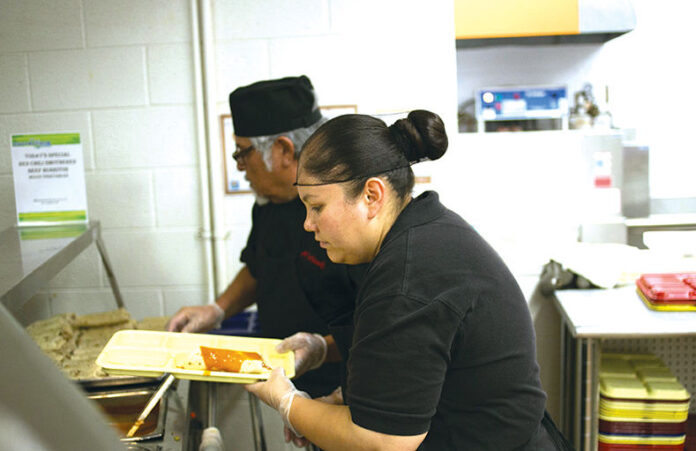
Free School Lunch Program for Students Expanded

Published:

    Some parents could see a reduction in their food bill, thanks to the expansion of the Española School District’s free breakfast and lunch programs.

    All students attending the District’s 13 schools, regardless of family income, can get breakfast to start their school day, 15 to 30 minutes before the morning bell.     

    They can choose between cold cereal, eggs or a hot cereal such as oatmeal and a variety of items for lunch. District Cafeteria Officer Patricia Romero said parents should check the schedules at their child’s school to learn when they will stop serving breakfast. The meals are served on a first-come, first-serve basis.

    “They have to be in class, so as long as they go before class, even if it is to grab an egg sandwich or a burrito or a juice,” she said. “It is something.”

    The District’s universal meal service eliminates the need for the free and reduced price lunch applications. The meals are funded through the National School Lunch and School Breakfast programs.          

    While the free meals have been available to the District’s middle and elementary school students, she said the service is fairly new to Española Valley High School.

    Romero and her colleagues were able to secure funding for the program expansion, after illustrating to federal officials, the District met the United States Department of Agriculture’s Community Eligibility Provision guidelines.

    The District’s Eligibility Provision ranking is about 86.6-percent, which means approximately the same percentage of students qualify for free and reduced lunch.

    The Eligibility Provision score is obtained by examining household income data throughout the District.

    “The Community Eligibility Provision (CEP) provides breakfast and lunch to all children at no charge and eliminates the collection of meal applications for free, reduced-price, and paid student meals,” a press release Romero published states. “This new approach reduces burdens for both families and school administrators and help ensure that students receive nutritious meals.”

    Superintendent Bobbie Gutierrez said besides ensuring District students don’t go hungry during the school day, the meal service could have a positive impact on classroom outcomes. Hungry students have a harder time learning.

    “I am delighted to expand our lunch program,” she said. “As we know, for many of our young people, the hot lunch they receive at school is the only hot meal they receive on a daily basis. When a child is hungry, it is difficult to learn, as it is a basic human need. I am hoping that by expanding our program, more students will have the opportunity to have hot, nutritious meals.

    The program, so far, is well received by parents and students alike, Romero said.

    During the first month of service, the District served 19,538 breakfasts and 37,175 lunches, to an average of 3,705 students, at all 13 school sites. However, she did say some families, for one reason or another, declined to participate in the program.

The meals are prepared and paid for in conjunction with funding from the Healthy Hungry Kid Act.

    “It is important,” Romero said. “It makes their minds function better. We have requirements of how much sodium and trans fat we can use. The kids get a healthy, nutritious meal so they won’t get tired and they can learn and function throughout the day.”

Related articles

Recent articles