Morse Code: Avid Angler Gives Rafting a Reluctant Opportunity

Published:

    For 40 years I have hiked and fished the Rio Grande from its headwaters in Colorado, through the gorge, and down to the Lyden Bridge north of Española, but it was not until last month that I decided to raft the river’s rapids.

    I had mixed feelings about rafting the Rio Grande. When I first started fishing the river, there were no rafting companies on it. They did not arrive until the 1970s.

    At times, anglers were forced to share fishing spots with rafters and kayakers. These latter two groups’ numbers grew in the coming years and always seemed to stop right in my fishing hole. Rafting tourists shouted and whooped like they were on a roller coaster and turned the river into an amusement park ride.

    After awhile, I came to accept the rafters and I didn’t mind sharing the river. The fish remained and there are many times of the year when rafts are few and far between. 

    The higher the river runs, the better it is for rafting. The lower the river runs, the better it is for fishing. Fall fishing after the peak of rafting season is still great and hiking into the gorge near Questa, where no rafters can tread, is still an adventure and a place to get away from it all.        

    So I drove to Pilar May 22 to take a trip with Big River rafting company through the Racecourse section of the river. With his long hair and braided beard, the owner, Billy Miller, reminded me of one of the hippies who moved to New Mexico about the same time I moved here. He had that sparkle in his eye that made you like him right away. He was a man who obviously enjoyed what he was doing.

    I had done some canoeing when I was a child growing up on the East Coast, but it had been a long time since I’d held a paddle. First thing I learned was how to sit in a raft. You don’t sit in the seats. You sit on the side of the raft, feet in front of you. This position turned out to be surprisingly stable and secure.

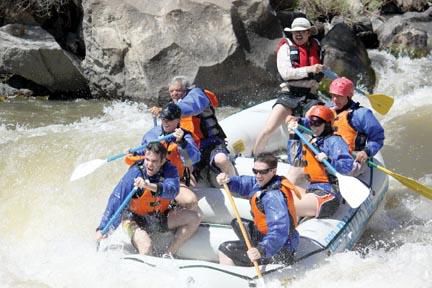
    Our guide, Rob Deyerberg, gave us some pretrip instructions. There was a sense of anticipation on the shore before the launch. On this trip were myself, two young couples from Oklahoma, a man about my age and the guide.

    Launching into the river, I immediately felt a part of the river more than I never did while fishing.

    It’s hard to describe a rafting trip, because it just sort of happens. After paddling a bit, you hit the first rapid and water splashes on you. The first few rapids were easy Class II-level rapids. The guide explained that a Class III rapid was one where you couldn’t see the river past the rapid. The first Class III rapid was Alberts Falls. As we approached it, you could see what he meant.

    As we hit the rapids, water splashed over all of us. It was fun and exciting. The raft rode out the rapid despite being bounced up and down. We’d obviously had a good line going through.

    The next Class III rapid was at Big Rock, a place I had seen many times while fishing. I was looking forward to it because here a big rock split the river in two and you could tell that you had to take the right path around it. The huge rock had crashed down the walls of the canyon, hit the road and bounced into the river. Looking at the rock, you can only imagine what that must have been like.

    If anything, Big Rock was a  letdown. That was because through our guide’s skill and solid paddling from everybody, we had a great line and the current zipped us past any danger.

    The next big rapid was Souse Hole and that proved to be more exciting than I had expected. Again, we had a good line and rode through it cleanly. Rob said that in all his years of guiding, the only time he had flipped a raft was in Souse Hole.

    Only one more rapid remained named Sleeping Beauty, so named because it looks easy but soaks you pretty well. After that, it’s mostly flat water to the take-out point where Rio Arriba and Taos counties meet.

     As the trip ended, there was that sense of camaraderie among all of us from having shared a brief but exciting experience together. I’m glad I finally did and even though I’d probably never see these people again I’d remember it and them. I felt good when our guide told me I had been a good paddler.

    “I would have told you if you weren’t,” he said.

    Billy Miller explained later what it is that has kept him in this business after 18 years.

    “It’s a wonderful life,” he said. “One of the best things is I get to meet people from all over who otherwise might not give me the time of day.”

    The Rio Grande is big enough to share with everyone. I’ll probably take another raft trip down it, but it still means more to me when I’m walking its banks full of hope that the mother of all brown trout is waiting to tighten my line. Sometimes, just the sense of being there watching it flow can be reward enough.   

Related articles

Recent articles