A traditional student, according to the National Center for Education Statistics, is a post-secondary student entering college that is between the ages of 18 and 22 who enter the collegiate realm directly after high school.
These students attend college full time, predominantly live on campus and do not have major life and work responsibilities.
These types of students have historically been the majority across the collegiate spectrum. However, times are changing, and the enrollment of non traditional students, students that are 25 years of age or older and have to shoulder life responsibilities on top of school, is increasing dramatically. These students are now the majority, according to How College Affects Students: 21st Century Evidence that Higher Education Works, a book researching current trends in higher education.
This dramatic shift has forced colleges to shift directions and approaches to higher education, prompting them to develop programs that focus on the success and ease of the non-traditional working student.
The population of Española is anything but traditional, and given the unique socio-economic and cultural populations of Española and Northern New Mexico, a non-traditional approach to college is necessary. That is why Northern New Mexico College has programs like CAMP. College Assistance Migrant Program.
The Program, acting as one of many programs that the College offers to aid non traditional students, like the HEP (High School Equivalency Program), provides support and retention services to first-year college students from migrant and seasonal farmworker families, according to the College’s website.
The Program works with faculty, student services and community-based agencies to improve educational opportunities for its students through offering nine key services:
• Scholarship to cover tuition and fees
• Stipend for textbooks and supplies
• Monthly training and transportation stipends
• Academic skills assessment and program orientation
• Tutoring and study skills assistance
• Career, financial aid and personal counseling
• Cultural events
• Peer mentoring
• CAMP courses
These services, coupled with community service programs, allow students that have been approved for the program to work closely with staff in their first year of enrollment to ensure that receive the guidance and support that they need to remain in and finish their respective degree paths.
Joshua Lopez, a freshman at the college, is about as local as one can get, having gone through the gauntlet of the Española School District, beginning his educational journey at Velarde Elementary, through Española Middle School and finally finishing at Española Valley High School.
Lopez, like many involved in the program, juggles full time courses along with his full-time job. The program is a vital aspect in his academic journey and provides services, Lopez said, that are vital for his success as a first-year student.
“It is the best support I could have,” he said. “I work full time at McDonald’s. They (the program) have helped pay for college, I have received a lot of financial support, We get meal vouchers four times a week, and they give us a lot of tutoring support, we go into study halls and there is good leadership promotion with these community service programs.”
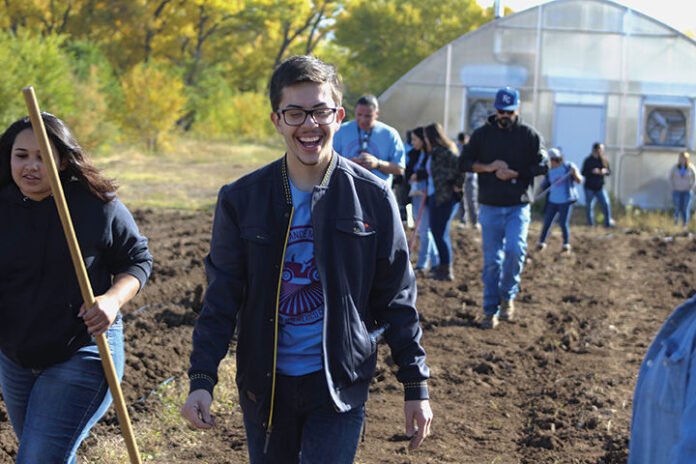
Community service is a large aspect of the program and the skills that they try to instill in its students. On Oct. 26, students in the program were engaged in campus beautification initiatives that took them from the classroom into the dirt where they were planting garlic for next year’s ¡Sostenga! Garlic Festival and planting bulbs around the entrance of the College.
These efforts, as part of the program’s curriculum, is to instill leadership skills and develop community spirit program director Stephanie Vigil-Roybal said.
Ashley Mondragon, a 26-year-old freshman in the program, joined Lopez and other students in the community service project on Oct. 28. Mondragon, a mother of two, is a prime example of why this program is so important.
“Growing up was kind of a rough situation,” she said. “I got a job at KFC and I thought, I’m gonna drop out of school and work full time. I was 15 years old, I barely started 10th grade.”
Before entering into the program to finish her four-year degree, she became a certified nurses assistant but decided that she wanted to do more in her field. The College helped her receive her GED and enroll in the program.
“I am interested in being able to help a little bit more and help people,” she said. “So I decided to come back and started in the HEP program, they helped me get my GED and then they helped me apply for the CAMP (College Assistance Migrant Program) program. Here I am today, I haven’t given up.”
Vigil-Roybal said the Program currently has students that range from 17 to 50 and are engaged in various areas of study. While the program is meant to serve students that fit the enrollment parameters in their first year being enrolled at the College, the educators and staff involved continue to foster their relationship with students throughout their degree programs to ensure their success.
“It has been really helpful,” Mondragon said. “They (the program) provide us with a lot of tutoring, we have study sessions in quiet places. I have two boys five and seven, so it is helpful to have a quiet place to study. Even after you leave the program, they still help you with tutoring. They are with you through it all.”
“