While officials at Northern New Mexico College work to improve the college’s reputation, it is the work and recognition of its student body that will truly improve its image.
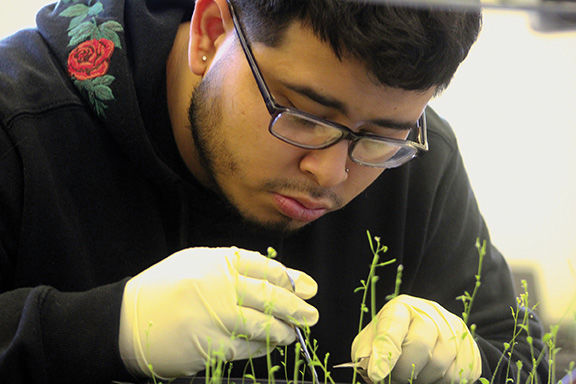
One such student is Antonio Serrano, a junior at the College seeking his Bachelor of Science in Biology. He has come out of left field and made a splash in the science community this past year with his research involving the Characterization of APA Events and Gene Expression Profile in the tcab Arabidopsis Mutant.
In simple terms, he is studying a certain gene in plant life that can provide insight into possible health issues or mutations in humans, said Serrano’s mentor Mario Izaguirre-Sierra, a biology professor at Northern.
“Antonio is working with a gene, with a protein that is involving polymers and stem cells,” he said. “The cool thing that we have in the lab is we are working on all aspects that have repercussions of humans, but we are studying them through plants. I’m using what Antonio has found through his data to expand upon my grant for the next five years.”
Serrano, with two other students from the College, in August presented their research at the New Mexico IDeA Networks of Biomedical Research Excellence symposium, against other undergraduate students from around the state. Serrano won first prize for the presentation of his research.
Aside from his victory at the symposium, Serrano spent four days at the beginning of October at Princeton University as part of the University’s prestigious Molecular Biology Scholars program, where he participated in their annual retreat and had the opportunity to present his research to the University’s scientific community. He hopes this aids in his long-term goal of seeking his PhD in molecular biology and/or genetics.
The program selects only a small number of undergraduate students nationwide, according to the program’s brochure, with exceptional ability and promise who will bring a diversity of backgrounds, viewpoints and cultures to the sciences, and who have demonstrated interest and passion for research in the broad field of molecular and cellular biology.
Diversity of background does little to describe Serrano’s journey or the kind of tenacity and passion he brings to the table.
“He is a student that came from nothing from the beginning,” Izaguirre-Sierra said. “Antonio has been fighting the last few years for any kind of application, scholarship or opportunity he could find. This year he was rewarded for all of his hard work and pushing. Hopefully, he has his foot in the door. He has been growing amazingly.”
Serrano has lived in Española since he was eight years old. Originally from Mexico City, Serrano’s parents, like many immigrants from south of the border, decided to make the dangerous trek via coyotaje — the practice of people smuggling people into the United States from Mexico.
His mother, father and younger brother made the journey first, leaving him in the care of his grandmother in Mexico City. When they made it safely across, he would travel, along the same route as is family, with strangers to cross the border in hopes of opportunity.
“So it was just like any other immigrant.” he said. “My parents came here first with my brother. I stayed behind in Mexico City with my grandmother, and then I came over. I went with a group of people that I barely knew across the border, and here I am now. We followed the coyotaje down the same path to the United States.”
He and his family have been in Española ever since, and he considers the Valley his home.
“I was raised here in Española,” he said. I am a first generation local. Since I was eight years old, I was raised here in the Valley.”
While difficult in the beginning, given the language barrier, Serrano and his family quickly adjusted and became a part of the fabric of the community.
“Coming here, and not knowing the language made it hard in the beginning,” he said. “But just like everything, you have to assimilate. I went to elementary at Sombrillo and did middle and high in Pojoaque. My parents pushed that education is important.”
Aside from being a first generation local, he is also a first generation graduate and college student. Initially, his interest, upon enrolling at Northern, was experimental psychology, until he met Izaguirre-Sierra.
“I had it in mind to be an experimental psychologist.” Serrano said. “I have always pictured myself as a scientist so, I was lucky enough to meet my mentor, Dr. Mario Izaguirre-Sierra, in my first semester.”
Izaguirre-Sierra was running a scholarship for students of Mexican descent. Given that he is a Deferred Action for Childhood Arrivals (DACA) student, any kind of government money or scholarships is nearly impossible for him to get, Serrano said.
Not one to be deterred, he was constantly checking in with Izaguirre-Sierra, so much so that he took Serrano under his wing and started showing him what they were doing in his lab.
“I was on him to try and get into the scholarship, so I just ended up being there a lot and he started showing me what he was doing,” Serrano said. “He was doing real in-lab research science, and I was like, oh, I really need to be hanging out with this guy more. He loves what he is doing and that says a lot.”
That was the beginning of Serrano’s journey into the realm of molecular biology and his recent success. While his goal is to continue his graduate studies, his heart is in Española and he hopes to bring positive change before moving on elsewhere.
“I have grown to see this place as my home town,” he said. “ I have big plans for this community and I feel that I need to make a difference here before I move on to other things. It is important to me that people know what we are achieving here in the Valley and at Northern. For them to realize what is happening and what we are capable of.”