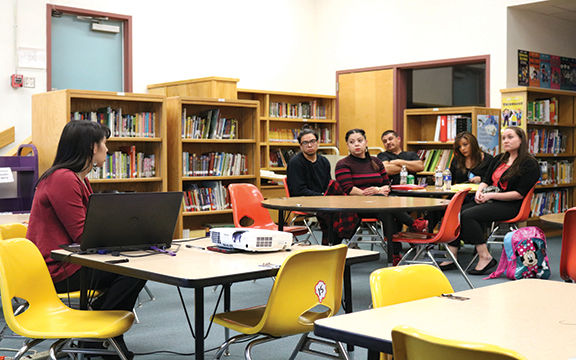
As first-grade teacher Tomacita Dominguez began her lesson, Feb. 8, she asked her students to take a seat at the short, round tables inside the Hernandez Elementary library.
Some students leaned back in their child-sized, orange chairs, while others sat with their hands in their lap, as they attentively listened to her speak.
This class was different than the one Dominguez typically teaches. Instead of a group of rambunctious five-, six- and seven-year-olds staring back at her, the room was filled with adults.
This was the second in a series of three Academic Parent-Teacher Team meetings, a program aimed at giving parents the tools to help their child learn and improve their foundational, grade-level language arts and math skills.
“What we are doing is hopefully creating a whole new culture for how parents talk to teachers,” Hernandez Elementary Principal John Sena said.
During each workshop, teachers introduce a new foundation skill for parents to work on with their child. They explain why the skill is important and demonstrate an activity they can do with their child to improve the skill, as well as watch an instructional video.
Each parent is given a folder with data about their child, so they can track their progress throughout the school year. The data also shows how well the student did on skill level assessments before and after working on it with their parent.
David Padilla said he attended the workshop because his daughter, Aieshah Barela, 9, asks him questions about her homework, but he doesn’t always know how to answer them in a way she understands.
“I want to get some help,” he said. “I teach her, but sometimes it is not helping her because they are teaching her things differently (at school).”
Dominguez, along with third and fourth grade teacher Susana Lopez and sixth grade teacher Maxine Ortiz, are participating in the program.
During the first workshop, Dominguez worked with parents on addition and subtraction. During the second workshop, she showed them how to help their child improve at reading the 100 sight words.
These are words that cannot be sounded out, such as by, in, he, at and has, that students must know how to read quickly and on sight, she said.
Each parent took home a set of flashcards they can use to practice with their child.
“We try to find high leverage skills that we know they are going to need for the rest of their lives,” Sena said.
For example, if a student doesn’t master addition and subtraction, it will be difficult for them to learn higher level math concepts later on in their academic careers.
Learning sight words is important not only for reading in school, but also to read things like menus and directions, Dominguez said.
The teachers also help parents set realistic goals for themselves and their child.
If a parent is busy, they can set a goal of practicing sight words with their child two times a week. If the student has mastered reading 25 sight words, the new goal would be for them to master reading 50 sight words by the time of the next classroom assessment.
Melissa Wallace, the senior engagement manager for WestEd, the parent company of Academic Parent-Teacher Teams, said they do an initial two-day training with teachers, about four weeks prior to the first workshop. Together, they look at student data, create an activity and practice workshop facilitation skills.
“The games are fun and engaging and not like a sheet of paper,” she said. “We want families to come together and work with their child and really become partners in their education.”
While the parents learn how to work on the skill with their child, they are also getting to know each other through team building exercises.
“Team building is actually networking with each other, so if they need help, they can reach out and they have a group of families they can do that with,” she said.
Española Public Schools Superintendent Bobbie Gutierrez said she likes the program because it helps parents have a better understanding of what is expected of their child in the classroom.
“I like how it actively engages the parents in learning versus sitting and telling them, ‘These are our standards and this is what we will be teaching,’” she said.
Currently, the Academic Parent-Teacher Teams program is at Hernandez Elementary and Sombrillo Elementary. The school district received funding for the program from the New Mexico Public Education Department.
Gutierrez said she wants to expand the program to other schools, with or without funding from the Public Education Department. Officials at Alcalde and Velarde Elementary have expressed interest in bringing it to their schools.
“It is a good investment with our set-aside money for Title I, for parent training and parent engagement and involvement,” she said.
Sena said there are about 40 to 45 children in all three classes participating in the program combined, and about 35 parents have attended at least one of the workshops.
The final workshop will take place on April 19. Dinner and child care will be provided.
“I think this is a great way to involve parents in very active learning and come to school and be engaged,” Gutierrez said about the Academic Parent-Teacher Teams program. “We are not asking them to come to school to have another fundraiser. Teachers are showing them how to help their children.”