Read-a-Thon Supports Abiquiú Library

Published:

   For five hours on Sunday, visitors to the Pueblo de Abiquiú Library and Cultural Center did something many people have not had the chance to do since elementary school: Listen to someone read them a story.

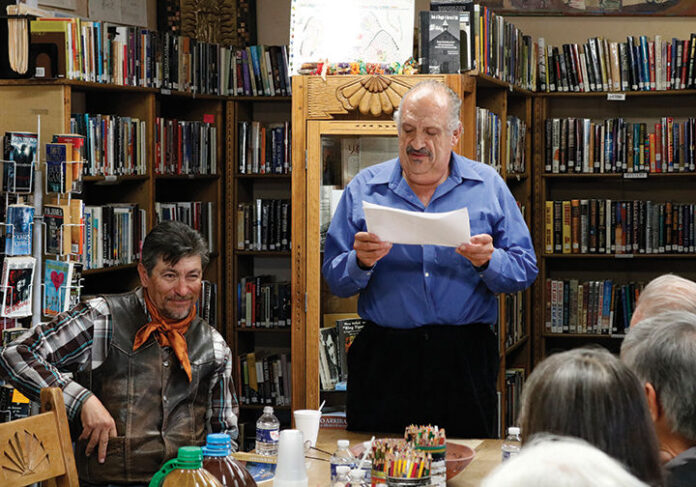
    People filtered in and out of the building throughout the day, while others spent the entire afternoon at a long wooden table listening to people read from Carmen Baca’s “El Hermano.” Readers had to have a sponsor for $50 and read for 15 minutes.

    The table was covered in coffee, espresso and tea cans filled with colored pencils. Plates of snacks, like spicy peanuts and slices of yellow cake with frosting, dotted the table. As one person reads, people snack and draw, sometimes they lean back and listen with their eyes closed. People jump in to help with the pronunciation of Spanish words.

    While the event serves the practical purpose to raise money for the library, the Library Board of Directors chose this year’s book in honor of Floriano Trujillo, known to people as Floyd, who died Feb. 8.

    The events of the book take place in 1928 and focus on a young man named José and his cousins during Lent. The story follows them as they attempt to spy on the secret rituals of the penitentes, before they join the brotherhood themselves.

    “We wanted to be sensitive to the community and then because Floyd Trujillo passed away and he had such a reputation for his hermandad and the penitentes is very strong here in the Pueblo,” Library Executive Director Isabel Trujillo said. “So when Carmen’s book came up, we thought it would be pretty interesting to show the relations that happen throughout New Mexico, not just in Abiquiú.”

    There was a small altar in celebration of Floyd set up on a side table in the library. Beside a picture of him was a shining silver harmonica and a handkerchief.

    Isabel Trujillo is married to Virgil Trujillo, one of Floyd’s sons.

    Both Virgil Trujillo and his brother Dexter Trujillo read during the event.

    Dexter Trujillo said while he has always attended the read-a-thons, listening to people read this book really hit his heart because of his own experiences at the morada.

    “I was looking at it more like a spiritual view point,” he said. “I was thinking, you know, we just had our father, who passed away a month and probably 13 days ago, and it’s, you know, a lot of things in there that just are touching. They mention a lot of the a la vados, which are really songs of prayer to us.”

    The book was also appropriate because it is currently Lent, Dexter Trujillo said.

    Virgil Trujillo said his father had a musical knack that made it so he could easily remember the long prayers and songs, like those mentioned in the book.

    “The interesting thing was he knew them from a really young age, too because that was normal in Abiquiú,” he said.

Seven-year tradition

    Isabel Trujillo said the read-a-thon and draw-a-thon are going on their seventh year and are a way to raise money in that period before they get annual grant funds.

    “Our grants come in normally around May and June, which provide for summer programming,” she said. “In other words, we start out the year pretty broke. January, February, March, we are surviving from last year’s monies, if there is any. I mean, we gotta make it last.”

    She said that this shows why the creation of the Rural Library Endowment was so important.

    They really drain their donors year after year because they get little state and Rio Arriba County support, she said. While a bill to create the Rural Library Endowment passed through the Legislature and is awaiting signature by Gov. Michelle Lujan Grisham, the amount of money to fund the endowment was cut from $5 million to $1 million in the final days of the session.

    “We won’t even get $1,000,” Isabel Trujillo said. “Because we are a grassroots, nonprofit organization, this is something people wanted in the community when they started it 20 years ago. And so, for that long, we’ve struggled but we’ve survived and we do gain support from the community.”

    Getting support for libraries has always been difficult in New Mexico, Isabel Trujillo said.

    She referred an article titled the “The Library Legacy” by Linda G. Harris that outlines the difficulties libraries have had in the state for over 100 years.

    New Mexico’s first territorial librarian John Ward was paid $100 a year in 1853 to run a small library inside the Palace of the Governors. He quit when the Legislature decided to only reimburse him for $25 of firewood. Ira Bond, who became librarian in 1869, was told to destroy books, manuscripts and other records.

    Each read-a-thon is commemorated with book of all the drawing, collages and paintings created during the event.

    Isabel Trujillo said they make drawing a part of the event because not everyone likes to read, it encourages young people to participate and because Abiquiú is an artist community.

    “So we put together a booklet,” she said. “Handsewn like an album with everybody’s drawing and its kept there in the library to be seen and we are really careful about the topics or the books that we choose.”

    Other books and texts chosen for the read-a-thon nclude Gilberto Benito Cordova’s 1979 dissertation titled “Missionization and Hispanicization of Santa Thomas Apostol de Abiquiú.”

    Other books have included Frances Leon Quintana’s “Pobladores: Hispanic Americans of the Ute Frontier” and Ruben Archuleta’s “Eppie Archuleta and the Tale of Juan de la Burra.”

Related articles

Recent articles