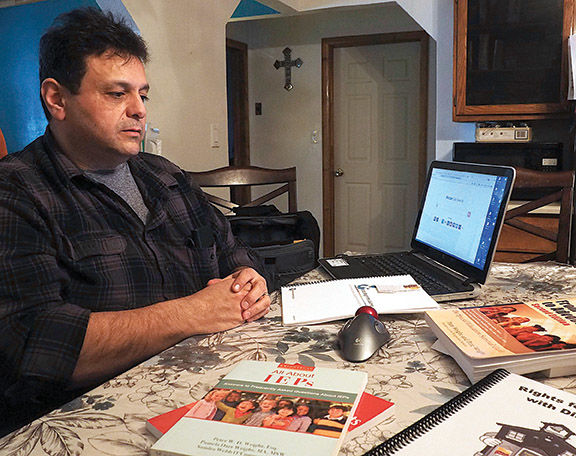
Manuel Martinez pulled a pile of large textbooks out of his computer case, laying them out on his kitchen table.
All the books focused on special education law in the United States, with titles like “All About IEPs (Individual Education Programs)” and “Rights for Children with Disabilities.”
It is here, with the books at his side and his laptop open, where Martinez helps local families with special needs students get the services their children require.
“This is what I do,” he said. “When I’m looking at IEPs, I’m doing my research. I usually have all my books, because I have to remind myself.”
Martinez and his wife Amy have two sons at Española Valley High School with autism, both of whom require services according to their IEPs, the document for every special needs student that determines what services they will receive.
Manuel and Amy said they are in a continuous fight with the Española School District to make sure their children receive the proper services according to their plan. It is a fight that has been going on for over 15 years, when their oldest son started school.
“This has been going on with Española Public Schools since he was in preschool,” Manuel Martinez said.
Now, a small group of parents say their children are not receiving the services they require.
Multiple filed complaints to the state Public Education Department against the District for failure to provide career transition services, which teach student how to do laundry, cook and other household activities they could not do otherwise.
The Martinezes, who filed a complaint on behalf of their son, received a response from the Department in July, in which investigators found their son’s IEP was not being met.
“The District failed to develop and implement the Individualized Education Program for student when they failed to provide transition services for the 2018/2019 school year,” the report read.
The Department also found the District failed to provide the student with a free appropriate public education, which school officials are legally required to do.
Debbie Trujillo, whose son also attends the High School and has a seizure disorder, filed a complaint against the District, which yielded similar findings.
The August findings specifically list that the District did not provide her son with community experience, employment services, daily living skills instruction and training for basic independent living, all of which were required under his IEP. The report said he was also denied a free appropriate public education.
All parents interviewed said even after these findings over the summer, not much has improved for their children.
“He needs skills to be able to do on his own,” Manuel Martinez said. “We’re working on laundry at home, we’re working at cooking. But this is also things they need to be working on at school, and they’re not.”
District disagrees
Student Services and Wellness Director Deirdra Montoya said the families had not voiced their concerns about transition services prior to filing a complaint with the Department.
“If I don’t know these problems exist, I can’t really do anything,” she said.
In an email to Montoya dated Aug. 15, 2018, the Martinezes write about the lack of transition services offered to their son.
“What has the District really provided as far as teaching skills for shopping, food prep, cooking, or laundry?” Manuel Martinez wrote in the email. “At the moment I feel like the District is not providing (my son) with an appropriate transition program.”
Montoya said that, since the findings, a transition program has been implemented at the High School. She said there are plans to take students to Smith’s in Los Alamos to learn shopping, but it has not happened yet.
She said concerns by a few parents do not reflect the whole of special education in Española.
“These parents are mad about something else that is not a special education issue, and I take offense that they’re attacking special education because of their unhappiness,” she said.
The Martinezes said they have begun teaching their sons how to do various household activities because the District will not. They said it is something they have always had to do.
“If I would wait for the school, they would be institutionalized,” Manuel Martinez said.
All the extra therapies and counseling for their sons have come at a cost. The family has had to refinance their home twice, sell vehicles and property in order to pay for treatments, which are not covered by insurance since the District is supposed to provide them.
In 2011, the Martinezes filed a complaint with the Department on behalf of all 500 special needs students in the District, claiming ancillary services were not being provided to students.
The District also underwent an extensive special education audit in 2009, one of only nine districts to go through such a process, over suspicion that the District was not forthcoming about what services were actually being provided.
‘Going into battle’
Other parents raised concerns about the often contentious process of drafting their student’s IEP with the District. Amy Martinez said IEP meetings used to take two days as her lawyers and the District’s lawyers would meet to discuss it.
“Everytime I’m going into an IEP meeting, I feel like I’m going into battle,” Margaret Lopez, whose daughter attends the High School and has a seizure disorder, said. “It takes me a week to prepare for it and it takes me two weeks to recover from it.”
In the past, the District has said a lack of funding for programs and special education assistants has led to IEP requirements not being met.
Superintendent Bobbie Gutierrez wrote about the lack of state funds in an affidavit for the Yazzie/Martinez lawsuit.
“The District has insufficient funding to hire additional educational assistants to serve students with disabilities,” she wrote.
Montoya also said during a Nov. 8 interview that if IEPs are not being met “it’s because the state is not providing the District with what we need.” She later denied saying that state funding was impacting special education in the District.
Federal law states it is illegal for school districts to use a lack of funds as a reason for not providing services. Montoya said she was not familiar with the law.
“I don’t know if that’s what the law states,” she said. “There’s a lot of laws.”
“I’m very surprised as a special education director she doesn’t know that,” Manuel Martinez said. “That causes so many lawsuits in the United States.”
The Martinezes longtime experience in special education has led them and other parents to become advocates for other families in the area. Amy Martinez, who is retired, often attends other IEP meetings, consulting with parents as far as Las Vegas and Tierra Amarilla.
“I firmly believe God put us in this life to help other families,” she said.
While some services are now being provided to their sons, the Martinezes said they want the same for other families.
“We’ll see them do things for our son, because we’re the squeaky wheel,” Manuel Martinez said. “What about the other families?”
Lopez agreed, adding that all families need to speak up in order for progress to be made.
“When their kids fall through the cracks, it makes it harder on our kids,” she said.
Manuel Martinez said he would like to see a parent’s advisory council specific to those with special needs children so they have a platform to voice their concerns.
“They can tell you one thing and you one thing and us a different thing, but collectively, they can’t lie to all of us,” he said.
An Oct. 31 list of employment vacancies in the District showed that there were 27 positions open for special education assistants, a position Montoya said they have trouble recruiting. Some parents said that is not an excuse for a lack of services.
“It’s not my problem,” Manuel Martinez said. “It’s not my kid’s problem. Why should my child’s IEP not be implemented because you can’t find anyone?”