Tackling the Truancy Problem

Published:

    When students don’t attend school one consensus is that they run a greater risk of getting involved with activities such as drug use and crime, which could negatively impact their future.

    To lessen the chances of students making poor choices, the Española School District is exploring ways to get the community involved in making sure area students go to school.

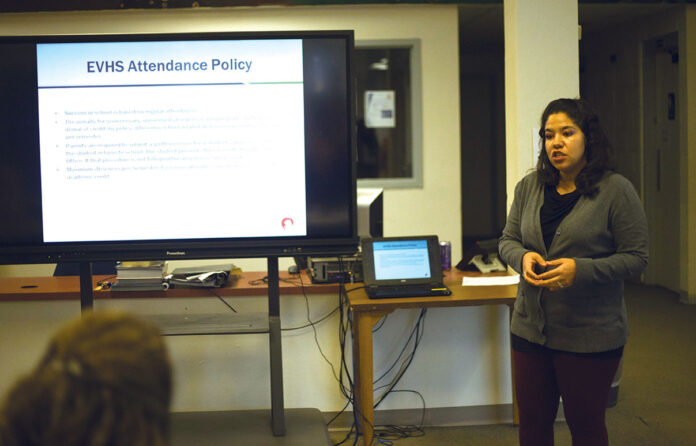
    Administrators met with school leaders, student success specialists and the school resource officer, Nov. 2, to discuss the District’s attendance goals and the possibility of creating a task force to help tackle truancy.

    The truancy numbers aren’t in yet for the 2016-17 School Year, but data from the 2015-16 School Year shows that about 69 percent of Española Valley High School students were habitually truant, compared to 37 percent a year earlier. Habitually truant means a student misses 10 or more days of school during the school year.    

    High School Student Success Specialist Marcella Maestas said the 32-percent gain between the 2014-15 and 2015-16 school years is significant, and is an accurate reflection of the high school’s habitual truancy rate. She attributes that sharp increase to a new student accountability system that more accurately tracked attendance data.

    For Maestas, creating a task force made up of local business owners, is a practical step for addressing an issue that wreaks havoc on the community.

    “The role of the task force is to spread knowledge about the severity of truancy issues and to gain their collaboration,” she said. “If they aren’t in school, are they at Wal-Mart, shoplifting or breaking into homes? If they aren’t at school what are they doing?”

    Maestas said the Valley’s business community has a vested interest in whether students attend school, because if they don’t, they aren’t learning, which could impact the labor force.

    University of Maryland researchers Kimberly Henry and Terrence Thornberry concluded, in their 2010, article, “Truancy and Escalation of Substance Use During Adolescence,” published in the Journal of Studies on Alcohol and Drugs, that students who skipped school are more likely to use drugs.

    “Truancy appears to be a robust predictor of substance use,” the article states. “The effect is likely to be a result of the deleterious effects of reduced school bondings and, in part, a result of the unsupervised, risky time afforded by truancy.”

    Maestas said although she sees a big difference in the community’s attitude toward school attendance, compared to when she started in her position three years ago, there is plenty of room for growth.

    “When I first started this position, people were like, ‘She is attendance,’” she said. The “(Children Youth Families Department) and (Juvenile Probation Office) would say, ‘How do you expect me to deal with attendance when I am dealing with a heroin case?’ And, I am, like, ‘Where do you think it started?’”

Phased intervention

    While Maestas and her colleagues, with the help of teachers and educational support staff, try to keep a sharp eye on attendance, they don’t swing into early intervention mode until after the student reaches five unexcused absences.

    The first-phase intervention involves contacting parents and meeting with the student in an attempt to learn the root cause, or causes, of the absences, but Maestas said, sometimes, it is not easy to get in contact with parents.

    “We will call parents, but guess what typically happens,” she said. “The number is not correct or parents don’t answer. When we do get ahold of parents, they often don’t show up to meetings and that is heartbreaking.”

    High school officials also give students an opportunity, during lunch, to make up assignments they may have missed because of unexcused absences.

    Maestas said those lunch time make-up sessions are heavily reliant on the school’s teaching staff.

    “We have lunch detention and opportunities for credit recovery,” she said. “We are working with teachers to allow students to make up work during lunch time. Teachers go above and beyond — we have several teachers who come in on Saturdays, they don’t get paid.”        

    She said after a student accrues 10 or more unexcused absences, they are considered “habitually truant,” and in violation of state law, which requires school officials to refer habitual cases to the Juvenile Probation Office.

    It is the job of probation officials to determine whether students are missing school because of neglect.

    Maestas said the District made about 30 referrals to the Juvenile Probation Office during the 2016-17 School Year, but most of those cases were closed without any concrete action taken.

    A few years ago, the policy changed in a way that no longer requires teachers to provide make-up work and extra support to habitually truant students, which means too many absences could ultimately have a disastrous impact on student achievement.

Why are they truant?

    School Resource Officer and Rio Arriba County Sheriff’s Deputy Sammy Marquez said, since taking over the position, he has learned there are many reasons students miss school.

    The research he compiled shows that approximately 10 percent of the area’s 16- to 19-year-old students are considered disconnected youth, which means they aren’t in school or in the labor force.

     “The strongest message we hear nationally, and across New Mexico, is that truancy shouldn’t be defined as a delinquent act or criminal offense,” he said. “Truancy should be viewed as a symptom and addressed by a partnership among schools, community probation, law enforcement, parents and youth.”

    Marquez said he enjoys working at the high school because it gives him an opportunity to have a positive impact on the students’ lives. Those interactions may prevent him from running into the students a few years down the line, in the back of a patrol car.

    “I appreciate my role this year and last year,” he said. “Just based on my experience with incarceration, once you get started, it is hard to get out of and be successful.”

Related articles

Recent articles