Teachers Prepare for the Worst

Published:

    Cracks of gunfire and the smell of gunpowder filled the hallways of Española Middle School last week, but none of it was real.

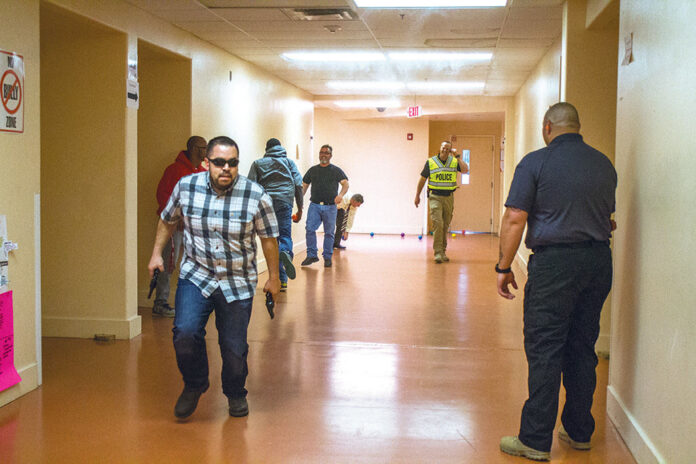
    About 40 Española Middle School teachers and staff completed three simulated active-shooter situations, March 13, run by officials from the Los Alamos Police Department.

    Other area schools, including McCurdy Charter School and Española Valley High School, have done similar training, after the deaths of 17 people in a shooting at Marjory Stoneman Douglas High School, Feb. 14, in Parkland, Fla.

    On Feb. 26, classes at the high school were canceled so administrators and teachers could do an all-day active shooter training session.

    High school students and teachers participated in more hands-on active shooter drills on Feb. 28. They learned how to find safety inside their schools during an active shooter situation, and how to quickly evacuate the buildings.

    “It’s unfortunate that we have to think like this, but it’s reality,” Los Alamos Police Cpl. Jack Casias told the middle school teachers and staff. “God forbid this happens here in Española, or anywhere else, but I want you to be prepared.”

    The day before, the teachers and staff attended a two-and-a-half-hour presentation on active shooter situations.

    Española Middle School Principal Julie Gutierrez said the Los Alamos Police Department was asked to do the training because Española Police Officer Michelle Ortega referred middle school officials to them.

    Four Los Alamos Police officials conducted the simulations.

    Rio Arriba County Sheriff’s deputies, Española police officers and New Mexico State Police officers conducted a similar training four years ago, she said, but this time, she did not consider calling them to conduct the training because she just took Ortega’s advice.

    Gutierrez said students were not included in the simulations because it would have been too traumatizing for them. The police officers repeatedly shot blanks and shouted profanities during each round of the simulation.

Run

    In the first simulation, groups of teachers gathered in classrooms like any normal day, and fled out the front entrance of the school as soon as they heard gunfire.

    Exiting the building, the teachers followed commands by Casias to raise their hands in the air. He was standing near a vehicle outside, pointing a fake shotgun at the doorway.

    He said in a real shooting, police would initially have no way of knowing who the suspect is.

    Afterward, the police recommended teachers label each room with the room number on the inside, so that in the event of a shooting, 911 callers will be able to communicate, to dispatchers, where they are.

Hide

    In the second simulation, Assistant Principal Robert Quiñonez and a group of five teachers and administrators were tasked with barricading a computer lab, with two entrances, both of which had doors that opened away from the room.

    As soon as they heard gunshots, they frantically pushed tables and chairs in front of the doors. Some grabbed chairs to use as weapons, and one teacher grabbed a fire extinguisher.

    Similar scenes played out in nearby classrooms, with police playing the role of a gunman struggling to open doors that teachers tied shut or blocked with piles of furniture.

    Afterward, the police shared various ways that the teachers can block doors, or tie them closed using everyday objects like cables, belts, science equipment and pieces of lumber.

    Los Alamos Police Sgt. Daniel Roberts taught the teachers the difference between concealment and cover. Cover is an object, like a brick wall, that will stop a bullet, while concealment, like a classroom table, may hide someone, but will not stop a bullet.

    Casias told the middle school teachers, along with those at McCurdy Charter School, that during class, every classroom needs to be locked.

    “The only person with a key to that class (should be) the principal, and that teacher,” he said. “Remember, they’re looking for a mass of people to shoot. If they can’t get into a door, they’re not gonna sit there and try to open it.”

    Robert Salazar, an educational assistant who works with students with disabilities, asked what he should do about students who could either start harming themselves or cry out while their classmates are hiding during a shooting.

    Los Alamos Police Sgt. Chris Ross told Salazar to start practicing with students on being quiet for a short period of time, to train them to stay quiet when it is needed.

    Salazar said he had never experienced active shooter training like this before.

Fight

    In the third simulation, the police instructed the teachers to fight. They gave them plastic balls to simulate the act of throwing things at an active shooter.

    Eddie Fields, an educational assistant, hid behind a corner in a hallway and ambushed Los Alamos Evidence Technician Anthony Lucero, who was playing the role of a gunman, one gun in each hand, both filled with blanks.

    “The shooter stopped, they were interrupted when y’all were throwing stuff at them,” Casias told the school staff after the simulation.

    Ideally, if a real shooter hesitates, and is outnumbered by teachers, they should rush him, take the gun away, and hide it either in a trash can or similar place, he said.

    “Just leave the gun alone,” Casias said. “In Florida, we saw videos of officers going room by room, and a lot of students had their hands up, with their phones in their hands. Have nothing in your hands when we come in, especially in a low-light situation.”

    While the simulation was harmless, Ross told the teachers they are protected from legal liability when they defend themselves or others from a deadly attack.

    “Go as hard as you possibly can,” he said. “Find whatever you need to live for, and fight for it. They (students) see you doing that, in this grade level, they’re gonna say, ‘Hell yeah, we got this guy.’ We’re fighting so we can all go home.”

Related articles

Recent articles