War over Santa Cruz Water Rights Pits Pueblos Against City and Acequias

Published:

    Anyone with water rights in the Santa Cruz and Truchas rivers, and anyone who uses water in the Española Valley, will want to sit up and take notice of a federal court case that’s headed for trial later this year.

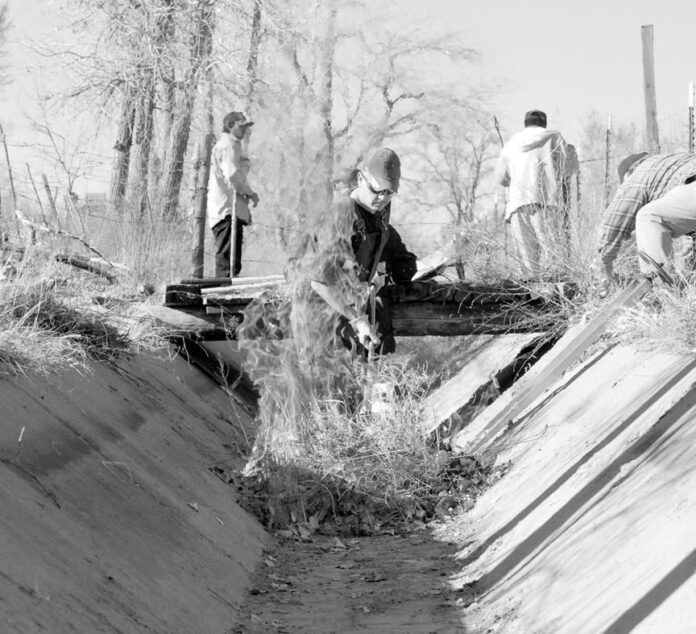
    It’s called New Mexico v. Abbott, and between now and 2013 it will divvy up the water that flows from the Sangre de Cristo Mountains to Acequia del Llano, the acequias of the Santa Cruz Irrigation District, the city of Española and the Ohkay Owingeh and Santa Clara pueblos.

    “Everybody who has a water rights claim or owns water rights has to be a party, and the court will decide what their rights are,” attorney Fred Waltz, who is representing 42 acequias, said.

    The main issue on everyone’s minds right now is the claims of Ohkay Owingeh, which are scheduled for trial in October. The Pueblo has staked out a large territory and is claiming first-priority water rights based on uses stretching back to pre-Hispanic times.

- Advertisement -
- Advertisements -

    “From time immemorial the Pueblo of San Juan (Ohkay Owingeh’s former name) has diverted and captured water for agricultural, domestic, cultural, hunting, gathering, and other sustainable uses on lands within their aboriginal territory, including lands comprising most or all of the stream systems of the Rio Santa Cruz, Rio de Truchas, the area including the Llano and Santa Cruz Ditch Systems, and minor stream systems within the geographical scope of this general stream adjudication,” court documents state.

    The Pueblo’s claims amount to surface-water diversion rights of 418 acre-feet per year from the Santa Cruz River. In addition, it is claiming diversion rights for 191 acre-feet of surface water from arroyos that run across Ohkay Owingeh lands, and 38 acre-feet of groundwater diversion rights for 10 wells.

    The federal government, acting as a trustee of the Pueblo, has submitted the same claims on its behalf.

    “They’re asking for more than what is currently being put to use,” said Tim Vollmann, one of the lawyers for the Pueblo.

- Advertisement -
- Advertisements -

    Vollmann said he doesn’t know how much water Ohkay Owingeh uses in a given year because it is subject to several variables.

    By comparison, the city of Española’s total groundwater rights equal 2,780 acre-feet, and it has approximately 1,010 acre-feet of additional surface-water rights. The past two years, the city has also been trying to purchase more water rights from owners in the Irrigation District.

    Based on court documents, there are at least 7,200 acre-feet worth of non-native rights within the Santa Cruz and Truchas Rivers. The court initially adjudicated those rights in 1975, sparking objections from both community acequias and individuals.

    Vollmann said Ohkay Owingeh’s claims are based on expert reports of historic and archeological evidence that shows water usage by Pueblo people. That includes written accounts of crops found in the area, but also archeological evidence of berms, canals, holding ponds and even lithic mulch — the practice of putting stones in the ground to slow rainfall as it percolates through the soil.

- Advertisement -
- Advertisements -

    “Water rights are based on manipulation of water resources,” Vollmann said. “There has to have been some manipulation of the earth.”

    When the court adjudicates Ohkay Owingeh’s rights, it will also decide the date at which those rights originate. That matters because in case of a drought, the available water is distributed on a first-come, first-served basis.

    “To the extent that somebody has a large water right but it’s a modern priority date, they may not be able to exercise the right in years of scarcity,” Vollmann said. “So priorities here are pretty important, and the sorts of dates that are being used in this litigation, because of the long history of water use in this area, are very, very early by American standards.”

    Other parties are taking issue with the Pueblo’s claims.

    “The Pueblo’s claims are so vast and extensive that we obviously don’t agree,” Waltz said. “But there is a possibility, and I hold out the hope, that we can reach a resolution.”

    The non-Pueblo entities aren’t willing to cede much. Waltz said an agreement may be possible when it comes to the small number of acres the Pueblo has irrigated in “recent historic times,” meaning the last 100 years. But the pre-Hispanic claims are more extensive, and his expert reports have concluded that those claims are non-existent, Waltz said.

    “There just simply is no irrigation from the Rio Santa Cruz from prehistoric times that survived today,” Waltz said. “If there ever was, it certainly has not continued.”

    The exact dates are important. According to expert testimony submitted by historian John Baxter, historical documents set a priority date of 1650 for 23 acequias originating below the mouth of the Rio Quemado and for the Martinez Arriba ditch in Chimayó. The Ortega acequia of Chimayó was up and running by 1706, and the upper Chimayó valley merits a priority date of 1743, Baxter’s report states. He also assigns 1743 as a priority date for the acequias serving Rio Chiquito, Cordova and Cundiyó.

    Based on their reading of history, the Santa Cruz and Truchas river acequias, along with the State Engineer’s office and the city of Española, essentially argue that the matter is already resolved and has been for more than 160 years. Specifically, they trace it back to May 13, 1846, the date that the United States declared war on Mexico. The ensuing Treaty of Guadalupe Hidalgo, which ended the war, recognized the property rights of Mexicans living within New Mexico and other ceded territories.

    In its legal filings, the State Engineer’s office claims that Ohkay Owingeh’s water rights in the Santa Cruz and Truchas rivers are limited to “those rights that were vested under Mexican Law as of May 13, 1846” and that those rights do not bear aboriginal, first-priority status.

    Neither Pueblo nor Hispanic water rights are enumerated or even mentioned in the Treaty.

    Arianne Singer, a lawyer who manages adjudications for the State Engineer in the northern part of the state, said the state tries to avoid taking an adversarial position against water defendants, though it often appears that way in legal proceedings.

    “We’re not trying to take anyone’s water away,” Singer said. “The point of it is not to reduce the water in the system but to recognize people’s rights.”

    The Abbott case was originally launched because the Santa Cruz River basin was slated for inclusion in the San Juan-Chama project, a system of diversion structures and tunnels that annually brings about 110,000 acre-feet of water from the San Juan River Basin into the Rio Grande, documents state. That water feeds various public entities along the Rio Grande, including the city of Española which was granted 1,000 acre-feet per year.

    “The idea was that we had to know what the current uses were before bringing this new water in,” Singer said.

    Like its counterparts in Santa Fe and Taos, the Abbott case has the potential to set new precedent in the question of how to quantify Pueblo water rights, Singer said. Although the Aamodt case addressed water claims among pueblos in the Pojoaque River basin, it’s an open question whether the court in Abbott will use that as a precedent or set its own standard, she said.

    Don Bustos, an organic farmer who has rights to 4.5 acre-feet from the El Llano ditch, said he’s not worried about Abbott’s impact on his personal water rights. But overall water shortages and ditch infrastructure problems are affecting his farm, he said.

    “They turned the water off early this year because people said they were going to do some repairs on the acequias,” Bustos said. “We have run into a critical situation where water is very much of a concern for our operation.”

    Waltz said individual water-rights owners are already identified as defendants in the Abbott suit, whether they’re actively involved in the process or not. He said most parciantes are hoping that the acequias are watching out for their interests.

Water Table

    Attorney Jay Stein, who represents the city of Española, said it’s hard to quantify the potential impact to the city of Española, pending expert reports that are due early next month.

    “We’re going to know what the effects are when all the reports come in on the 5th (of February),” Stein said.

    That’s the deadline for any non-state and non-federal parties — including the 42 acequias and the city — to submit a detailed response to Ohkay Owingeh’s claims. The city is facing that looming deadline as it negotiates a contract with Glorieta Geosciences, to complete a hydrologic study documenting the potential impacts of Abbott-related water claims.

    A draft contract has offered Glorieta up to $27,772 to complete the work. As of Tuesday the contract had not yet been finalized.

    City Water Director Marvin Martinez said Glorieta would essentially “proofread” the Pueblo’s data to verify that any hydrologic calculations are correct. Martinez declined to comment further on the Abbott case.

    Stein said the city is focused primarily on how water rights will be administered once they’re officially quantified by the court. Because the city draws its water primarily from underground wells, it has little stake in the extent of the surface-water claims of the Pueblo.

    But Stein confirmed that it could become a concern if the Pueblo were to gain a significant number of surface-water rights that were eligible for conversion into groundwater rights — thus affecting the Valley’s water table.

    “That’s a concern we have, yes,” Stein said.

    Vollmann said under basic principles of Indian law, the state has no authority to regulate tribal water rights. Vollmann said he wouldn’t want to speculate on the degree to which a federal court could regulate those rights.

    “The court has some authority in that area, but ultimately when the award is made and the adjudication is over, it’s our position that the Pueblo would be able to administer its own rights,” Vollmann said.

    One of the ironies in this case is that the city is itself attempting to buy up a small number of surface-water rights in the Santa Cruz Irrigation District and use them to offset increased well production — the very thing it fears the Pueblo could do. Last fall the City Council authorized the purchase of nearly eight acre-feet of rights from individual owners, but the deal stalled because District Chairman Kenny Salazar said he would protest the rights’ conversion for domestic usage.

Far from Over

    Regardless of what happens in 2009, the Abbott case would be far from over.

    Ohkay Owingeh is just one of several pueblos to make claims in the Santa Cruz and Truchas rivers. Santa Clara Pueblo is scheduled to submit its claims in 2010, for trial in March 2013, and claims from the pueblos of Nambé and San Ildefonso were already settled, in 2002.

    According to court documents, Nambé Pueblo will be allowed to maintain the 0.28-acre arroyo-fed Nambé Pond at its current location. The Pueblo may use the impounded water for stock or wildlife, but it does not have the right to divert additional water into or out of the pond, court documents state. San Ildefonso Pueblo agreed to a similar arrangement for a 4.67-acre dammed pond on Pueblo land. In addition, the settlement formalized San Ildefonso’s three acre-feet of well-water rights with a priority date of 1935, and 23 acres of irrigated lands with a priority date of 1900. The settlement with Nambé and San Ildefonso in no way establishes a legal precedent for other adjudications, court documents state.

    Vollmann said Ohkay Owingeh is open to discussing a settlement, but it takes more than willingness to get parties to the table.

    “There’s always a lot of talk about that — that this will be settled,” Vollmann said. “But nobody’s approached us with any proposals or even a suggestion of a process.”

Related articles

- Advertisements -

Recent articles

- Advertisements -