Young Scientists Experiment

Published:

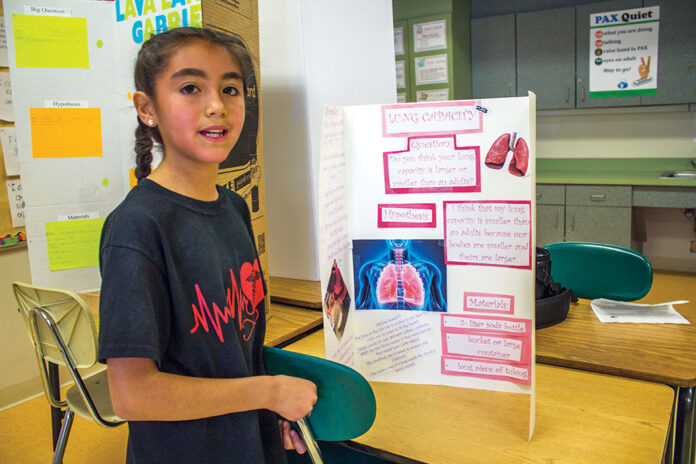
    Vanessa Trivino, an 11-year-old fifth-grader at Española Elementary, wanted to know for sure, how much air someone can fit in their lungs when they’re a child, compared to when they’re an adult.

    Before last week, she had never conducted a scientific experiment. She is one of 50 fifth-graders at the school who made projects last week, for the science fair.

    On Tuesday, teachers announced five winners.

    Faith Garcia won first place, Mya Martinez won second place, Peter Velarde took third, Chelsea Sisneros won fourth, and Evan Vigil took fifth.

    Winners chose from five science kits donated by Mr. Carpet, Century Bank and Trader Joe’s in Santa Fe, teacher Pamela Gallegos said. Other students received medals for their work.

    Other projects addressed scientific topics like the greenhouse effect, the solar system, volcanoes and crystals.

    While fifth grade students made the experiments, 60 fourth-graders judged them.

    In the process, both groups of students learned more about the scientific method, Gallegos said.

    “At this school, we’re really taking seriously the importance of encouraging STEM,” she said, referring to science, technology, engineering and math. Maria Elena Salazar, a parent, was the first person who pushed for a science fair.

    “In the District, we do inquiry science, which means it’s all hands-on science,” Gallegos said. “It’s not like when we were kids and we read out of books. For them, they actually do the projects, work with groups and discuss their learning.”

    On March 29, younger students asked questions like whether a particular project had a clear hypothesis, whether the experiment used to test the hypothesis was detailed enough and whether the hypothesis correctly predicted the results of the experiment.

    During class before the competition, Trivino guessed that her own lung capacity would be smaller than her mother’s, because a child’s body is smaller than an adult’s.

    At home in Hernandez, she and her mother, Christina Trivino, conducted an experiment to see if her hypothesis was true.

    Photos on Vanessa Trivino’s project board show them building the device they used to measure their lung capacities.

    They poured water into a large bucket, then took an empty, closed two-liter bottle and submerged it, upside down.

    They unscrewed the bottle, allowing water to fill it. They placed a bent straw so they could blow air into the cavity created by the bottle.

    Daughter and mother took turns taking deep breaths and filling the bottle with air and marking the side to keep track of how far it rose above the water.

    “We also tested one where you run in place and then breathe into the bottle,” Vanessa Trivino said. “The adult was still more than the child’s.”

    With that information, she concluded that her hypothesis was correct — that adults have a larger lung capacity than children.

    When she’s not doing homework for school, Vanessa Trivino likes to mix together ingredients to make different kinds of slime, like the green kind found on Nickelodeon TV shows.

    “I’m not sure why I make it,” she said. “I like to play with it.”

Related articles

Recent articles