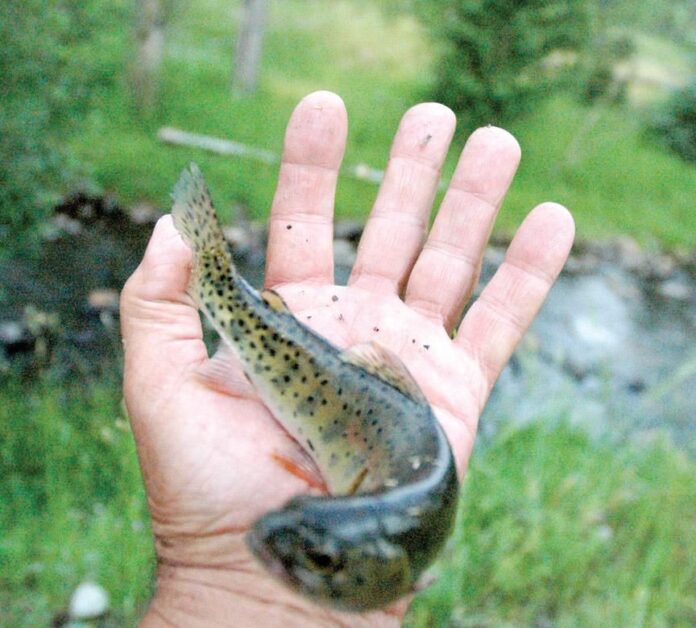
When Spanish settlers first colonized Northern New Mexico in the early 17th century, the only trout found swimming in the streams of the Sangre de Cristo and southern San Juan mountain ranges was the colorful Rio Grande cutthroat. The cutthroat, so named because of two orange slashes under their lower jaw, provided many a meal for the hungry inhabitants.
The combination of subsistence fishing, over-grazing of the river banks and logging diminished the cutthroats’ habitat. Water drawn for irrigation depleted the flow in the streams, especially lower down in the fertile valleys where crops were planted.
The introduction of brown and rainbow trout to New Mexico in the early 20th century hastened the demise of the cutthroat. The aggressive brown trout reproduced naturally in the streams and took over the cutthroat’s habitat. The rainbow, closely related to the cutthroat, interbred with the native species and the gene pool became diluted.
The cutthroat’s range shrank, and they retreated to the headwaters of their native streams.
The cutthroat now inhabits just 10 percent of its historic range and has been proposed as a candidate for the Federal Endangered Species List.
In Rio Arriba County, naturally-reproducing populations of Rio Grande cutthroats can still be found in the headwaters of El Rito, Rio Tusas and Rio Vallecitos. On a July 19 fishing trip to the El Rito (Spanish for “the small river”), angling for small but feisty cutthroats proved rewarding.
El Rito is typical of the small streams that are the stronghold of the remaining cutthroats. barely 10 feet wide and only inches deep along much of its length. It’s shaded and overgrown banks keep the water cool and give the fish shelter from predators.
The biggest challenge at El Rito proved to be finding room to cast a fly. There were plenty of overhanging branches to snag up on.
Because deep pools are scarce along El Rito, fly fishing the shallow riffles is the most effective form of fishing. An elk hair caddis with a small prince nymph as a dropper was effective at fooling the fish, which averaged under 6 inches in length.
“We were catching bigger ones earlier during and just after runoff,” Eddie Campos, of the town of El Rito, said.
Campos, fishing with his daughter Mauri, said fishing was better when he was younger. He had fished the Rio Tusas July 17, where he said the fish average larger and he had taken some pictures of a couple of 12-inchers to prove it.
The state Game and Fish Department raises Rio Grande cutthroats at Seven Springs Hatchery near Fenton Lake. They were recently reintroduced to Comanche Creek on the Valle Vidal and have been stocked in the Rio Grande above Pilar. Nabor Lake and Nabor Creek on the Edward Sargent Wildlife Area near Chama, as well as the streams of the Valle Vidal, have catch-and-release fishing for Rio Grande cutthroats. In other waters of the state, the daily bag and possession limit for cutthroats is two.