Hall-of-Famer Coached Sports, Life

Published:

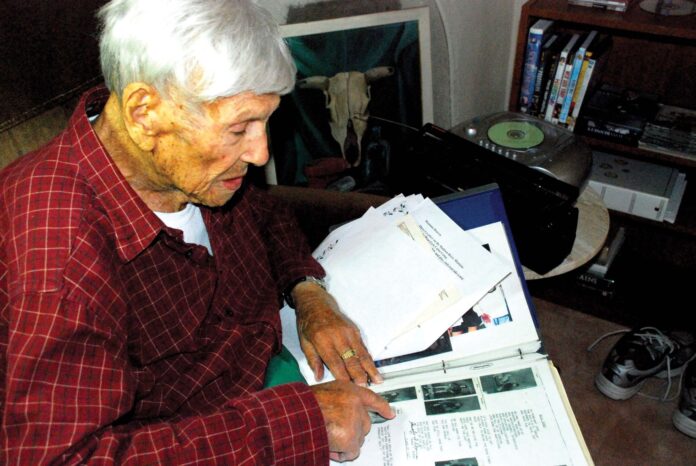
Frank Byers was a fixture on the New Mexico sports scene for so long that he can give anyone a history lesson on not only Northern New Mexico athletics, but on much of the state.

    The 97-year-old Española resident has been a student-athlete, teacher and coach. He mentored a number of players who went on influential careers as coaches in Northern New Mexico and was himself taught by coaches who have become legends in New Mexico.  

    Byers’ athletic career began at Albuquerque High School, where he was an all-state football player in 1931.

    “We had one coach, Frank Wilson,” Byers said. “He coached everything.”

    Wilson Stadium in Albuquerque is named after Frank Wilson.

    Upon graduating from high school in 1932, Byers attended the University of New Mexico in Albuquerque where he played football, tennis and participated in track and field before graduating in 1936.

    “I had the fourth-longest javelin throw in the Border Conference,” Byers said. “Of course, it wasn’t as long as what high school kids throw now.”

    Byers was coached by Ray Johnson, whose legacy includes the Johnson Center on the University campus which still hosts high school state championship events. Johnson oversaw the construction of the gym in 1957 and for years it was the home of the University of New Mexico Lobos basketball team, before the construction of the now famous “Pit.”

    After graduation, Byers went to work for the Atcheson, Topeka and Santa Fe railroad. He served in the United States National Guard during World War II. In 1946 he went to Belen High School as a basketball coach and teacher. It was here that Byers began the legacy he would leave behind.

    “I could be the only letterman left from that class,” Byers said.

    That first year, Belen was defeated by Forrest in the state basketball tournament. At that time, there were no classes of competition in high school sports and all schools, regardless of size, competed for the state title. Forrest, a small school from Eastern New Mexico, was a powerhouse in the early years of the state basketball tournament. The school no longer exists. Forrest was runnerup in 1946, and in 1931 and 1933 won state titles.

    Byers’ next stop was Northern New Mexico Normal School in El Rito from 1947-1955, where he coached both basketball and football. During his first three seasons, there was no official state football champion. State champions were decided using a point system and in 1951 El Rito and Melrose were co-champions of Class C. It would be the only state championship Byers would win.

    “We never did have a grass football field at El Rito,” Byers said. “There was no two platooning and the helmets didn’t have face guards.”

    Byers also helped found the Northern Rio Grande Basketball Conference in 1947 and its tournament, now known as the Northern Rio Grande, has been held annually since its founding, making it one of the longest continually held tournaments in New Mexico. In 1991, Byers was elected to the Northern Rio Grande Hall of Fame.

    Although he never won a state championship in basketball, Byers laid the foundation for future hoops success at El Rito. Two years after he left the school in 1955, the Eagles won the Class B state championship.

    “I was a point guard and he taught me a lot about basketball,” Ruben Lucero, a 1953 graduate of El Rito, said.

    Dennis Salazar, recently retired from the Board of Regents at Northern New Mexico College, played football for Byers, graduating in 1953 from the Normal School. 

    “He was a gentleman and easy to play for,” Salazar said. “He was very good at talking to people, a good communicator.”

    Byers remembers Salazar and his brother, Regino (Reggie), as his mentors, rather than the other way around.

    “Dennis and Reggie were sort of my advisors when I’d get mad at some of the players,” Byers said. “Even though they were just high school kids.”

    The normal school  evolved into today’s Northern New Mexico College.

    Byers moved over to Española High School, known as the Hornets. While there, he coached some good teams and coached some bad teams.

    “I remember one year we only scored two points the whole season,” Byers said. “You’re only as good as your material.”

    Thomas McReynolds, who went on to his own career as a coach and athletic director at several area schools and was also inducted into the Northern Rio Grande Hall of Fame in 2005, played quarterback for Byers at Española, graduating in 1960.

    “What I really liked about him was he taught us what life was going to be like,” McReynolds said. “He was instrumental in guiding me into my profession.”

    No matter what the team’s record, Byers always tried to encourage his players.

    “He always reminded us to give everything we had,” McReynolds said. “Win, lose or draw.”

    Byers’ last year as football coach was 1963. He continued to teach at Española,

    “He was teaching at the high school when I was there and used to tell us his old coaching stories,” Joe Guillen, a 1967 graduate of Española and former member of the Española School Board, said. “He was the announcer at our football games. He was an outstanding teacher and I wish we had more individuals like him now.”

    Byers retired in 1978 and since then has spent his summers in Montana fly-fishing the Madison River, staying at the West Fork Cabin Camp in Cameron. There he uses flies that resemble the insects that hatch and emerge from the river

    “You fish the hatches,” Byers said. “You try to match the different hatches.”

    He used to fish the Rio Grande north of Española.

    “So many people fish the Madison now,” Byers said, “The fishing in New Mexico is probably just as good.”

    Byers still lives at his home on San Juan Drive in Española. His sons, Rupert and Frank Hugh, graduated from the University of Pennsylvania and Massachusetts Institute of Technology, respectively. His daughter, Alicia Ann, graduated from New Mexico Highlands University. His wife Muriel passed away in 2001. He has nine grandchildren and seven great grandchildren.

    He had a simple answer when asked to describe his coaching philosophy.

    “I always tried to bring out the very best in my players,” Byers said.

    Judging by the number of his players who have gone on to success in their lives, Byers did his job well.

Related articles

Recent articles