Hopewell Lake Awakes from Winter Slumber

Published:

    Hopewell Lake has awakened from its winter slumber.

    After months of being locked beneath a heavy layer of ice and snow, Hopewell Lake is now free of ice and offering anglers the opportunity to catch rainbow and brook trout.

    Because its elevation is close to 10,000 feet, snow falls heavily at Hopewell Lake during the winter but can melt quickly in the spring. Over three feet of snow remained on the ground May 1 at a snow-depth measuring site at Hopewell, but by May 18, the site recorded no snow and anglers could drive to parking areas along the lake’s shore.

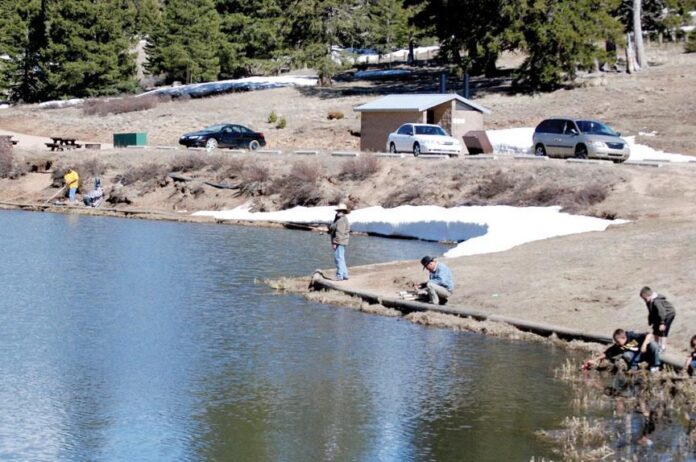
    A few lingering reminders of winter remained at Hopewell May 16 with a few small banks of snow still hugging the shoreline in spots. After being locked below the ice for nearly five months, the lake’s trout are hungry and cruising around the lake looking for food.

    Although Hopewell is heavily stocked throughout the season with rainbow trout, the early season  is more likely to yield some of the lake’s naturally-reproducing population of brook trout to the angler’s creel. The hardy brook trout were introduced to the lake years ago and have established themselves through natural reproduction. The hatchery trucks hadn’t yet arrived by May 16, so the catch consisted primarily of brook trout with the occasional rainbow trout that had survived the winter.

    The hatchery trucks will likely be arriving soon, as the lake is normally heavily stocked prior to the Memorial Day weekend, when the lake attracts a crowd of anglers.

    Although prepared baits, like salmon eggs and power bait, will tempt the stocked rainbows, the brookies are attracted more to natural baits like worms. Fly fishing enthusiasts will find small flies such as the Warden’s Worry effective, especially when the fish are actively rising to the surface. Small spinners, like Mepps and Panther Martins, will catch fish, both rainbows and brookies, at times.

    The short growing season limits the size of the fish. Most brookies are in the eight- to 10-inch range, but some will reach 14 to 16 inches. The most common size for rainbows is the size at which they are stocked between nine and 11 inches, but occasionally a holdover rainbow can reach 14 inches or longer.

    Hopewell covers about 15 acres and is relatively shallow. As the water warms during the season, aquatic weed growth in the lake can be heavy. Baits dropped to the bottom of the lake with heavy weights are likely to get snagged in the weeds. A bobber will keep the bait out of the weeds.

    On summer evenings, the fish will rise to the surface to feed on the abundant insect life the lake produces, so fly fishing by wading or from a float tube can be very successful.

    Boats without motors are allowed at Hopewell, and there is no launch ramp.

    Camping is not allowed at the lake, but a nearby campground has 32 sites and officially opens Friday. Hopewell is a popular weekend destination with summer campers trying to escape the heat. Thunderstorms are frequent in July and August.

    Fall fishing and camping at Hopewell can be idyllic, with the summer crowds gone and the surrounding stands of aspen trees ablaze with golden color. The brook trout will be preparing to spawn and their colors will deepen, with the males sporting bright orange bellies and hooked jaws. Bull elk can be heard bugling in the mountains. Snow begins to fall in October and by Thanksgiving Day the lake is already locked in ice for another long winter.

Related articles

Recent articles