
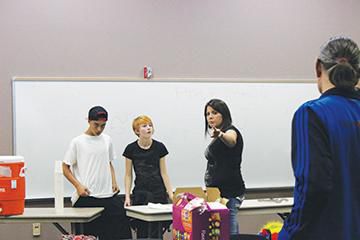

A local nonprofit invited a neuroscientist to Northern New Mexico College, Oct. 15, to illuminate the mysteries of the mind to teenagers who are interested in knowing more about science.
Staff from Café Scientifique asked Garrett Kenyon, a scientist at Los Alamos National Laboratory, to speak about the human brain, how it processes information and how it compares to the most sophisticated computers mankind has developed.
Café Scientfique is an organization that encourages children, particularly teens, to pursue science and technology interests.
Once a month, staff sponsor presentations for the community’s children about a range of scientific topics, from geology to computer programming and anything in between. The speakers are experts in their fields who have worked in the industry or have done extensive academic research on the topic.
“Before we can even create computers that are as fast as the human brain, we first need to understand how the brain works,” Christian Madrid, a teen attending the event, said. “The problem is that we still do not know a lot about how it processes information.”
Kenyon has long been fascinated with the brain. He said it is his life’s passion and wants to understand more about it.
“Most people want to know about big issues such as emotion and critical thinking,” Kenyon said. “Neuroscientists are more interested in how the brain works so that we can function every day.”
To illustrate the point, Kenyon showed audience members a picture of chess champion Gary Kasparov. The picture showed Kasparov when he lost to Deep Blue, a computer program that can process thousands of chess moves in fractions of seconds.
Kenyon said most people remember that Kasparov lost, but they miss the bigger picture. He said many people attribute this event to the day computers became so powerful, they could perform actions similar to human beings.
He said Kasparov actually lost to the person who programmed the software. After all, the human being designed and created the code that allowed the computer to process those thousands of chess scenarios.
Also, it was the programmer who moved the chess pieces on the board and provided the information about the game. These are actions the most sophisticated computer has not yet been able to do.
Kenyon said simple movements such as reaching for an item, or even vision, is a complex biological process that involves many moving parts and the brain has to coordinate all those pieces. He said that makes the brain a much more powerful tool than the most refined computer.
He then demonstrated just how different the human brain is compared to computers. He had a volunteer look at pictures for fractions of seconds to try and identify the image. This imitated an experiment he performed previously.
Kenyon said when he analyzed the results, he found that in some instances, computers could discern images similar to a human being, but overall, human subjects were much faster at scrutinizing the images put in front of them.
“When a computer captures an image of a cat, it cannot tell whether the animal is calm or if it is angry and about to attack,” Emmett Moulton, a teen attendee said. “We can tell and we can back off when we see that.”
This is not the first presentation many of the teens have seen. The previous discussions included talks about computer
hacking, biofuels and natural disasters and how to avoid them.
“I really liked the algae presentation,” Café member Brooke Trujillo said. “It was really fun.”
Savannah Trujillo is a staffer with Café and she oversees the program, but it is the teenagers who are in charge of making the decisions.
“They are the ones who decide the topics that are discussed,” Savannah Trujillo said. “They are the ones who choose the presenters. They are the ones who pick the food. They are the ones who manage the budget. I get the food for them, but they tell me what to get.”
The teen leaders chose a number of different topics for the current presentation series. September’s presentation was about matter and antimatter and how we came to be.
Next month’s presentation is about microbiology and how bacteria are becoming resistant to the antibiotics we use.
“We like to choose things that people have not heard about,” Madrid said. “Everyone has heard about technology but not too many people know about biofuels.”
Kenyon said he really enjoyed giving his talk and the teens had some terrific questions for him.