
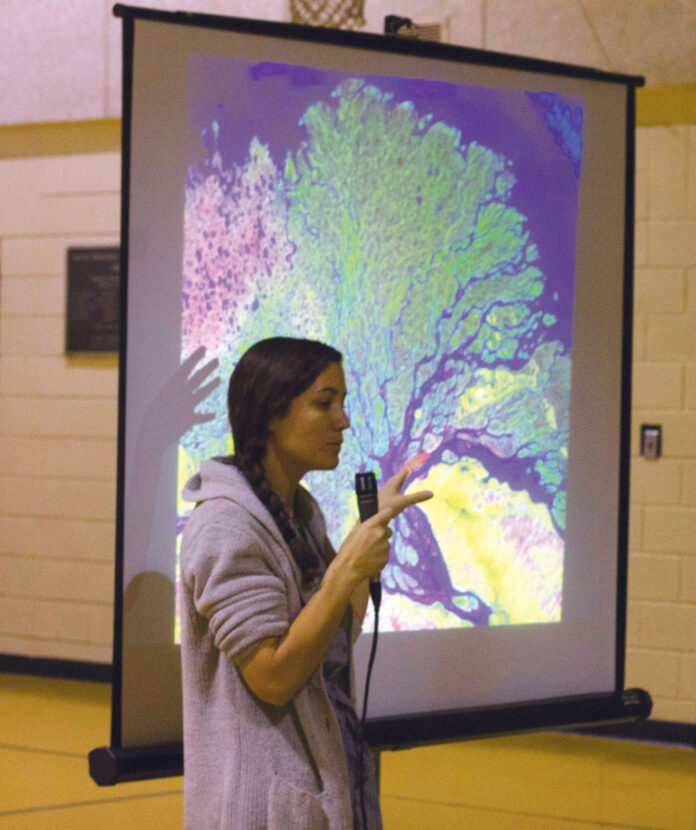

Students at Velarde Elementary School got a lesson, Nov. 30, that could spark a life-long interest in science and math.
Fractal Foundation Education Director Emma Eckert stopped by the school to teach the students and staff about fractals and the various roles they play in everyday life.
She explained to the audience of approximately 80 students, and a handful of staff members, that fractals are “never-ending complex patterns” created by repeating the pattern on various scales.
Equipped with a bevy of colorful slides displaying several different types of fractals, Eckert captured the attention of all present, including the school’s teaching and support staff. Eckert and her colleagues characterized the complex patterns as SMART (Science, Math and Art) and notes they can be found in everything from human lungs to tree branches.
She said the Foundation’s work is important because it gives educators, and others involved in instructing young people, new tools for teaching math.
“We often think of math as this closed box, separate entity, but the patterns of math are all around us,” Eckert said. “By encouraging children to learn to appreciate mathematics, and to see how math is relevant to many aspects of our lives, we can foster a deeper learning experience that encourages exploration into other subjects and show more of the big picture in which everything is connected.”
She said getting children interested in math at an early age can also have a positive impact on the child’s educational outcomes at every grade level.
“Becoming proficient in mathematics allows us to feel more comfortable exploring other subjects, because they are all interconnected,” she said. “Studies show students with a higher proficiency in math do better across the board.”
Eckert, a teacher by vocation, said she learned about fractals several years prior to taking the job as the Foundation’s education director, after she attended the monthly fractal show the foundation hosts at the Albuquerque Natural History Museum.
“A friend of mine invited me to the first fractal show,” she said. “I went and I was hooked and years later, I saw the advertisement for the job.”
Velarde’s head teacher, who doubles as the school’s top administrator, Sherri Rodriguez, said she welcomed Eckert and the Foundation’s efforts because it is an opportunity to introduce students to the fun side of learning.
“Learning about fractals helps all students develop their curiosity for math and science,” she said. “Students don’t realize they are learning while they are having fun.”
Fifth-grader Jacob Samaniego and his two younger brothers, fourth-grade twins Emillio and Ricco Samaniego, attended the fractal assembly with the rest of their classmates.
“It was cool,” Jacob Samaniego said of the presentation. “I like all of the different patterns.”
Like his older brother, Emillio Samaniego said he enjoyed seeing the different patterns and can’t wait to try a little bit of what he learned on his own.
“It kind of gets you going,” he said. “I will try it when I get home, if my parents let me use my laptop.”
Emillio Samaniego is referring to using the XaoS software.
The software can be found by visiting www.fractalfoundation.org, under the Explore Fractals tab, clicking on the Fractal Challenge link and downloading the available software.
There are several free options for parents and their child to choose from.
If those aren’t appealing, students can purchase fractal building and exploration phone applications and computer programs, at a cost of $.99 to $29.99, depending on the application.
There’s even a Fractal Challenge, which is a competition to design the best fractals.
Once the students get a feel for the software, they can choose one and enter it into the Fractal Challenge by the Dec. 31 submission deadline date.
Judges will weigh the beauty, originality and interest of each artwork.
For complete details on submission requirements and timeline, visit the Foundation’s website,www.fractalfoundation.org.
The Foundation also has online classes where parents and students can learn about fractals at their own pace.