Getting by with A Little Help

Published:

    Fed up with working a string of low-wage jobs, 19-year-old Tamara Romero decided it was time for a change.

    She considered her options and enrolled in Northern New Mexico College’s High School Equivalency Program to earn the credentials (diploma) she missed out on when personal difficulties prompted her to drop out in the 12th grade.

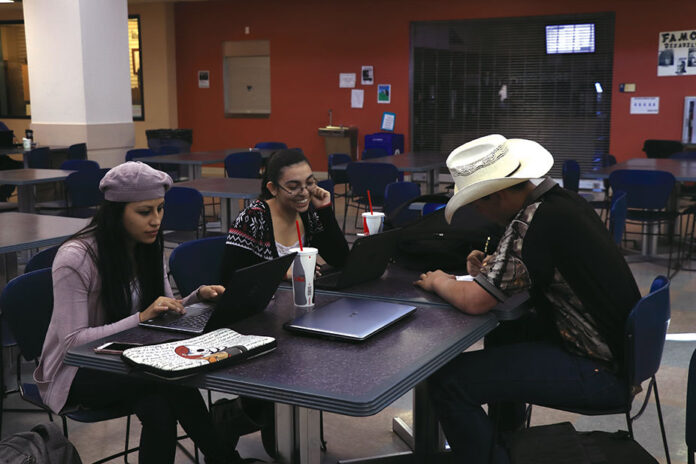
     Today, Romero is one of 32 first-time college students participating in Northern New Mexico College’s College Assistance Migrant Program.

    The United States Department of Education established the Program in 2002 to provide seasonal farm workers or their children support that would make it easier for them to get through the first year of college.

    Romero said she appreciates the program’s support and would recommend it to those who are looking for assistance.

    “I dropped out of high school in 2014 for personal reasons and honestly, I just got tired of working at fast food places,” she said. “The program has helped in so many ways. Financially, it is my support system.”

    She said the financial support helps alleviate stress and allows her to focus on studying, with positive results. The aspiring sociologist finished the semester strong.

    “They help you financially where you don’t have to work,” Romero said. “You can focus on your studies. Because of the Program’s support system, I was able to make the dean’s List.”

    Students must be eligible for financial aid, which pays for classes, and they receive a $500 stipend to pay for books and other school supplies.

    The first-year college student said the support system goes beyond the Program’s tutors, who keep her and other participants from having to go to the library seeking those services.

    “There are some friendly faces here,” Romero said as she completed her homework outside of the Program’s office. “Everyone here is family.”     

    Program officials sponsor several extra-curricular activities each semester, such as bowling, to help participants relieve the stress associated with being a first-year college student.

    Stephanie Vigil-Roybal, the Program’s director, said hosting the activities allows the students to learn, while forming lasting connections.

    “It is important to get a well-rounded education,” she said. “They go on field trips with their class. It allows them to learn differently.”

    The Program’s Academic Advisor Thansewi Martinez said the activities help the students adjust.

    “It (the Program) gives them a sense of belonging,” she said. “I think it gives students who thought they would never go to college the experience.”

    Vigil-Roybal said the Program could have a positive impact on the community that transcends the individual students, because they could serve as an inspiration for their family and friends who may be unsure about returning to school.

    “I think it is uplifting,” she said. “The community knows there is hope that their child can get a quality education and in turn, give back to the community.”

    The college freshman chose sociology as a course of study because she wants to understand more about communities and the social problems that influence them.

    Although she is a long way from earning a degree of any type, Romero said she is committed to doing just what Roybal-Vigil suggested — work toward improving the community in which she was born and raised.

    “I want to understand the community,” she said. “I am not going to take the education that I gained and take it somewhere else. I am going to take the education I get and keep it in the community.”

    College Admissions and Recruitment Director Frank Orona first became familiar with the Migrant Assistance Program through a family member who was a participant. Now he serves as one of the Program’s many staff mentors.

    “I got involved at the beginning of the fall term,” he said. “My nephew was a part of the program a year ago and he got so much out of it.”

    Orona meets with his mentee on a regular basis to make sure he stays on track. The idea is to address any issue the student maybe having before it gets out of control.

    During those sessions, which can, and sometimes do, occur more than once a week, the Program mentors help the students with everything from homework to just listening to them.

    “We check in with them to make sure they don’t need anything,” Orona said. “We help them become better writers and public speakers.”

    He said a lot of his work is on a referral basis, which means he has to be available when needed.

    Like Vigil-Roybal, Orona sees the Program as a boon to the Española area because one of the Program’s main messages is community involvement.

    “It is going to produce an educated workforce,” he said. “The students leave here with a greater sense of community responsibility. They learn to serve their community and that is something.”

Related articles

Recent articles