
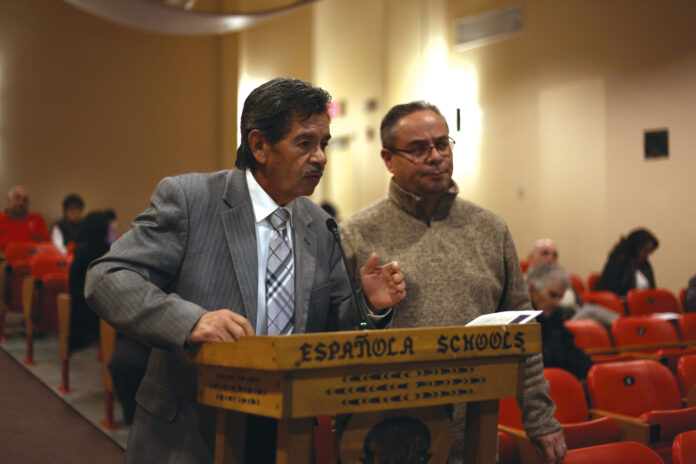

Española Valley High School leaders unveiled a plan they believe could increase the District’s graduation rates and improve the student’s overall performance on the mandated Partnership for Assessment of Readiness for College and Careers exam.
High School Principal Robert Archuleta and Assistant Principal Ruben Salazar laid bare a plan, at the Jan. 25 Board meeting, to raise the District’s graduation rates to 70 percent. The increase, if it is achieved, represents a six-point jump from School Year 2015-2016’s 64-percent rate.
The 70-percent goal would translate to a an overall 15-point increase from 2015’s 55 percent.
Salazar said the District will start pushing credit recovery in core areas like English, math, science, social studies and Spanish.
The idea is to give students a second chance to pass the core classes that they failed. They’ll accomplish this by attending the Credit Recovery classes at the High School at 6:30 a.m. and 8:30 p.m.
Once administrators reviewed students’ records and found they’d failed one of the core classes, Archuleta then notified parents, by mail, that their student was a potential participant.
Parents and students were given a Feb. 3 deadline to enroll in the program, but it is unclear how many students signed up for the classes.
The amount of time a student spends in the Credit Recovery program depends on how much credit they need to make up.
“If they are missing a half credit in biology or a science, they have to do 90 hours of instruction,” Archuleta said. “If they are missing a whole credit, they would need 180 hours and that is a PED (Public Education Department) requirement and statute.”
Board Member Yolanda Salazar asked whether the District had enough qualified teachers for the initiative to succeed.
“How many students, primarily seniors, are we enrolling in these courses that have substitute teachers who aren’t really qualified to teach those core classes?” Salazar asked Archuleta at the Jan. 25 meeting.
Only four of the school’s nine substitutes are teaching classes in place of full-time teachers, according to Archuleta.
He and Salazar also want to see improvements in student math and reading proficiency. The number of the High School’s students that proved proficient in reading and math dropped significantly between 2014 and 2016.
Thirty-three percent of the students were reading at grade level in 2014, but that number dropped 12 points to 20.9 percent, in 2016.
The data for math shows a similar decrease. Slightly more than 14.5 percent of the students were proficient in math in 2014, but that number fell approximately nine percentage points to 5.7, in 2016.
Salazar said he would like to see the math and reading proficiency rates go up a full 10 points. If that goal is reached, the math proficiency average would jump to 25.7 percent and reading would grow to 30.9.
Archuleta said he hopes to achieve the aforementioned goals by implementing several measures, including professional development and short-cycle assessments.
Neither Superintendent Eric Martinez, Associate Superintendent Myra Martinez, Salazar or Archuleta returned multiple telephone calls seeking comment regarding the sharp decline in student proficiency.
Archuleta said the idea behind the short-cycle assessments is to give students practice.
“We have a number of practice tests that PARCC and Pearson (Pearson is a for profit, British-owned publishing and assessment company) have in common,” Archuleta said. “We are going to start using them because we need to make sure the students feel comfortable taking this type of test. It is a totally different type of test. I have had teachers, and even an administrator, that took a third-grade level PARCC test and it was difficult for them.”
Martinez told those in attendance that the testing language serves as a barrier to some students performing well on the standardized testing.
“One of the things we worked on at the High School is developing that academic language map,” he said. “One of the things we don’t do is, we don’t use the Common Core language. So when the kids take the assessments, they struggle through the assessment because the kids don’t understand the academic language and don’t have the capacity to manipulate the exam.”
The Common Core State Standard Initiative is a federal government mandate that sets bench marks for what students should know at the end of each grade.
All the preparation won’t do a bit of good unless students attend class, Archuleta said.
The High School’s administration want to get more parents involved by keeping them abreast of their child’s attendance and overall educational progress.
Archuleta and his team believe they can reduce the number of students that skip school by calling the offending student’s parents and notifying them of their child’s attendance and overall educational progress.