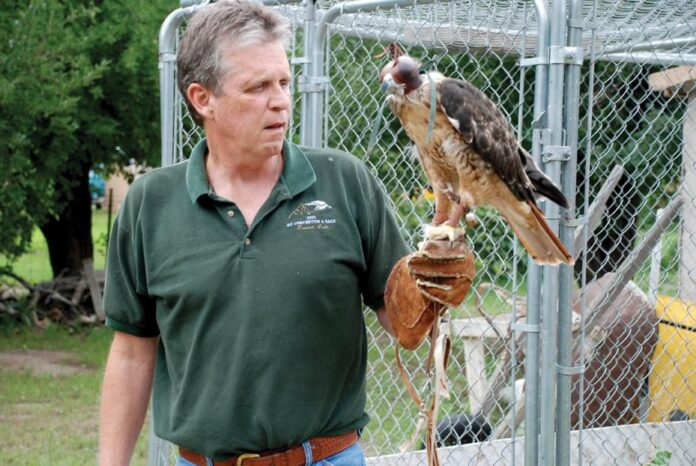
Ancient Sport of Falconry Put Talons into Embudo Man at Young Age

Published:

    Richard Martin became familiar with the hawks, falcons and other raptors that hunt the skies while growing up and working on ranches in the Tucumcari area of eastern New Mexico.

    Martin used this experience to become a practitioner of the ancient sport of falconry.

    “I always enjoyed watching them,” Martin said. “I began to read about and study falconry, discovering that it was an ancient sport.”

    Falconry is the use of birds of prey, commonly known as raptors, to hunt and kill game for humans. Martin said the sport originated in Asia with the Mongols. Falcons, hawks and even eagles have been trained by humans to hunt for centuries.

    Martin first trained a raptor, a red-tailed hawk, when he was 14. The bird he is presently training is also a red-tailed hawk named “WD.”

    “One day he took off up a canyon and when we found him he was messing around with a can of WD-40,” Martin said explaining the origin of the bird’s name.

    Martin, 59, is a retired educator who lives with his wife Edna along the Rio Grande in Embudo. WD was captured by Martin near his home.

    “I’d been watching the nest and it was his first flight out of the nest,” Martin said.

    WD is registered as a passage bird, one of three types of birds typically kept by falconers. A passage bird is one that is in its first year after leaving the nest and has been raised by its parents

    The two other types are imprint birds, which are taken from the nest before they leave it and imprints with the falconer rather than its parents, and captive-bred birds.

    Falconers are regulated by the state and federal governments, and are licensed by the states. There are 95 falconers in New Mexico and 4,000 in the United States.

    To obtain a license, a beginner must have a sponsor and pass a 100-question test. The license costs $25, according to Letitia Mee of the state Game and Fish Department.

    Martin has a general license, which requires at least three years of licensed falconry and is the second highest level a falconer can attain.

    “It’s the most regulated sport by the state and federal government and rightly so,” Martin said. “It’s not for everyone. Training a bird is a long process and takes lots of patience.”

    It also requires walking a fine line.

    “They are not pets, and you don’t want to make pets out of them,” Martin said. “You want to keep them wild.”

    The bird must trust its falconer and realize that they are the one with the food, Martin said. During training, the bird is tied to a perch with a rope and taught to fly to the owner’s gloved hand.

    The rope is gradually extended up to about 100 yards and then finally the bird is left untied at the perch to fly to the gloved hand. This is the moment of truth.

    “It’s 50-50 as to if they’ll come to you or take off,” Martin said.

    WD has been trained to hunt rabbits and squirrels. When hunting, Martin places the bird on a perch, where red-tailed hawks prefer to hunt from. Martin then goes out and beats the brush trying to kick up a rabbit or squirrel. When one bolts from cover, WD takes off and attempts to kill the animal.

    “It’s a switch, I become the bird dog,” Martin said. “When one of my birds kills a rabbit, I let it eat it.”

    The Cadillac of birds to a falconer is the peregrine falcon, which hunts by soaring thousands of feet in the air and then going into a powerful dive that can reach speeds of over 200 miles-per-hour. Only those with a master’s license may keep a peregrine.

    Peregrine falcons in 1970 were listed as an endangered species, primarily due to the pesticide DDT, which caused the eggs of birds to have thin shells which cracked in the nest. DDT was banned in 1972 and falconers were instrumental in raising captured peregrines to be released in the wild, Martin said.

    The peregrine falcon was removed from the endangered species list in 1999, but the number that falconers can take is still strictly controlled. Only two permits to gather peregrine falcons are issued for New Mexico and are selected by lottery, according to Mee.

    When a falconer gathers a peregrine or any other bird from a nest, he must report it and provide a photograph that there is still a young bird left in the nest. If only one bird is in a nest, it cannot be taken.

    Despite the time and patience that a falconer has to invest, the experience makes it all worthwhile to Martin.

    “For me, when my bird leaves its perch to make a kill, it’s as if everything slows down and is in slow motion,” he said. “Early in the morning when it’s cold as hell and the sun’s coming up, it’s just me and my bird. That’s my church.”

Related articles

Recent articles

Weave a Mug Rug