Española Valley High School and McCurdy Charter School have been selected as finalists in the Samsung “Solve For Tomorrow” Contest, a nationwide science technology engineering and mathematics competition with more than 4,000 participants across 51 states.
Participating schools have a chance to win a share of $2 million in technology and prizes. There were 255 state finalists, five from each state, representing approximately 230 school districts.
The contest, open to students in grades 6-12, consists of submitting a video project, outlining an issue affecting the local community. Students then document the steps on how to apply science and technology to address the issue and also describe hurdles they had to face in the classroom.
Samsung Spokesperson Lindsay Hyman said as state finalists, the teachers from each of the five schools developed an activity plan outlining how they would address the challenge.
Hyman said each school will be judged based on strength of overall concept, activity objective and how it relates to piquing student interest in science, technology, engineering and math subjects, including the planned execution of the concept.
Española Valley High School teacher Gloria Basden-Woelfel’s science class was chosen as a finalist for their project on affordable water filters.
McCurdy Secondary School Principal Chelamia Quintana said, “This is great news for a school that continues to be dedicated, since its beginnings as a charter school, to putting technology into the hands of our students.”
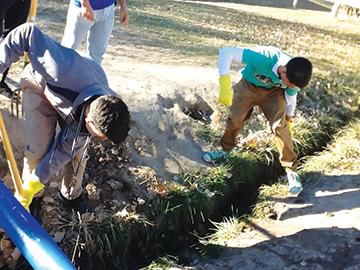
McCurdy Charter School Science Teacher Laureen Pepersack said it’s been her dream, for about a year, for her students to work on a project dealing with ditch water.
“Our 100-year-old campus is bisected by acequias, (ditches),” Pepersack writes in the essay originally submitted for the contest. “Ditch water is used for farming both upstream and downstream. Preserving the water quality is essential for the sustainability of the Española Valley.”
Pepersack said McCurdy students treat their acequias with little regard for the quality of the water, trashing the ditch and by extension, possibly trashing the rivers and streams nearby.
She said when students learn how their actions impact water quality by seeing accurate data, they can be encouraged to develop better habits.
“Our goal is to have a collaborative school environment in which parents, students, teachers, administrators and community members work toward common, well articulated goals in a situation highly supportive of challenge and innovation,” Pepersack said.
The project would have students measure turbidity, conductivity, pH and other indicators of water quality, making plots of the changes over time. Pepersack said students will also remove, on a regular basis, the trash placed in the stream and record how much and what kind of trash they find. She said students will use technology to create videos or Internet presentations to share with their community, to increase understanding of water quality.
“At Samsung, science, technology, engineering and math are core to everything we do,” Hyman wrote via email. “The United States has a serious science and technology skills gap in K-12 schools. We are a company of engineers and we need to foster the next generation of the workforce and innovation.”
Hyman writes that in order to ensure today’s students are interested in science and technology subjects, and eventually engineering or science and math careers, the company is empowering students and teachers “to transform learning experiences and revitalize their communities.”
Robin Dow, a Samsung spokesperson said the company will award five teachers in every state, with two Galaxy tablets. Dow said there will also be one winner from each state that will receive a $20,000 technology package for their school.
Dow said 15 national finalists will receive a trip to attend a pitch event, where they will present their video to a panel of judges and will win a minimum of $40,000 in technology.
The five national winners will also be invited to attend a celebratory event in Washington D.C., in addition to winning a $120,000 technology package for their school.
Pepersack said McCurdy teachers have attended professional development on their own to improve their teaching and to increase their resources for their classes.
Through a program offered by Northern New Mexico College, the Española Valley Environmental Education Teacher Academy, she said she was able to secure money to purchase equipment and supplies for classes which she used to buy probes to analyze ditch water for the Samsung video contest.
The 51 state winners will be announced in mid-December.’