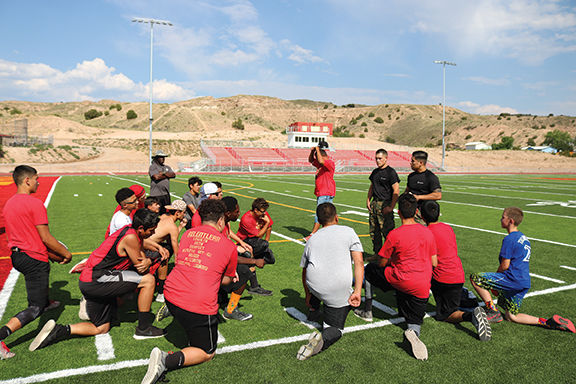
Velarde residents may have to wait a few more years to see their elementary school renovated because the money set aside for the project was pulled to fund a new athletic field.
The Española School Board’s June decision to transfer $2.1 million from the District bond account to the Operational Fund to cover the cost of the controversial Española Valley High School Track and Field project, translates to the District being short on the required match for the Velarde Elementary School renovation project.
After covering the football field costs, $600,000 remains in the District’s bond account. Based on the 2013 contract the District was poised to award R and M Construction, the District’s match for the $3,699,936 project would total $1,331,977, double what is available.
“There is not enough money in the current bond (fund) to pay the District’s portion of the state match, regardless of keeping the standards-based award that has been placed on hold or the systems-based award that is our current reality,” District Superintendent Bobbie Gutierrez told Board members at a July 17 work session.
A standards-based award would mean a complete renovation. A systems-based award would include honing in and improving specific systems, such as buildings’ plumbing and electricity.
While a fact sheet, regarding the 2011 bond, shows the Velarde renovation project was listed as one of the many allocations for the proceeds from the $28 million in the bond sales. The new administration building, the Abiquiú renovation and the track field projects weren’t listed.
However, before District administrators can take action to secure funding, the Board must amend the Española Facilities Master Plan to show the school is no longer slated for closure. The amended Facilities Plan would also include a revision of the Velarde project to reflect the school’s declining population.
Velarde-area parent Roiba Sanchez said, while many components contributed to the school’s sharp enrollment decline, she believes the talk of closure and the negative comments from Board members may have dissuaded parents from enrolling their students in the school.
“With the threat of closure, parents either didn’t want to send their children to a school they thought was going to close or was told by school employees (not Velarde employees) that they shouldn’t send kids to that school because it was the worst school in the District, including (then Board member) Lucas Fresquez saying that at Board meetings,” she said. “Also parents started pulling students out because of inconsistency of head teachers and general ed teachers.”
When the Board approved the original project in 2013, the scope of work reflected renovations designed to accommodate 130 students. A scaled-back version would be designed for about 70 students.
Vote for closure
The Board voted in 2014 to close the school. But those plans were rejected by former public Education Department secretary Hanna Skandera and Santa Fe District Court Judge Sara Singleton.
“We will reevaluate current enrollment status and scale back the 2013 plans, address the systems issues and provide a face lift for the school but forgo the full-renovation plan,” Gutierrez said. “Velarde would be the first elementary school to receive renovations in the next bonding cycle, if the community would support and approve another GO (General Obligation) Bond for the District, some time between 2019 and 2024.”
Depending on the year, a successful bond election could gross the District anywhere from $16,414,732 to $28,994,732 based on a report bond advisor Leo Valdez presented at the June meeting.
Regardless of the District’s future bonding capacity, Gutierrez said the $28 million bond voters approved in 2011 was about 35 percent of what the District needed to conduct system-wide upgrades.
“I think the District would have needed about $78 million to address the facilities issues and needs, ranging from health and safety to code compliance to programmatic needs,” she said.
Other funds?
Board President Ruben Archuleta and Secretary Gilbert Serrano wanted to know what could be done to transfer some of the $1,243,582 the District has set aside for the pending Abiquiú renovation project, to the Velarde project.
FBT architect Sanjay Engineer said although he would need more time to answer that question, he believes if the District can come in under budget on the Abiquiú renovations those savings could be used to move the Velarde renovations along.
“There may be possibilities to explore, but right now I don’t have an answer for that,” he said. “The state has appropriated a certain amount for work to be done and as long as the work is done and money saved, it would be very good news for the District.”
Serrano recalled the effort Velarde- and Alcalde-area residents put in to ensure the measure passed, and he “hates to see them left out.”
Archuleta was one of the residents who campaigned to get the measure passed. He said the community stood behind the bond effort because they were promised school upgrades.
“This is a blow that is difficult to grasp,” he said. “They did come out in big numbers. If you look at the demographics, Alcalde and Velarde went out in big numbers to vote and I think they deserve it.”
Sanchez said she believes District administrators passing out fliers, which stated the school would be renovated and then not following through, could have a negative impact on future bond efforts.
“You don’t go out to a school and have advertisements listing our (Velarde) renovations for students to take home, for your past past superintendent to go out and have community meetings saying this is what is going to be done,” she said. “There is a lack of transparency there. You are going out and asking people for $28 million and then doing what you please with it. It won’t happen again in Velarde.”
Sanchez said the District’s mishandling of the 2011 Bond is an example of history repeating itself. She points to a failed 2002 promise the District made to fix up the dilapidated school. She said voters remembered that unfilled promise when they rejected a 2008 bond initiative.