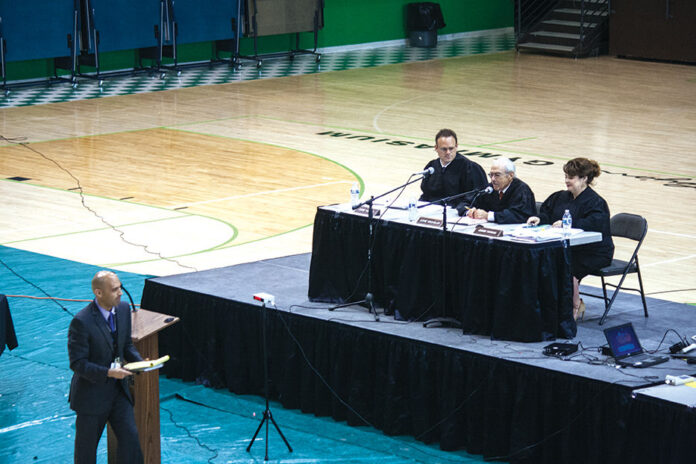
A three-judge Appeals Court panel held court in the Pojoaque Valley High School, April 6, with a hundred students bearing witness.
Appeals Court judges James Wechsler, Miles Hanisee and Julie Vargas heard arguments from a Bernalillo County drug trafficking case as a part of their effort, conducted over the past seven years, to educate students and the community about the Appeals Court’s role in the judicial system.
By holding real oral arguments in the school, and answering questions afterward, students were able to see what the Appeals Court does and what role it plays in the justice system, event organizer Angelique Herrera said.
Herrera is the paralegal for Appeals Court Judge Tim Garcia.
“The reason we do it is to get the students involved,” she said. “We don’t want any of them to get in front of us (as defendants).”
The judges were hearing a prosecutor’s appeal of an order to suppress evidence gained through what they found was an illegal search.
On May 5, 2012, Johnny Ray Ortiz lost his wallet at the Sandia Casino, even though he had been banned from the casino in 2007. Sandia Pueblo tribal police officers found Ortiz on the property, handcuffed him and put him in a police car. They asked to search his car and he denied them permission, according to court documents.
The officers then conducted an extensive search of his vehicle, finding evidence of drug trafficking, and had other officers arrest him on further charges, according to court documents.
After an hour-and-a-half of oral arguments at the high school, the judges retreated to a closed room to briefly confer and, after five minutes, came back and rendered their opinion.
They told the audience of students, teachers and administrators, that they were upholding a District Court judge’s order to suppress evidence gained through an illegal search and seizure.
Wechsler made the announcement to the gym, that the order in the ongoing case was being upheld and that Ortiz’s de facto arrest, followed by the extensive search of his car without a warrant, violated his Fourth Amendment rights.
When asked for questions, few students raised their hands and instead, the judges began to talk about what made them want to become lawyers and encouraged the students to follow them into law careers.
Hanisee told the students that the panel’s decision is a reflection that they, as citizens, have a right not to have their person or vehicle searched without their consent.
Vargas expounded on the differences between the Appeals Court and the trial court.
“At trial court, they’re telling a story, telling it from beginning to end,” she said. “When it gets to us, it’s very (specific) issues we’re worried about.”
In an interview after the decision, Vargas said she enjoys letting the students, many of whom are in the school’s mock trial program, see what the Appeals Court actually does.
“It’s great to show them because most people don’t know about (what we do),” Vargas said. “We’re up there doing a job, and I hope it interests them.”
Amalia Armendarez, a junior at the high school, said she was not able to attend the briefing before the oral arguments, but she quickly understood the nature of the arguments.
She said she joined the mock trial team because she has been through the family court system and wants to become a lawyer advocating for the interests of children in the system.
“A lot of (lawyers) are there because it’s another profession, not because of the kids,” she said, referring to the family court system.
She said she could understand both arguments being presented, but the defense had a more convincing argument.
“I thought it was cool, especially since I’ve (never) seen actual court hearings,” she said.
Seeing the appeals court judges and appellate attorneys in action, opened another possible career path for her, outside of family law.
“I could really see this as another possible profession, another opportunity to right possible wrongs and to make sure justice is being served,” Armendarez said.
Fellow junior Anyssa Villalovos, also in mock trial, said, were she a judge, she would have sided with the prosecution.
In her view, Ortiz was never arrested and being placed in the police car was just a standard practice for his own safety.
“The cops did act in the right,” Villalovos said.
She said we live in a new era of violence against the police and that should allow for a less strict reading of rights under the Fourth Amendment.
Eli Sanchez, a senior in the mock trial program, said he would have sided with the defense and upheld the motion to suppress.
“The defense argument was pretty solid,” he said. “The big issue was his Fourth Amendment right that didn’t allow them to search the car. They presented that pretty well.”
Sanchez said it was bothersome that Ortiz, who was trying to find his lost wallet, had been detained at all, let alone arrested and his car searched.
“It’s morally wrong,” he said, referring to the officer’s behavior. “He was not doing anything wrong. He wasn’t violating any law or causing any problems.”
Herrera said she chose Pojoaque to host the arguments because she is a former graduate and because an attorney with the Court of Appeals has a daughter who goes there.
“I think it went good,” Herrera said. “I liked that we went before, to the students, and talked to them so they understand what’s going on.”
She said the Appeals Court does the outreach so more students can understand how the justice system works and that they have a right to appeal.
“It’s giving back to the community, as well,” Herrera said.
She said she aims to set up four oral arguments in schools across the state, each year.
“I thought it was great that the judges ruled from the bench,” she said. “It’s not often they do that.”