District Technology Getting Updated

Published:

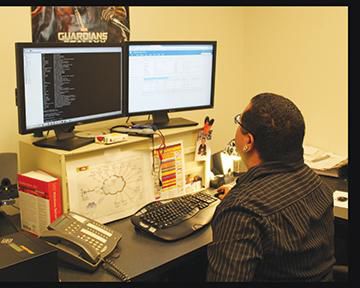
    Despite shortages in staff and challenges addressing outdated infrastructure, the Española School District’s technology department is close to completing a number of projects aimed to improve systems throughout the 14-school District.

    The improvements include replacing network switches and WiFi upgrades, upgrades to its business information system and an update to the student information system

    “None of these projects are frivolous,” Network Administrator Luis Peña said. “We have all these systems that are getting old and the challenge has been to complete them in a sequence that makes the most sense.”

    Peña said over the course of a few years, the District downsized the department from 12 staffers to four and the department has been taking on the biggest projects with about a third of the staffers they once had. Technology Coordinator Andrew Trujillo said staffing was adversely affected when the Los Alamos National Laboratory Foundation grant, which previously funded the department, ran out.

    “If I have 12 things to do one day, and I get eight of them done, that’s a good day for me,” Peña said.

    Peña said the department upgraded switches to provide connectivity to school buildings. He said the Partnership for Assessment of Readiness for College (P.A.R.C.C.) was the catalyst for addressing the District’s technology issues, as was the New Mexico Public Education Department’s big push toward Broadband connectivity and a new Internet standard of 1 megabit per second, per student, by 2018.

    The network administrator said providing the infrastructure to District sites is the first step in addressing the aging infrastructure. He said changes in the federal e-rate program allowed the District to get reimbursed 85 cents on the dollar and purchase the switches. The program provides discounts to help schools and libraries through the school and libraries program, under the aegis of the Federal Communications Commission.

    “We went through the usual request for proposal procurement process and were able to score the vendors,” he said. “We selected VLCM out of Rio Rancho and we were able to provide wireless access points for every school.”

    In addition to firmware upgrades and battery backup systems, Peña said the department was able to perform a wide area network upgrade through Windstream. The District was previously working with Cyber Mesa, but leveraged e-rate funding to extend fiber optic conduits during the summer months.

    Peña said the federal government had not been funding the e-rate program at the same level as previous years, but in fiscal year 2015-16, the District received $690,000 in e-rate funds. This allowed for 90 percent reimbursements in costs to long distance telephone services, Internet and site-to-site transports.

    “As it stands now, every site in the District is on high-speed Internet,” he said.

    Technology staff worked with Windstream  over the summer to use all the copper wiring at schools like San Juan Elementary, to create one massive connection.

    “We hope to get fiber to all the sites still on copper,” Trujillo said.

    According to a report on Internet connectivity in rural areas released by Education Week, over the past two years, the country has made huge strides in connecting schools, including those in rural areas. More than three-quarters of districts nationally, now provide at least adequate Internet access, according to a new analysis by the broadband advocacy group EducationSuperHighway.

    The District considered spending $50,000 to purchase a new Voice Over Internet Protocol phone system at technology work sessions last year. Another option would require a $200,000 upgrade of hardware and software, while a third alternative recommended by the technology department after a Districtwide assessment by Española-based vendor Computer Assets, totals $295,000 for new Voice Over Internet Protocol phones. 

    Trujillo said the District is still considering which option they will select and figuring out funding sources for the phone system upgrades.

    The department contracted Computer Assets for support of the new network, redesigned on June 24, 2015 at a cost of $15,571.

    Peña called the student information system one of the most important projects the Department has been working on because it encompasses all aspects of student participation, including grades, attendance and reporting and tracking. He said he hopes to have the system up and running by the time summer school starts. 

    Another system recently implemented by the department is the lobby guard system, which replaced the District’s outdated scanners with an upgrade for both the lobby guards and front desks at Española Middle School and Española Valley High School. The system scans visitor’s driver licenses for added security, tapping into the national sex offender database.

    “What we found out is, we were having parents come up to the campus, but only one license was scanned,” Peña said. “Often there were two people in the vehicle, but only the one driver’s license was being scanned.”

    Peña said the situation has been rectified by the addition of two additional scanners at the front desk level, at both the high school and middle school.

    The pilot system may be soon pushed to all the District school sites. He said with the addition of two new schools to the District (Alcalde and Fairview Elementary), and the renovation of the Los Niños Kindergarten Center, the District discovered that the new buildings are designed with a significant amount of technology for building controls and automation.

    For example, Fairview Elementary has IP-based surveillance cameras and systems, network-based physical access and lighting controls, and network-based temperature monitoring for walk-in freezers.

    District officials are also in the process of redesigning their website. As previously reported in the Rio Grande SUN, Wolfman Brothers Web and Print Services entered into a professional services agreement with the District to have a complete redesign of their website launching on July 1.

    Superintendent Bobbie Gutierrez said the cost of the redesigned website, which will include a content management system, would be covered by e-rate funds. Rio Arriba County Commissioner Barney Trujillo, contracted to market the District through his 2Smooth Advertising firm, is also involved in the redesign.

    Barney Trujillo was paid $4,166 by the District for advertising and marketing support last month, while John Romero, doing business as Wolfman Brothers Inc., has been paid $2,000 for website maintenance, management and support since September 2015.

    Andrew Trujillo said the website is in the design stage and the web consultants are looking into web hosting options.

Related articles

Recent articles

Weave a Mug Rug