Española Hospital is doing a better job of preventing difficult-to-treat hospital infections than health care facilities elsewhere in New Mexico — and the United States — federal Health and Human Services documents show.
The documents, based on 2008 patient surveys, show that for key practices that can stop the development and spread of antibiotic-resistant infections — administering antibiotics before surgery, ensuring they’re the proper antibiotics and stopping antibiotics within a day of surgery — Española Hospital has outperformed other hospitals (see sidebar on page A7).
Giving patients the wrong antibiotics — or the right antibiotics in the wrong amounts or at the wrong time — can breed bacterial strains that are immune to antibiotic drugs.
Indiscriminate prescribing of antibiotics has contributed to a worldwide epidemic of drug-resistant infections. In the U.S., over 90,000 Americans die each year as a result of hospital infections, and more than half of those cases involve drug-resistant infections, according to the federal Centers for Disease Control.
Española Hospital Administrator Derrick Yu credits his hospital’s small size and low staff turn-over as part of the reason Española scores higher than other hospitals on infection-prevention practices.
“This hospital is far better than the others I’ve worked at in other states,” Yu said. “Turnover (of staff) is very low because many employees are local people. There’s a lot of teamwork between doctors and nurses here. Most hopsitals have revolving doors that don’t allow much team-building. Many use temporary Emergency Room doctors. We employ our own ER docs.”
Yu and Española Hospital Infection Control Nurse Susan Wagner are quick to admit that the hospital also has relatively few of the patients — like burn and cancer patients — who are at highest risk of becoming infected with methicillin-resistant Staphylococcus aureus bacteria (MRSA, pronounced “mersa”) or other drug-resistant bacteria.
But under the guidance of Wagner, who was the Presbyterian system’s first accredited infection control nurse, Española Hospital has also taken aggressive steps to prevent the development and spread of hospital infections. Medicine bottles are dated to note when they were first opened and staff who touch patients are not allowed to wear artificial or long finger nails that could harbor bacteria.
Española Hospital was years ahead of much of the rest of the nation in tackling the threat posed by MRSA and other hospital infections. Wagner attributes that to a 1989 MRSA outbreak among patients arriving at the hospital from the Española Valley Nursing Home, she said.
“Our lab people and physicians worked with the state Health Department to develop an oral antibiotic treatment regimen,” Wagner said. “Six months later, we cultured the treated residents at the nursing home and they were negative. Their infections were gone. But others had become infected.”
Over the next few years, Wagner sought special training and became an accredited infection control nurse. To this day, patients arriving from nursing homes are tested for MRSA. Wagner said. Those who test positive are isolated from other patients to avoid spreading the bacteria.
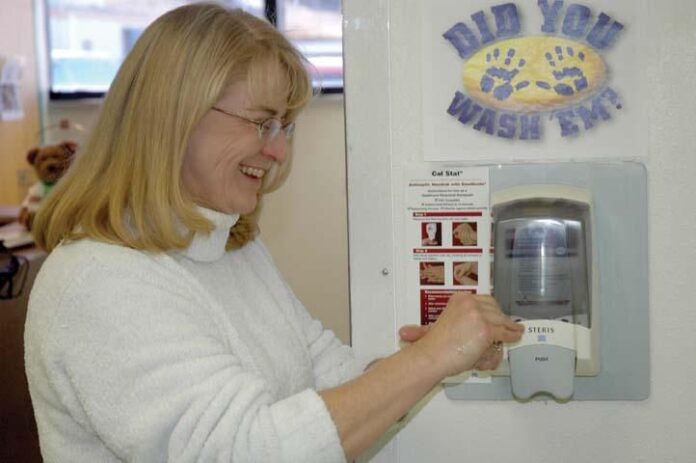
“We started installing alcohol gel dispensers in the summer of 1992,” Wagner said. “We initially installed them in patient rooms for doctors and respiratory therapists. It’s been proven that they work if you put where they are easy to get to, so soon after that we started including them in hallways, trying to use signs to get visitors to gel too. Housekeepers check dispensers to make sure they’re full and working. We put a lot of effort into educating new employees.”
Using alcohol-based hand gels with emollients to prevent skin drying and cracking, allows faster hand cleaning than soap and water, Wagner notes. It also improves staff compliance.
Wagner said nationwide, between 42 and 50 percent of hospital employees comply with federal hand hygiene rules.
“That is just appalling in a health care setting,” Wagner said. “So we conduct monthly audits. Staff know that if I’m there, they’re being watched — but I have them fooled because others (on staff) are keeping track too. We’re not just watching nurses and doctors. We audit everybody — including volunteers and candy-stripers. It’s a mind-set.”
Nurses approached in the hallway — and who asked not to be named in the SUN — confirmed they “never know” when they’re being watched, causing them to use the alcohol gel more frequently than they might otherwise.
“Infection control is compulsory training,” Española Hospital Director of Adult Volunteer Services Mary Beth Shymkus said.
The result of this vigilance has been an absence of hospital-acquired MRSA at Española Hospital since the 1989 outbreak, Wagner said.
“I think it’s a great program, a great idea to prevent the spread of viruses,” outpatient Priscilla Baldonado said. “I feel more confident as a patient knowing they do that.”
Wagner is quick to note, however, that patients already colonized with community-acquired MRSA are a frequent occurrence in the emergency room. Community-acquired MRSA is genetically distinct from hospital-bred strains of MRSA.
“People often think a MRSA infection is a spider bite,” Wagner said. “We see MRSA abcesses in IV drug users; 49 percent of staph bacteria we culture from patients is drug-resistant, is MRSA (see sidebar).”
In addition to encouraging — and monitoring — good hand washing practices at the hospital, Wagner pushes staff to get vaccinated against flu viruses. Yu twice ducked the question of whether or not he was vaccinated, but Wagner said staff physicians and most other hospital employees, including herself, do receive free immunizations.
“We offer all employees free flu shots and tuberculosis screening each year,” Wagner said. “And at the annual Health Fair, we give 400 free (immunization) shots to the community.”
The surgery-related antibiotic practices tracked by the federal government — administering the right antibiotics to patients within an hour of surgery and then stopping that antibiotic therapy within a day of surgery — has been key to avoiding hospital-bred outbreaks of MRSA, Wagner said.
“Getting the right concentrations of the right antibiotics into the tissue before cutting is key,” she said. “Depending on the surgical site, different antibiotics are needed.”
Bowel surgery would use different antibiotics than heart surgery because of the different bacteria likely to be encountered, for example.
“Third is timing,” Wagner said. “Not to prevent infections so much as to prevent the emergence of drug-resistant strains. So we discontinue within 24 hours of surgery. We have preprinted order sets of standard operating procedures, sort of like cook books. This surgery requires so much of that antibiotic for so many hours.”
From Española Hospital, hand hygiene and other anti-infection practices have spread throughout Presbyterian hospitals in New Mexico, Yu noted.
“We have monthly teleconference meetings between all the hospitals,” he said. “We learn from them and they learn from us.”
Even Presbyterian’s administrative offices in Albuquerque are now equipped with hand gel stations, Presbyterian Marketing and Communications Director Gayle Sumner said.
Presbyterian Hospital in Albuquerque scored higher than Española Hospital for the percentage of surgery patients given antibiotics within an hour of surgery (98 percent versus 94 percent) and the two hospitals tied (at 98 percent) for the percentage of surgical patients given the right antibiotic to prevent infections for their type of surgery. Española did better than Presbyterian in Albuquerque (96 percent versus 92 percent of patients) when it came to stopping antibiotics within a day of surgery in order to prevent the emergence of drug-resistant bacterial strains.
The state Health Department announced Sept. 24 that Presbyterian Hospital in Albuquerque is one of six New Mexico hospitals participating in a pilot project to track hospital-acquired infections. The other hospitals participating in the project are the San Juan Regional Medical Center in Farmington, the University of New Mexico Health Sciences Center in Albuquerque, the Gerald Champion Regional Medical Center in Alamogordo and the Memorial medical Center in Las Cruces. Data from the project will be kept confidential until a Department committee decides the best way to interpret it for the public, according to a press release.
Española Hospital outperforms other New Mexico hospitals — and the national average — at preventing the emergence and spread of the antibiotic-resistant “super-bugs” that plague many U.S. hospitals, federal Health and Human Services Department records show. The data, based on patient surveys, measure hospital performance on three key practices that reduce drug-resistant infections: giving patients antibiotics within an hour of undergoing surgery, using the correct antibiotic for different types of surgery and stopping antibiotics within 24 hours of surgery.
Below, Española Hospital’s performance is compared to that of Los Alamos Medical Center, St. Vincent Hospital in Santa Fe, University of New Mexico Hospital in Albuquerque, and the New Mexico and U.S. averages for all hospitals.
1. Percentage of patients given antibiotics before surgery:
Measure
Española Hospital Los Alamos St Vincent UNM State United States
1. 94 percent 67 91 49 76 85
2, Percentage of surgery patients given correct antibiotic to prevent infection
Española Hospital Los Alamos St Vincent UNM State United States
98 percent 90 94 96 86 92
3, Percentage of surgery patients for whom antibiotics are stopped within 24 hours of surgery to prevent bacteria from developing drug resistance
Española Hospital Los Alamos St Vincent UNM State United States
96 percent 76 90 68 83 83
Is it really a spider bite?
Community-acquired methicillin-resistant Staphylococcus aureus (MRSA, pronounced “mersa”) infections are becoming more common, although the federal Centers for Disease Control has no exact numbers on how many Americans are infected each year.
Because they tend to abscess or appear as a red boil, community-acquired MRSA infections are frequently mistaken for spider bites. In reality, they are highly infectious infections.
Intravenous drug use is a risk factor, according to recent studies at the University of California in Davis, Calif.
The Centers for Disease Control emphasizes the “4 C’s” of infection risk: (skin) contact with infected individuals, contaminated surfaces, crowding, and cleanliness. Frequent, thorough hand washing with soap and water is the best defense against this and most other infections, according to Centers for Disease Control documents.
Most people whose skin becomes colonized by MRSA will not become ill. But if colonized skin is cut, punctured or scraped, an infection can result in painful red pustules that do not heal on their own. The liquid from these pustules is infectious and can spread MRSA to others. If the infection reaches the bloodstream, a deadly toxic shock syndrome can result. At highest risk of life-threatening infection are elderly people, those with impaired immune systems — including HIV-positive individuals and cancer patients undergoing chemotherapy — and people with compromised skin barriers, like burn victims. Living with an infected person is another risk factor for infection, particularly when skin-to-skin contact occurs or showers and towels are shared. MRSA has spread in jail and sports lockerroomS, according to the Centers for Disease Control.
Suspected spider bites, painful swelling, skin pustules, abscess or boils at the site of cuts and abrasions or at areas of the body covered by hair should be carefully examined by a doctor.