Exploring the Diverse World of Serigraphy

Published:

Steven Sonheim became interested in serigraph/silkscreen printing while he was a student at The University of New Mexico in 2018. He had visited an exhibition of prints at a gallery near the campus and became enamored with the process.

“I feel as if it’s a very democratic way to make some very sophisticated fine art prints,” Sonheim said. “By ‘democratic’ I mean it’s a low-cost, low-tech way for almost anyone to create some high-end art and in a world where things are becoming more and more expensive, cost is a factor to be considered.”

Serigraphy 101

Serigraphy is a fancy term for silkscreen printing, coming from “seri,” which is Latin for “silk,” and “graphos,” which is Ancient Greek for “writing.”

The word was coined early in the last century to distinguish the artistic use of the medium from its more common commercial purpose. Silk screening is familiar to us in countless ways. It is used for everything from T-shirt logos to posters. The medium’s roots lie deep in ancient history, originating in China and Japan as a technique for applying stencils to fabrics and screens.

In that respect, silk screening is allied to woodblock printing, which first arose in those countries for similar ends. Both techniques were adopted by European artists and artisans in the 15th century and were developed further for a wide variety of decorative and artistic applications.

silk screening, as we know it, however, dates only to the early years of the 20th century. In 1907, Samuel Simon of Manchester, England, was awarded the first-known patent for the process, which quickly gained wide use in commercial applications.

But it wasn’t until the mid-1930s that the medium’s artistic potential was recognized by a group of Works Progress Administration (WPA) artists in the United States. That is when true fine art serigraphy was born.

Serigraphy came into its own in the 1960s with the advent of Pop Art and Op Art. Artists such as Andy Warhol, Robert Rauschenberg, Josef Albers, Peter Max, and Richard Anuzkiewicz saw the medium’s commercialism — which previously worked against its artistic acceptance — as a positive asset.

These painters, among others, exploited serigraphy’s technical potential and cultural associations, attributes that resonated with the spirit of the times.

How Serigraphs Are Made

Serigraphy has proven extremely popular, especially with younger artists, because the general process requires a minimum amount of equipment and materials, unlike most other forms of printmaking.

The medium is incredibly forgiving, easy to master and adaptable. Serigraphy has an almost chameleon-like quality because it can utilize so many different related materials and techniques.

At its most elementary level, serigraphy involves covering portions of silk or a similar material with a coating. First, the silk is stretched on a frame attached with hinges to a baseboard. Then, the window for the image is masked with tape, and a coating of shellac or glue is applied.

Any part of the silk left exposed becomes the design through which ink or other pigment such as paint is pressed using a squeegee or brush. This simplified description hardly does justice to the technical flexibility and artistic versatility of the medium.

For example, the design can be transferred from an original study using photography, or lacquer film can be substituted for silk. Although most serigraphs are from negative stencils that are the reverse of the finished print in appearance, a positive stencil that looks just like the final product can be made from the same greasy inks (known as tusche) used in lithography.

In serigraphy, multiple colors are often involved, each color being applied separately to achieve a perfect image. The technical possibilities are almost limitless, as are the effects, which range from flat, simple colors to richly textured surfaces.

Sonheim majored in biology at UNM and minored in studio arts.

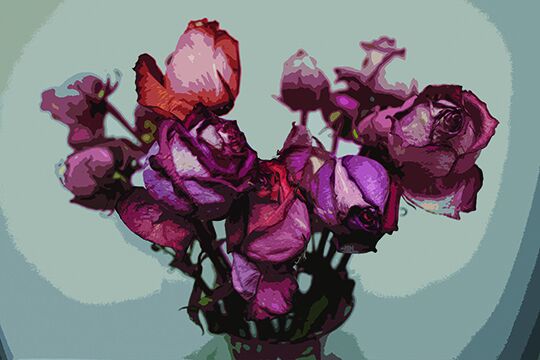
“My biology background, with an emphasis on botany, has influenced my choice of subjects for my serigraphs,” Sonheim explained when discussing two of his prints in his studio at his home a few miles from Truchas. “One is a group of dried flowers I say in a vase one day and the other is an iris with some water droplets I encountered while on a hike in the Jemez Mountains near Gallina.”

Sonheim’s work embodies the essence of the plants and flowers he works with, but at the same time adds a hint of abstract, which adds to the allure and mystery.

“I first started with prints that were extremely realistic, but as time went on, I thought the added abstraction made for more compelling images,” Sonheim said.

Although Sonheim loves botanical subjects, he’s created New Mexico landscapes and a few wildlife images; particularly avian (bird) subjects.

“I can’t imagine botanical images not being captivating, but that is certainly my prejudice,” Sonheim said with a laugh. “But aside from subject matter — and it could be almost anything — I truly love the — and I’ve said this numerous times previously — the ‘democratic’ aspect of the medium.

“I recommend trying it to anyone,” Sonheim concluded. “Particularly children. When I’ve held informal workshops, the children were particularly fascinated with the images they created.”

Related articles

Recent articles