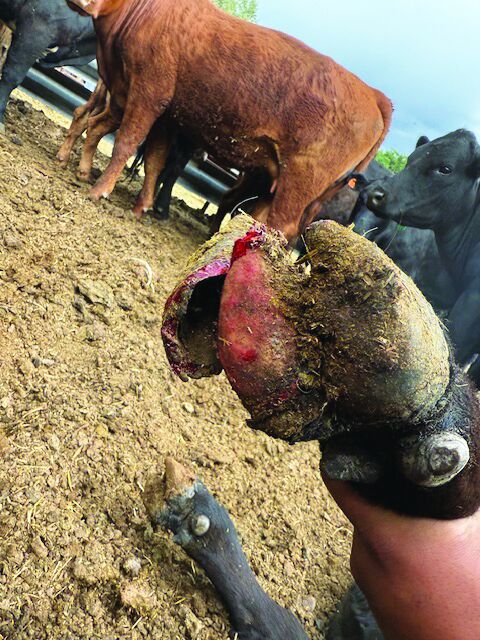
The Laguna Fire has burned 17,413 acres of the Santa Fe National Forest since lightning ignited it on June 25. Now at 78% containment, it has left a trail of burned cattle and the Rio Arriba County community flaming with distrust of the U.S. Forest Service.
A July 21 letter from 3rd Congressional District U.S. Representative Teresa Leger Fernández, D-N.M., echoed the community’s vocal disapproval of how the fire was handled.
“The livestock in these herds are more than mere farm animals, they are the livelihood of our rural communities in New Mexico, and represent the lifeblood of our entire way of life in Rio Arriba County,” Leger Fernández wrote in a letter addressed to Forest Service Chief Tom Schultz. “New Mexicans will feel the damage from this fire for generations to come.”
Her letter emphasized the long-term damage caused by the fire, as well as the ongoing risk to historic sites, including a church and cemetery, which are still threatened by the Laguna Fire.
Following the initial ignition in late June, the fire wasn’t immediately suppressed by the Forest Service. Instead, the Forest Service opted to let it burn in a planned controlled perimeter, treating it as a de facto controlled burn.
“Safety drives every decision we make,” the Forest Service said in a statement to the Rio Grande SUN, citing a 13,000-acre containment perimeter that was set to “reduce intensity and protect water systems, guided by expert analysis of terrain, weather, fuels, and public risk.”
But when the fire jumped the containment lines on July 11, it roared out of control, devastating French Mesa and beyond. Leger Fernández was blunt in her letter to the Forest Service, sharply questioning its decision to manage the fire rather than fully suppressing it.
“Given the ongoing drought conditions throughout the Southwest and lack of snowfall received in the area over the previous winter, why did the Forest Service decide not to fully contain the fire, despite these ongoing risks?” she wrote. “Why was the strategy of full containment not a top priority?”
Her letter also questioned whether staff cuts played a role in the fire’s eventual destruction, demanding headcounts for the Santa Fe National Forest and the Southwestern Region Office for June 2024 and June 2025. In a statement to the Rio Grande SUN, the Forest Service stated that the fire was “fully staffed,” but did not give headcount numbers.
Additionally, Leger Fernández specifically questioned the Forest Service’s communication, or lack thereof, with local ranchers.
“What actions did the Forest Service take to communicate with local ranchers whose cattle were grazing on Forest Service land within the fire area?” she wrote.
The Forest Service said in a statement to the Rio Grande SUN that it informed permittees “immediately,” and provided daily updates and maps.
“Misconceptions persist,” the Forest Service said, arguing that “strategic use of natural fire helps prevent future, more destructive wildfires.”
The Forest Service pointed to USDA programs like the Livestock Indemnity Program and Livestock Forage Program, along with support from Rio Arriba County Cooperative Extension, as lifelines for ranchers.
Tort claim guidance was also offered, the Forest Service said. Though, for many in Rio Arriba County, no compensation can replace what’s been lost, Leger Fernández said.
“The forests that have burnt to ashes are integral to the culture, history, and economy of the communities embedded in them,” she said. “Did the Forest Service consider these historic sites when it made its fire management decisions?”
The fire now approaches 80% containment, with 17 personnel still on the scene, according to an Aug. 3 update from the Forest Service.
The Burned Area Emergency Response team has mapped soil burn severity and firefighters are patrolling while repairing suppression damage. But for Leger Fernández, along with many locals, the scars cut far deeper than the charred landscape.
“I hoped that the Forest Service could make strides in the long process of restoring the community’s trust,” she said, referring to her 2022 letter to then-chief Randy Moore, following the Hermit’s Peak/Calf Canyon Fire. “This (Laguna Fire) incident indicates the Forest Service is failing.”