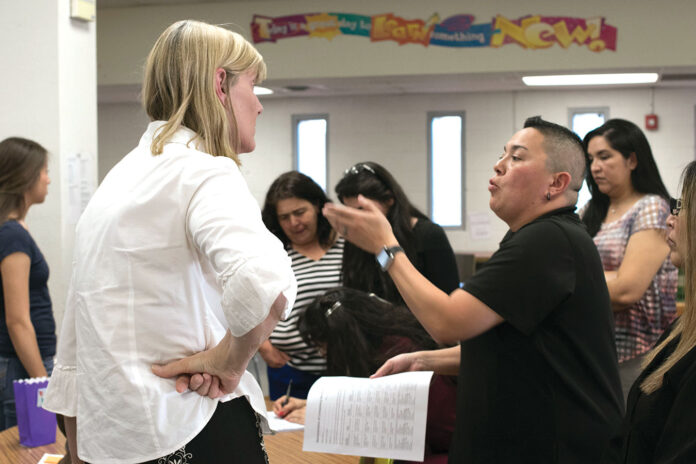
A standing-room-only crowd packed Española Valley High School’s library, March 21, to find out why they were just learning, approximately two months before commencement, that some students may not have the credentials needed to graduate.
Approximately 150 parents, guardians, and high school seniors attended the meeting to learn what could be done to ensure the students won’t miss out on their diploma.
Many students, the exact numbers isn’t clear, learned on March 13, that their Partnership for Assessment of Readiness for College and Careers (PARCC) and Standards Based Assessment (SBA) scores weren’t good enough for them to graduate.
The Partnership for Assessment of Readiness, which is designed to measure a student’s math and English proficiency, including reading and writing, and the Standards Based Assessment, which measures science competency, serve as the state’s version of high school exit exams.
However, poor test scores rarely translate to a student not graduating, because state law allows students to make up those poor test results through other means called Alternative Displays of Competencies.
A student can make up those poor scores a number of ways, including receiving favorable scores on the Accuplacer, or college entry exams, ACT and SAT exams. The seniors can also receive credit by earning favorable scores on their Advanced Placement course work or state-approved end-of-course exams in the five core areas of reading, math, writing, science and social studies.
The Española seniors who don’t secure their graduation requirement through either of the aforementioned paths, can make up those test scores with an acceptance letter from one of the state’s four-year colleges.
However, parents expressed concern because District officials were having trouble accessing last year’s test and classroom data, which is needed to determine if a student has to seek an alternative route to get enough credits for a diploma.
High School Counselor Evelyn Martinez attributed problems accessing the data to a change in the District’s content management system.
“I am attempting to access the grades from PAW (Parent Accountability Web),” Martinez told the crowd of parents and students. “We had a different system last year and our student information didn’t roll over from the grades area. The transcript grades came in, but not class grades, like final exam grades or class final grades. I don’t know why, but we are still researching how we can get those exam grades.”
Since the meeting, Martinez has been able to gain access to last year’s data.
One unnamed parent who attended the meeting, said much of the confusion and panic centered around unclear information. She said her daughter panicked because she didn’t realize some of her final exams and other course work could be counted to show competency.
“It was not explained that a final exam grade on these different (core) areas with a C or better would fill the requirement,” the parent told Martinez.
Martinez told parents she would systematically go through the senior class files to determine what each student needs to graduate.
“I am going student by student,” Martinez said. “I have three spreadsheets I am looking through right now.”
Española parent Marissa Roybal said she has, on numerous occasions, attempted to speak to Martinez about her child’s graduation status, but hasn’t had any luck reaching the counselor outside of the March 21 forum.
Roybal expressed concern about Martinez not having enough time to review the remaining files before the final bell sounds on the school year.
“When will that information be ready?” Roybal asked. “Even though you are working on it, when will it be ready? May is just around the corner.”
Martinez assured Roybal and the other parents that the file reviewing would be finished by April, which, for Roybal, was cutting it pretty close.
High School Principal Robert Archuleta told the parents that regardless of how it may look, he is confident that the majority of students won’t run into any obstacles and will be able to graduate with their class.
“There is no reason we can’t comply with a hundred-percent of that (the alternative displays) except for the kids that didn’t meet the 24-credit requirement,” he said.
Several of those in attendance wanted to know why the test scores didn’t come from the state sooner.
Archuleta said he couldn’t answer that question, but would pass the information along to state regulators, but couldn’t guarantee that they would be responsive.
“Those assessments are done by the state,” he said.
District Associate Superintendent of Instruction Myra Martinez said she hasn’t had a chance to review the data to pinpoint exactly why the students may have performed poorly.
“PARCC is in the third year and they only have had two opportunities to take the PARCC in their sophomore and junior year,” she said.
District parent Evelyn Dixon said while the high school’s presentation may have provided comfort for some parents, she is reluctant to take it on face value, especially as it relates to her son.
Dixon said she will make an appointment to speak with Martinez about her child’s progress.
Acceptance letter
During the fall of 2016, Northern New Mexico College received a record number of applicants from high school students — 461. But when it came time to register, only about 149 of the 461 students that received admissions letters registered for classes.
That number is nearly 300-percent more than the 157 applications Northern received from high school seniors in 2015.
Northern Provost Ivan Lopez-Hurtado told the Board of Regents, in October 2016, he believes the influx of applications represented students who were attempting to manipulate the system so they could fulfill an alternative graduation requirement.
“Unfortunately, some students were using us for this purpose,” he said. “That creates a huge load on our admissions staff.”
A Public Education Department official said a college acceptance letter does not fulfill the alternative display requirement by its self.
Unlike its counterparts, New Mexico Highlands University and the University of New Mexico-Los Alamos, Northern is an open-enrollment college, which means students do not have to maintain a certain grade-point average to show they are capable of doing the required work.
While Northern won’t be able to stop students who have no intention of registering, from applying, they hope the $25 application fee they imposed in October 2016 will deter students from frivolously applying.