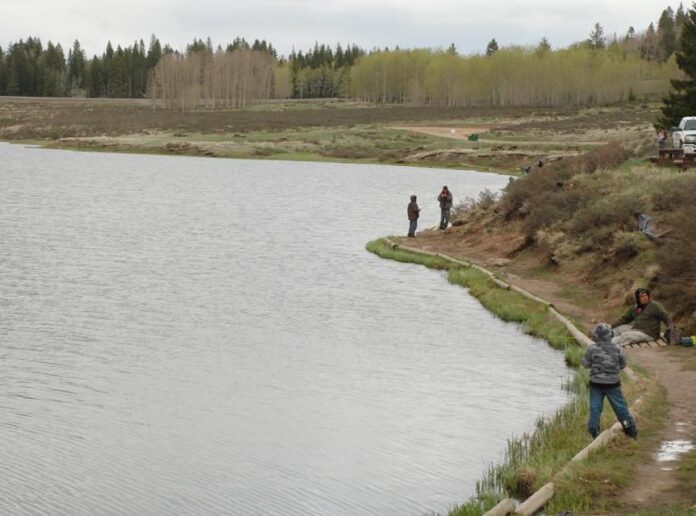
Lying nearly 10,000 feet above sea level, Hopewell Lake normally stays iced over and locked in by deep snow drifts until early May. When winter finally releases its grip on Northern New Mexico’s mountains, this little 14-acre gem offers a cool getaway from the increasing heat of the valleys.
Despite its small size, Hopewell delivers big when it comes to trout fishing. The state Game and Fish Department stocks the lake with catchable-size rainbow trout averaging 9-10 inches in length, but the real prize is the brook trout. These red-spotted beauties reproduce naturally in Hopewell, and they can measure 15 to 16 inches.
Brook trout are native to the eastern United States, but have been widely planted throughout the nation. Actually a char rather than a true trout, they prefer slightly cooler waters. They found the high country of the western United States to their liking and have established naturally-breeding populations throughout the Rockies.
Many people prefer the taste of brook trout to that of the hatchery-reared rainbows. When cleaned, brookies often have richly-colored orange meat from their natural diet of aquatic insects, leeches and snails. Hopewell is rich in trout food.
You’ll see practically every angling technique being used at Hopewell, from anglers soaking power bait on the bottom to fly fisherman tossing small dry flies. Small spinners can be effective as well, especially early in the season.
Power bait and salmon eggs dangled on the bottom will certainly fool many a hatchery rainbow, but they’re not the best techniques if you’re after brookies. The lake supports substantial weed growth that gets heavier as the summer progresses. Fishing on the bottom will likely end with your bait buried in the weeds.
Fishing with a bobber will suspend your bait above the bottom. Worms are a good choice because they seem to be more attractive to brook trout than prepared baits, although worms will entice plenty of rainbows too.
Perhaps the best angling at Hopewell occurs at dusk, when increased insect activity brings the fish to the surface and the lake becomes dimpled with the rises of feeding trout.
That’s the time to start using flies. If you’re using spinning gear, a small, clear plastic bobber filled with water will give you the needed weight for casting small flies. You should have the fly on a leader about 3-4 feet behind the bobber. Some of the flies that work well are the Warden’s Worry, the Humpy and Irresistibles.
Since the banks of Hopewell are free of trees, fly fishermen have plenty of casting room. Skilled casters can find fish biting on nearly every cast.
One angler I know always tries to fish Hopewell’s evening rise on his birthday. It’s his gift to himself.
Fishing from a belly boat or a canoe can also be effective. Be aware that only boats with electric trolling motors or hand-propelled motors can be used at Hopewell, and there is no boat ramp.
There is no camping right at the lake, but Hopewell Lake Campground is close by with good campsites for $10 a day. There is no electricity or running water.
Come prepared for inclement weather — Hopewell can be chilly at any time of the year due to the elevation, falling into the 30s even on mid-summer evenings and well below zero in late fall and winter. Summer thunderstorms are frequent and snow can fall 10 months out of the year.
Hopewell Lake lies on Highway 64 between Tres Piedras and Tierra Amarilla in the Carson National Forest. The drive through the mountains is spectacular, particularly in the fall when the aspen trees turn golden. Wildlife is abundant, and deer and elk can frequently be spotted along the highway.