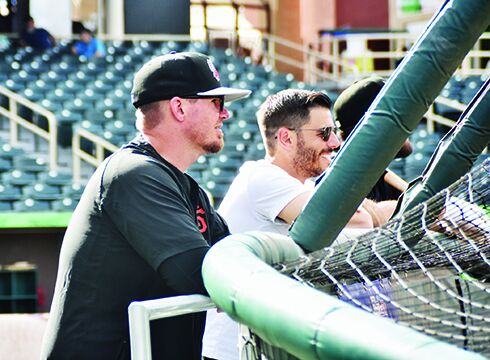
ALBUQUERQUE — It’s a long way from the Pojoaque Valley baseball field to the major leagues, but former two-time Elks coach Robert Riggins is just one step away.
Along the way, it’s been quite a trip for Riggins, who is originally from Raton and bounced around the state before finishing his prep-playing days in Clovis, where he led the Wildcats to the Class 5A state championship game in 2004.
He was recently back in New Mexico as the first base coach and assistant hitting coach for the Sacramento River Cats — the top farm team for the San Francisco Giants — as they played the Albuquerque Isotopes.
And that right there shows just how strange this story is.
“So what’s kind of weird is, I was a pitcher my whole life, and here in New Mexico, I mostly focused on pitching, and I was a pitching coach for most of my years here,” the 40-year-old Riggins recalled in an interview in a busy tunnel underneath the stands at Isotopes Park.
But he was also a student of the game and he wrote a master’s thesis dissecting hitting physics, swing-attack angles and their in-game correlations. Then he posted his findings on his website, Baseballtheory.com.
Surprisingly, it got noticed and in early 2020, the Milwaukee Brewers hired him to be an assistant hitting coach at the team’s spring training facility.
Sounds great, until it wasn’t, which was just about a week later, when all spring training facilities were shut for the pandemic.
“So I wrote that paper,” Rigging said. “The Brewers hired me as a development coach, and they said that I was going to focus on hitting. And I was like, I’ve never worked with hitters. I’ve mostly worked with pitchers. And they said you wrote that paper, you’ll be fine. So we were there for about 10 days, and then COVID hit and I got furloughed, so I didn’t really get to do much.”
Baseball wanderer
After graduating high school, Riggins went to Eastern New Mexico University, where he planned to pitch, until those thoughts were derailed by a heart condition diagnosis of bicuspid aortic valve and Wolff Parkinson white syndrome.
Riggins, however, was not to be stopped, instead earning a degree and setting out to be a baseball coach and teacher. And that led to a rather nomadic life around the state with stops at Lovington, Atrisco Heritage, Los Lunas and two different times in Pojoaque — 2013-14 and again in 2018-19. While with the Elks, he compiled a 24-84 record, but Riggins still retains found memories of those times.
“I just love the area,” he said. “I love the kids and the families, and I just felt like they were, I mean, they would do anything for me. They just wanted someone to care about them. The first time I left was because we were living in Rio Rancho when I was taking the Railrunner every day, and the days just got long, and we had a kid. I never got to see him.”
Then he came back for a second stint.
“So the second time, we were able to find a place in Santa Fe that’s why I wanted to go back, because I really enjoyed the area and the kids and the families,” Riggins said. “It was great.”
Coaching small town baseball, when the coach is usually waiting for the athletes to get off the basketball court before really getting to put together a team, had its challenges.
“Well, if you look it up, I wasn’t a very successful high school baseball coach, but I think what helped was I had to learn what actually mattered and what things would actually work,” he said. “Because waiting for those kids to get out of basketball, and it’s like, I’ve got six weeks to make this guy who’s never played to be my starting shortstop. And so you really had to figure out what has to happen, or what has to work. You don’t have time for stuff that isn’t useful. So I think that’s what helped.”
Bouncing
back, again
When COVID struck, Riggins was left with a family to take care of and no job.
“It was the second time that happened to me, because, like I said, my freshman year, I wanted to pitch in college, and I thought I could pitch professionally, and then they said, you’re done because of your heart issue,” he said. “And then it happened again, I got just the same feelings. I mean, you kind of almost pout a little bit, like, this isn’t fair.”
The family went to live with his wife’s parents in Texas and he took a job as a butcher and did other odd jobs, as well as provide individual hitting instruction for local players.
“That first year in COVID was pretty tough because it was hard to see a chance of going back,” Riggins said. “But I’ve always had this belief, and it kind of comes from my high school coaches and my dad … that if I just worked hard enough, that eventually, things would work out.”
That perseverance has been a blessing in his journey.
“I just thought, if I can’t make it as a player, I try to make it as a coach,” Riggins said. “And then, yeah, I did. And then it was like, well, what do I do now? But yeah, that first year of COVID was pretty tough because it was hard to see a chance of going back. But I just kept putting out research, and then talked to some teams, and just kind of slowly just worked my way out of it.”
He eventually got a coaching job at a junior college in Scranton, Pennsylvania, before the Giants got a sniff of his work, and there were some folks in the organization who were with Milwaukee during his micro-stint there so he was originally brought on with San Francisco’s Dominican Summer League team.
Then he advanced to a gig as the hitting strategist in the Dominican before becoming a Giants minor league hitting coach, just one stop away from the majors, a very long way from his days with the Elks.
“I’m very blessed with more than I deserve,” Riggins said. “I don’t miss having to fix the field before the game and chalk the field and fill the water buckets and tape up guys and make sure the umpires are taken care of. I don’t miss that. I’m very spoiled to not have to, like even after batting practice is over, I don’t have to tear the turtle down or anything. So (I’m) very blessed with the opportunities that we’ve been given, and the things that I have available to me at this point.”