Learning Computer Science through Hour of Code

Published:

Some students throughout the Española School District and Northern New Mexico spent a portion of their classroom time last week, learning about super computers and what makes them work, as part of Computer Science Education Week.

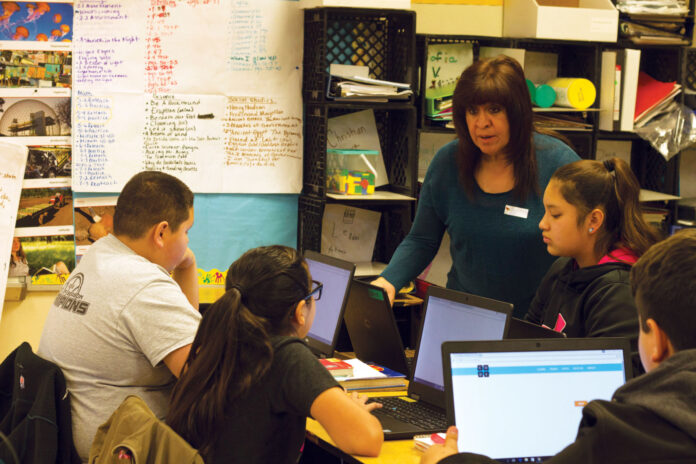
    A computer scientist and a support technician from Los Alamos National Laboratory, David Kratzer and Frances Castellano, respectively, dropped by Ruby Dominguez’s classroom, at Española Elementary School, Dec. 13, to give her sixth grade students a brief introduction to writing, what computer scientists refer to as code.

    Code is the language used to program instructions into computers to make them work.

    The visit was part of the annual Computer Science Education Week Hour of Code, an initiative aimed at getting children involved in computer science.

    The project started in 2013, with a goal of introducing code to 10,000 students worldwide, during that first year. Today, more than 326 million students have participated in the Hour of Code.

    Computer code is used in everything these days, from computers and mobile phones, to household appliances and automobiles.

    David Kratzer is a research scientist in the High Performance Computing Environment, working with Trinity, the Lab’s most recent supercomputer to go online.         He told the audience of mostly 11-year-old students that understanding and writing the language used to operate the computers, mobile phones and automobiles we have become reliant on, could some day prove beneficial.

    “Supercomputers are big and fast, but they are not smart,” he said. “They are only as smart as we program them to be. That is why we want you folks to learn how to program computers. There is going to be lots of jobs in the computer field in the near future.”

    Kratzer said one of his colleagues, who conducted a similar outreach session at Sombrillo Elementary School, made an observation he happened to agree with.

    The unidentified scientist told the group of elementary students that he thought more girls should become scientists — a notion Kratzer supports.

    “Why do we need more women in technology?” he asked the sixth grade class.  

    Angel “Nico” Griego said, “Because women know more.”

    Although there may be some truth to Griego’s assertion, it was his classmate, Alejandro Martinez, who offered the more acceptable answer.

    “Because they have different ideas and ways of doing things,” Martinez said in response to the research scientist’s question.

    Castellano, Kratzer’s colleague, is a Tierra Amarilla native.

    She said she realized her affinity for working with computers after she was already employed at the Lab.

    “I think it was the people in the group I was in when I started,” she said. “An opening came up and I applied. I was finally able to see the super computer — with all the programing, they are amazing.”

    Dominguez said she welcomes Kratzer and Castellano because it breaks up the classroom monotony.

    “I think it is good for them to learn something different besides math and reading,” she said. “It prepares them for the future.”

    Her student, Nathaniel Maestas, who already has his sights on a technical career as a diesel mechanic, said he enjoyed the session for practical reasons.

    Before going to Dominguez’s classroom, Kratzer and Castellano visited the school’s two other sixth grade classes. About 65 Lab scientists conducted presentations at McCurdy and Sombrillo Elementary school, as well as several others schools throughout Northern New Mexico.

    Kratzer presented the students with a student coder certificate to mark their participation in the activity.

    Parents of children all ages can get involved by visiting https://code.org/learn and clicking on the learn tab, which will take the user to a page with about 100 computer science activities. All the activities are free.

    Hour of Code representative Jon Lanthier said parents can also participate by contacting school officials and asking them to establish computer science education.

    “We’re currently urging them to write to their child’s principal or teacher and ask them to put computer science in classrooms year round,” he said.

Related articles

Recent articles