One local nonprofit organization is doing what it can to provide hands-on science education to students in Española and other Rio Arriba County school districts.
Every other Wednesday, an activity bus makes the rounds, picking up Gifted and Talented Education (GATE) Program students from the various elementary schools, so they can participate in the New Mexico Wildlife Center’s river class.
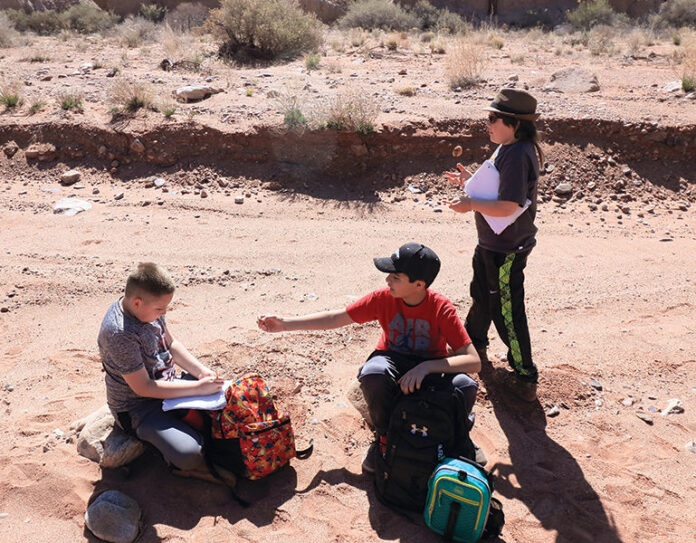
Through the class, the students learn how to detect unhealthy levels of bacteria in river water or recognize the different types of rocks, in an impromptu, open-air classroom along the Rio Chama or a dried up arroyo.
The students hiked along the arroyo not far from Abiquiú Elementary School on April 12. The purpose of the hike was to get the students to apply what they learned, during a previous class session about the three different types of rocks: igneous, sedimentary and metamorphic.
The Center’s Science and Education Director Christy Wall, Biologist Audrey Sohikian and Gifted Program Coordinator Jennifer Ortiz, had no problem getting students to answer questions regarding the rocks or how they were formed.
Recalling the lesson from a couple of weeks earlier, the fifth- and sixth-graders from San Juan Elementary School and Española Elementary School, for the most part, knew without hesitation, that sedimentary rocks were often layered, igneous rocks sometimes had crystals or that metamorphic rocks were existing rocks that were transformed through heat or pressure.
The gifted fourth grade students missed the field trip because they were taking the Partnership for Assessment of Readiness for College and Careers (PARCC) test.
Sixth grade San Juan Elementary School student Dominic Sandoval said he likes the river class because the instructors make education enjoyable.
“They always find new and fun ways to incorporate all the learning we do here,” he said.
His peer, sixth-grader Loren Vigil, agrees. The future video game designer said he likes participating in the program because he gets to have fun while learning.
The river class students would normally put on waders and scour the bottom of the Rio Chama looking for vertebrae and other small creatures, but the high, fast-moving water made studying rocks in the arroyo a much safer option.
Wall said she and her team anticipated the river’s water would be strong this spring, so they decided on some less intense options.
“Right now, the river is running at 1,700 CFS (cubic feet per second),” she said. “It is way too high for the students to safely wade. It is running really fast, too, and that is a big concern because the students aren’t that tall.”
Ortiz, who was somewhat side-lined by a December trampoline accident, made it through the sandy arroyo, despite having to use forearm crutches. She said Española Middle School gifted seventh- and eighth-graders also benefit from the Wildlife Center open-air classrooms. They meet every other week to study the various New Mexico ecosystems.
Last year, Ortiz said instead of the habitat class, the middle school students spent the spring building a kayak.
She said it is exciting introducing the students to topics that encourage them to take care of the environment. “I think what is most exciting is providing them with exposure to topics, which are meaningful to them,” she said. “Because it is connected to where they live, they are able to create an ownership or investment in the area.”
No cost to the
school districts
When the Wildlife Center first started offering its river classes five years ago, it was for Española students, only.
But since then, the Center has expanded its reach and now provides hands-on science education to students in other school districts, like Chama and McCurdy.
The Wildlife Center pays for everything, including transportation, so the only thing the various school districts have to supply are the students.
“River classroom is entirely funded through grants,” Wall said. “I write grants like crazy. It is primarily through private foundations. We are really lucky to have private foundations to help us out.”
She said her organization believes the benefits of providing the science education far outweighs the cost. It’s also an excellent way to illustrate science in every day life.
“It is our goal to provide this (hands-on science class) because no one else will,” Wall said. “No one will teach them the science they have to have — the next generation science standards. So there is a context for learning. Science isn’t just a book.”