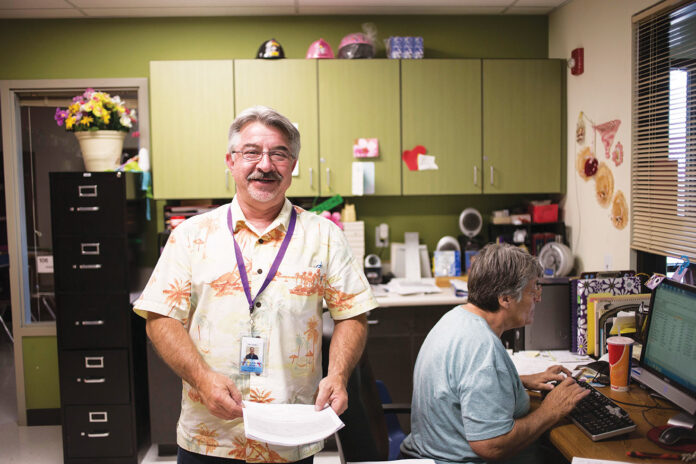
A longtime Northern New Mexico educator decided to take a break from writing his second book, to help fill an Española School District administrative hole.
Hernandez Elementary School and Los Niños Kindergarten Principal Mike Katko was writing his latest work, a historical fiction novel centered around the now defunct Chili Line Express Railroad, when he started receiving calls from his friends in the Española School District. The callers told him the District needed a principal for Hernandez Elementary School.
Katko said after thinking it over and talking with his wife of 32 years, Debbie Katko, he decided to end his short retirement and return to work.
That was in March, and since then, he has agreed to an additional assignment as the Los Niños Kindergarten Center principal.
“I was glad to retire and take two years off,” he said. “I went to Italy and Spain, and walked the camino. I worked around the house and took care of the dogs.”
Prior to his 2014 retirement, Katko published a book titled, “Skies and other Poems.”
Returning to work meant he would have to take a break from writing “Big Medicine and Pretty Water,” a novel about the Chile Line.
The Line officially ended it’s run from Antonito, Colo., to Santa Fe, in 1941, when the Army destroyed the tracks to make bullets for the war effort.
“Pretty Water’s” protagonist is modeled on characters from his mom’s side of the family, who come from a long line of sheepherders and farmers.
The burgeoning author said besides believing he can still make a difference, he returned to work because he missed the camaraderie.
“In retirement, you don’t get a chance to see your old friends,” Katko said. “I am still pretty young, I can get right back in there and get to work.”
His commitment to education was tested during his first teaching assignment in a southern New Mexico classroom, more than 30 years ago. He began teaching in 1987, as a social studies teacher and coach.
“I had 40 kids in a class with no air conditioning in Anthony and we just bared under and pushed through until the end of the year with fans running and two kids to a desk,” he said. “We just bared through it.”
He didn’t allow the negative challenges to deter him because he saw himself in those students.
“I wanted to be a positive force for those kids,” he said. “They come up in intolerable conditions. I grew up poor, spending time with my mom’s Mexican family. I understood where they came from.”
Katko’s teaching career would take him to various points throughout the state, until he landed at Santa Fe’s Ortiz Middle School. While there, he was appointed team leader, which started his transition from a teacher to an administrator.
Leadership comes easy for Katko, who as the oldest of eight children, was often responsible for making sure his siblings didn’t get into too much trouble while his parents were away.
“I’ve always been in a position of leadership,” he said. “I had to take care my brothers and cousins. I was the oldest and the oldest usually gets into watching the others.”
For Katko, the Ortiz team leader experience years ago was an extension of the leadership roles he assumed growing up, and as a soldier in the United States Army.
He didn’t always see himself as an educator. In the early days, he imagined himself following in his father’s footsteps by choosing a career where he worked with his hands.
Then he remembered his uncle Abie Duarte, who decided to break with family tradition of working the fields to attend college.
“Even in the early 70’s, I didn’t see myself going to college,” Katko said. “I wanted to be like my dad and join the service and be a soldier or construction worker. But, then I saw Uncle Abie move up from a teacher to a principal.”
He decided to pursue the administrator’s license so he could work as an athletic director, but once he got into the academic side of administration, there was no turning back.
Before he retired from the Pojoaque School District in 2014, he served as administrator in the Santa Fe, Los Alamos and Española school districts
He said although he has worked in some of the state’s richest zip codes, he believes Española affords him an opportunity to do his best work.
“If you want to help kids, I always thought this was the prime place,” he said. “It is these districts that have the burden of poverty, where you can bring hope and optimism to lives that don’t have that opportunity. Especially if you are good.”
Katko recently convinced the School Board to authorize out-of-state travel for four of the Hernandez Elementary School educators to attend workshops that will train them on how to best teach poor students.
He said the focus of the training will be to combine neuroscience research with classroom practices.
The training will teach participants that elementary school-age girls develop the part of the brain that allows them to be good listeners and their male peers develop first as visual and tactile learners.
Katko said this information can help generate classroom success for boys who, because of different learning styles, often develop negative educational experiences.
“One of the things that negatively impedes boys’ learning is making them sit down and read,” he said. “That isn’t what their brains are developed to do. What happens is, some of the boys become disenchanted with school right from the start.”
Katko said he is looking forward to next year, but doesn’t know what type of changes to expect after the Board settles on a new superintendent.