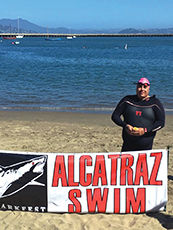
Local Swims with the Sharks

Published:

Diving headfirst into Abiquiú Lake’s cold water in May, wearing only swim trunks, Española resident Nathan Romero felt like he was being punched in the chest — and that he was about to drown.

    Romero, a lifeguard for Los Alamos County and the former city of Española aquatics director, needed to understand how his body reacts to cold water, to prepare for the 2017 Alcatraz Sharkfest Swim in San Francisco, Calif.

    The Sharkfest Swim is a series of open water swimming races held at various locations throughout the year, in the United States and Mexico.

    Jothy Rosenberg, founder of Stinson Beach, Calif.-based Enviro-Sports, organized the first Sharkfest in 1993, after he competed in the Escape from Alcatraz Triathlon, and thought people might want to make the swim without having to also bike and run.

    Sharkfest is not associated with efforts to raise awareness about cancer, but over the years, individuals and groups have used the event to promote their own causes.

    Romero paid his own entry fee for the event.

    When he arrived at Alcatraz Island, June 4, the water in the San Francisco Bay was 58 degrees, according to the National Ocean Service.

    Sharkfest organizers say when someone gets in the water, it’s normal for their heart to beat rapidly and their breathing to feel out of control, because of the temperature and excitement of race day.

    “Training did not prepare me for the cold,” Romero said. “Nothing prepares you for that, not at all.”

    He started six months of intense training for the race after his mother, Monica Roybal, reached 10 years in remission, following a fight with breast cancer. His sister, Chrisan Romero, was also diagnosed with the disease in October 2016.

    “My little sister and mom both recently beat cancer, so I wanted to do it for them, to raise awareness,” Nathan Romero said.

    He trained at the Larry R. Walkup Aquatic Center in Los Alamos, under Wendy Lott, his boss, and a coach for Los Alamos Charger Aquatics. He was swimming as many as 10,000 yards a week.

    “It’s easier swimming in open water,” Nathan Romero said. “The pool is really boring, swimming that many laps.”

    The week before her brother left for the race, Chrisan Romero had a mastectomy, and in a Monday interview, she said she is waiting on the call for one last procedure.

    “I’m very blessed to have a loving family, a loving brother, and I’m proud of him for making it through the swim,” she said. “He has inspired and humbled me to hurry up and get through this hurdle in life.”

    Monica Roybal and Chrisan Romero, along with nearly 30 other breast cancer survivors, signed Nathan Romero’s pink swim cap, which he wore during the race.

    Leading up to the event, another 170 survivors left signatures on his Facebook page.

    Chrisan Romero has been forced away from work at the Santa Fe County Planning Division for the last few months because of the treatment. The surgery also prevented her from witnessing her brother’s feat, but she got updates via text messages, the entire day.

    “The cancer has been kind of like a nightmare,” she said. “I knew about it since I tested positive as having the gene associated with it, but it’s always a different story when you feel a lump in your breast and find out you have cancer.”

    Her brother was joined by about 700 other swimmers on the morning of the race, from 30 different states and 13 different countries.

    To qualify, everyone had to prove they could swim one mile in a pool in less than 40 minutes.

    Nathan Romero started on the east side of Alcatraz Island, swimming south, toward the Aquatic Park, but aiming about 200 yards to the east, to counter the strong current pulling him westward.

    The San Francisco Bay is home to a variety of species of sharks, including great whites, which can grow up to 20-feet long. There is no known record of an attack on humans by a great white shark in the Bay.

    The sharks don’t bother anyone and they don’t come any higher than 20-feet below the surface because of the sediment brought into the bay by the tide, Nathan Romero said.

    Even with that in mind, he avoided any television depicting sharks before the event and chose not to go to San Francisco’s Aquarium of the Bay when he arrived that weekend.

    “It is scary, but once you jump in the water, you just gotta put it behind you and go,” he said.

    Nathan Romero swallowed so much salt water during the race, at one point he vomited.

    “You’re fighting the waves, so it’s hard to breathe,” he said.

    Floating at about the halfway mark, Nathan Romero stopped to take in everything around him.

    “It was so beautiful, the water is emerald green,” he said. “I had never swam in the ocean before.”

    Within seconds, Nathan Romero realized he needed to get moving again, because as soon as he stopped, he started losing body heat.

    He completed the mile-and-a-half-long swim in 49 minutes and 30 seconds. The event’s cut-off time is 75 minutes.

    When Nathan Romero pulled himself out of the water, he could not speak because his entire face was numb, along with his hands and feet.

    Now he wants to do another race, run by the same people, called the Lady Liberty Sharkfest Swim, on July 23, in New York City, to raise money to fight the disease.

Related articles

Recent articles