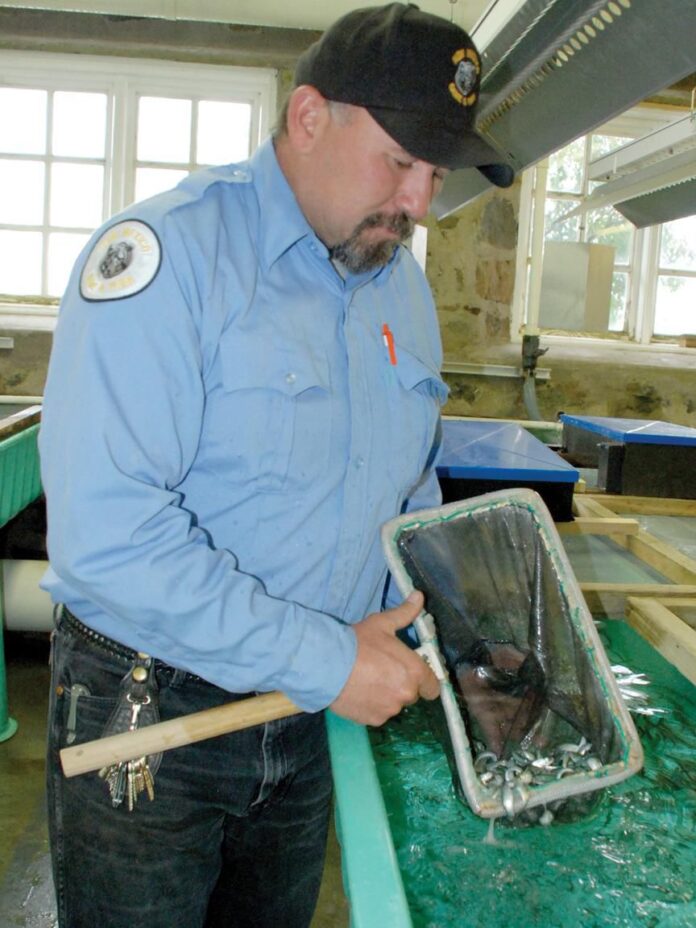
Los Ojos Hatchery Puts $2 Million into Reopening Long-Closed Stocking Facility

Published:

    The Los Ojos Fish Hatchery is undergoing a $2 million renovation in order to reopen after a four-year layoff.

    Production had been halted in March 2005 after whirling disease was discovered in the hatchery. The construction work is being performed by El Prado Construction Inc., of Taos., and is being funded by the federal Fish and Wildlife Service, Hatchery Manager Greg Friday said.

    The infestation was discovered in March 2005 and the state Game and Fish Department-run hatchery has been shut down ever since. One previous attempt was made to clean and disinfect the hatchery but whirling disease was again found in the fish.

    Whirling disease is caused by a parasite and infects trout and salmon. It resides in the bone and cartilage of trout, causing skeletal deformities that make the fish swim in circles, hence the name whirling disease. Rainbow trout, the trout most widely raised in New Mexico hatcheries, are highly susceptible to the disease.

    Los Ojos was the third hatchery in New Mexico where whirling disease had been discovered. Hatcheries near Questa and Pecos were also temporarily closed due to the disease but have since at least partially reopened. None of the diseased fish were released into New Mexico waters, according to the Department.

    The spring at Los Ojos has been found to be free of whirling disease, but the hatchery was infested. It was determined that predators such as raccoons and ospreys were the possible sources of the infection when trout were in the raceways, so it was decided that the raceways should be covered.

    Raceways are where trout are raised and fed at hatcheries. They are normally placed in raceways after they have been hatched and raised to a fingerling size inside the main hatchery building.

    “It will be a 150-foot free-span building covering the raceways with 12-foot wide doors so we can drive the (stocking) trucks inside and load them with fish,” Friday said. “The raceways will be disinfected with a really careful application of high chlorine solution. We’re also a public water supply, and we’re closely monitored by the Environmental Protection Agency.”

    Los Ojos is fed by springs, which discharge 1,700 gallons-of-water-per-minute and holds water that is 48 degrees, according to Friday. Once the hatchery has been disinfected and the raceways fully covered, Los Ojos should be able to return to operating at full capacity. The construction project started in mid-June and is scheduled to last until December, Friday said.

    After the hatchery is back in operation, trout will be raised at the hatchery for about one year and tested to be sure the hatchery is free of whirling disease.

    “We want to be 99.9 percent sure that we don’t still have a light infestation,” Roddy Gallegos, of the Department, said. “We have never knowingly stocked fish from a hatchery that tested positive.”

    Prior to its closing in 2005, Los Ojos was a brood facility where large rainbow trout were kept and eggs were taken from them to be hatched and raised at the hatchery to catchable size (9 inches or longer) for stocking. When the hatchery returns to production, it may be turned into a facility that raises only fingerling trout for stocking because of the slow growth rate of the fish due to the cold temperature of the spring.

    “That hasn’t yet been decided,” Gallegos said.

    Los Ojos was constructed in the 1930s as a Works Project Administration project and initially was named the Parkview Fish Hatchery. The original stone hatchery building is registered as a National Historic Building.  

      Salmon Study   

    Despite not rearing trout, there is plenty to keep the seven members of the hatchery staff busy.

    Los Ojos is currently raising 100,000 kokanee salmon fingerlings in the hatchery building. The kokanee were hatched from eggs taken by hatchery personnel in November from nearby Heron Lake. The kokanee are part of a study to determine growth rates. Before they are stocked, they will have a fin clipped for identification and when harvested or collected for spawning they will be analyzed.

    In a new project for the hatchery, they are also raising tadpoles from boreal toads.

    Boreal toads are an endangered species in New Mexico. Last year, tadpoles from Colorado were transplanted to the Trout Lakes near Cebolla, where they survived the winter. The tadpoles this year are also slated for transplanting to help increase the population.

Related articles

Recent articles

Weave a Mug Rug