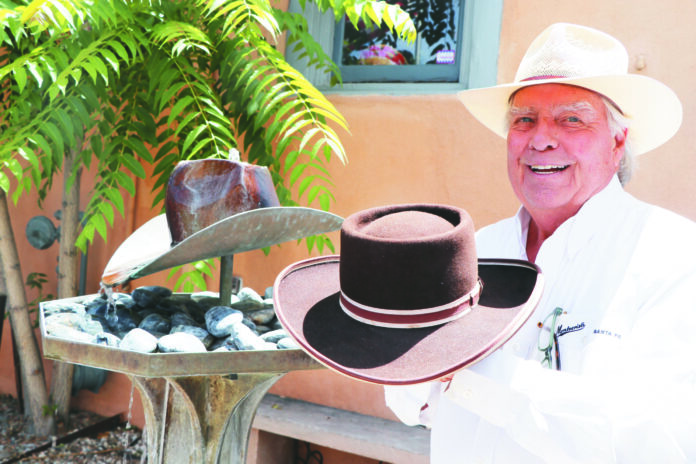
‘Magical realism’ defines decades-long career of iconic New Mexico hatmaker Milton Johnson at Montecristi Hat Works

Published:

Richard L. Connor
El Rito Media

He always had an eye for opportunity, the boy with the bike and a nickel who wanted not one but two Cokes.

Milton Johnson, 10, lived in Handley, a Texas neighborhood that had been a town before it was swallowed by a bigger neighbor named Fort Worth.

“I used to ride through Handley on my bike, and I had me a nickel I’d take to the drugstore for a Coke,” Johnson said, recalling his childhood. “I wanted two.”

So, he’d sidle up next to a person at the counter, a person who seemed to want privacy.

“I’d get me that Coke and slurp it all the way to the bottom of the glass,” Johnson said.

The slurping would annoy his countermate, who would order the clerk to give Milton another Coke and order Milton to “stop that damn sound.”

“And soon I had me two Cokes for one nickel,” Johnson said.

And, as the song says, “the cowboy rode away.” It’s easy to imagine little Milton hopping on his bicycle and riding into the morning sun with a cat-caught-the-canary gleam in his eyes.

At 81 years old, Johnson still has the gleam, the spark, despite fighting the exigencies of life. Adventure. Fame. Ups and the downs. College flunk out. Eye-opening and ugly Vietnam war as a grunt. Learning hat-making and navigating the road to glittering success but falling prey to drugs and an interruption in life’s long march with involuntary confinement for 11 months.

Check out more videos of Milton Johnson’s process.

Through it all he has maintained his zest for life, seasoned with a sense of mirth that keeps the diamond-like glitter in his eye. It’s a personality trademark, indelible as the trademark on the hats he creates at his world-renowned Montecristi Custom Hat Works in Santa Fe.

A fellow Santa Fe retailer, asked if she knows Johnson, responds with a smile. “Know him? Everyone knows Milton Johnson. He was wild. I mean really wild.”

And, for good measure: “Popular and fun.”

Later in life, after the clever Coke trick, Johnson’s calculating eye drew him to seize an opportunity that eventually brought him fame for making and selling Panama hats.

Decades later, the opportunity is an institution: Johnson and the Panama hat.

Assorted versions of the Panama perch atop Johnson’s mop of unruly gray hair each day but he doesn’t just wear the brand. He is the brand.

Milton Johnson not wearing a Panama would be like Henry Ford cruising the streets of Detroit in a Cadillac.

Johnson is a rake and a rambling man, though his gait is now more ambling than rambling. Hands that have shaped thousands of hats are now bent with a crook here and there but still guided by the delicate touch of genius. At one time those hands were athletic, quick as lightning in a sport that puts a premium on quickness. Johnson was a star basketball player at Fort Worth’s Polytechnic High School, earning all-tournament honors in the 1962 Texas state tournament.

Those hands, outsized relative to his 5-foot-6-inch frame, are still nimble with felt and straw.

“I learned leadership when I was co-captain of that basketball team,” he says. “Then I developed it more when I was president of my University of Texas fraternity, a job I focused on so much I flunked out.”

His leadership skills have been invaluable in business, inspiring loyalty and enduring relationships with those who have joined him along the way.

Synde Parten met Milton in Texas, helped him learn to work with fur, and still works with him more than 30 years later. J. D. Noble runs Johnson’s non-custom retail store, Santa Fe Hat Company, and has logged 37 years with the hatmaker.

Noble is Johnson’s burly counterpart who in 1989 was on his way from Missouri to Taos with hopes of being a painter and detoured into Johnson’s store.

“Want a job?” Johnson asked.

Johnson told him to meet him later in the day at his hangout, The Pink Adobe. Someone made him a bowl of Green Chile Stew.

“Done,” says Noble. “I was hooked.”

Johnson’s life, a long and winding road of adventure, misadventure and rebellion, is also one of adherence to strict business rules. The contradiction is one of many that define an untamed man who can be so self-disciplined that he refused to pause for an hour of conversation on an especially busy March day at his store.

“We want to interview you more, and in depth,” said the editor.

“Not during the end of my sale month,” Johnson said.

The 10-year-old who devised a way to turn one nickel into two Cokes is still striving to succeed. And he’s still the charming rascal who hustled that second Coke.

Johnson’s life is a study in contrasts, ups and downs, pushes and pulls. How to make sense of it all?

“Magical realism,” he says matter-of-factly.

Along the bumpy dirt roads and even an LA freeway-kind of life, he has become legendary, and life’s often harsh realism has been spiced with magic.

Johnson became a devotee decades ago of magical realism, one of the hallmark themes of books by Gabriel Jose Garcia Marquez, the famed Colombian journalist, author and winner of the 1982 Nobel Prize in Literature.

“It changed my life,” Johnson says.

After Johnson flunked out of the University of Texas in 1966, he joined the Marines and went to Vietnam. He later returned to UT, graduating in 1969 with a degree in political science.

He opened a restaurant in Buda, Texas, serving Indonesian food, but closed it and told his new wife they were moving.

“Well, sugar, let’s move to paradise,” he said.

“Where is that,” she asked?

“Medellin, Columbia.”

They moved and he began learning the rug and blanket trade in the late 1960s and early ’70s. He’d buy goods there and bring them back to Texas to sell on the street, mostly on “the drag” adjoining the University of Texas campus in Austin.

Along the way he discovered the village of Montecristi where they grew paja toquilla, the plant that provides the fiber, the straw, for the Panama hat.

The process of producing the straw is featured on the Montecristi website in a video, “Journey to the Source.”

Intrigued by Colombian culture, Milton read Marquez, and given the lifestyle of the era – hippie, freewheeling, often drug-drenched –Johnson was fascinated by the contrary notion of harsh realism, balancing experiences such as his service in the Vietnam War with hopes and dreams that might be achieved through a magical sense of the possible.

Defying his wilder instincts, Johnson learned a trade and mingled with famous, influential people such as Stanley Marcus of the Neiman Marcus retailing empire. It was Marcus who offered Johnson a chance to market his hats in the upscale chain’s department stores, particularly at store openings in Las Vegas and Los Angeles.

Milton Johnson flashes his welcoming smile in front of his custom hat store, Montecristi Custom Hat Store. 

Folks loved Milton’s hats, especially the Panamas. The Neiman Marcus connection could have been Johnson’s launch pad to retailing glory.

“It should have been, but I was so messed up on drugs I didn’t capitalize,” he said.

Fame, or maybe infamy, sent Johnson back to his hometown of Fort Worth in 1985 – not to a hero’s welcome or parade. He was sentenced to federal prison there for conspiracy to distribute cocaine. While his hats and sometimes raucous anti-establishment behavior attracted fans and friends, his newfound fame also brought him “friends” he didn’t need, some of whom turned out to be working with the DEA and eventually sold him down the river after they secured a plea bargain.

“I was not guilty,” he says without a trace of bitterness. “But I was an easy target.”

A setback? A tragedy?

“No. It saved my life.”

During the 11 months he spent in a prison where his fellow inmates included future President Bill Clinton’s brother Roger and some Oklahoma county commissioners who had perpetrated an asphalt scam, Johnson became reflective. And he trained to become a runner.

“They let me out to run the Cowtown Half- Marathon,” he said. He ran nine-minute miles.

His sentence was called “indeterminate,” meaning he could be released in six months or remain locked up for 10 years.

He credits the late and former New Mexico Chief Justice Charles “Charlie” Daniels with getting him freed after representing him at a parole hearing. Daniels was a character himself, racing vintage cars and playing guitar in a band called The Incredible Woodpeckers.

Imprisonment produced a new Milton Johnson, a man with both body and mind on track, and he quickly turned his focus to the hat business.

He was soon on his way to resuming his status as a legendary hatmaker – only this time on more subtle terms.

Legendary. It’s a word more often abused than used correctly.

Johnson, though, is legendary, the real deal. He is the nation’s – maybe the world’s – most famous and accomplished creator of Panama hats.

If you want the best Panama hat made by the best Panama hatmaker, you find your way to Montecristi Custom Hat Works, where Johnson does business in a small Santa Fe adobe at 322 McKenzie Street. His second store, Santa Fe Hat Company, is at 118 Galisteo St.

Johnson recently sold a hat for $25,000 but his custom shop also has hats for $1,000. Less expensive offerings are available at Santa Fe Hat Company, some for under $400. Johnson also sells premium fur felt hats from Stetson and other manufacturers.

These days the band on a hat can make it special. He has those, too, and recently someone paid $36,000 for a hatband.

Johnson opened his first Santa Fe hat store in 1974 but it was only open during June, July and August. He bought Lone Star Hatter in Austin a few years later.

He learned some initial hat-making techniques from Ralph Anderson, an Austin hatmaker. Johnson had been selling materials to various Texas hat companies. His craftsmanship with Panamas is mostly self-taught and refined through years of experience.

It was in Austin that he met Parten, who had expertise in fur and still works in the Santa Fe custom shop.

If you want to learn many of life’s lessons, you listen to Milton Johnson and marvel. His hard-won wisdom shines in his bright blue eyes, full of mirth but with a serious mien, a soulful depth.

The life reflected in those eyes has been colored with what writers like to call “universal irony.” You flunk out of the University of Texas, get drafted into a Southeast Asia war you find dishonest and ugly, come home matured by life’s hard realities, are befriended in college by a professor of Latin who tells you to just show up for class and he will pass you in order to help you graduate and then, riding high on early success and fame, you blow it all.

You go to prison.

Ironically, all these experiences motivate you to redirect your talent and energy to achieve new heights of success through hard work and paying attention.

J.D Noble says the success comes from Johnson’s constant search for perfection.

“He and the rest of us who learned from him to make hats are driven to strive for perfection,” says Noble.” That is his gift – always striving for perfection and never quite getting it. Never giving up.”

Success is paved with failure.

“My first hat was for a small-time actor,” Johnson recalls. “I wanted it to be perfect., stayed up all night shaping it. When I started placing the hat it just kept sliding down and quickly it covered the actor’s eyes, stopped only by his nose.”

Dejected, Johnson started over.

Now, when Milton places a hat on someone’s head it’s as if he is handling delicate crystal or porcelain. Both hands steadily lower it.

The hats don’t drop anymore. They fit and the cash register rings.

Looking for a hard, definitive answer, you ask, “How does he do it?” How did he learn and master this remarkable skill?

In the late 1960s the fastest downhill ski racer in the world was Jean-Claude Killy.

Cornered by a reporter who had pursued him for months and finally latched onto an adjoining seat on a nonstop plane trip, Jean-Claude was asked how he learned to raced so fast.

“I don’t know,” Killy said.

And how did Johnson master the art of making Panama hats?

“No idea,” he deadpanned, “except I’ve built a lot of hats.”

After everything, the highs and lows, the stumbling failure and the soaring success, Johnson is still at his shop every day, personally measuring and fitting those extraordinary hats. Yet he’s weary and haunted by uncertainty about the future, by not knowing who will preserve his legacy.

Johnson is a master of a craft and to those who blaze careers in crafts, there is no blueprint for ensuring the future of the craft or identifying those who possess the magical “touch” that makes the product special and unique.

Told that many believe him to be the world’s best Panama hatmaker, Johnson says, “Well, my modesty escapes me. They are telling the truth.”

But who will carry on his work?

He needn’t worry. The founder and guardian of Montecristi Custom Hat Works believes in the power of magical realism to guide the hand of fate. His legacy is secure.

Related articles

Recent articles