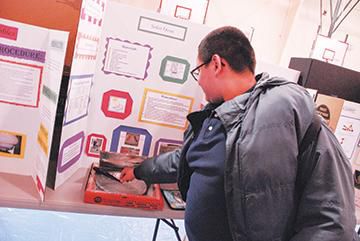
Seventh-grader Alexandra Llano said she was amazed to discover ice can feel warm.
“We tried to make a bubble out of dry ice,” Llano said. “We were getting into a group and we tried it and I accidentally tried to touch the dry ice with my hand and it was hot.”
Llano was one of hundreds of Española Middle School students who participated in the school’s third annual science fair. The fair was all day, Jan. 29, at the school.
Setting her goal to one day become a patron of the sciences, Llano, 12, said the fair helped peak her interest in the field. It was her first time as a participant, but she said she won’t hesitate to join again next year.
“I liked it because we got to do experiments,” Llano said. “I want to be a scientist when I grow up.”
About 600 seventh- and eighth-graders submitted projects for this year’s fair, seventh grade science teacher Laura Thomson said. All middle school students were required to participate and were allowed to do it individually, in pairs, or groups.
Thomson said students were allowed to pick the topic that interested them. They have been working on their projects since last September.
She said the event benefits the local community because it encourages students to pursue careers in science.
“If we don’t have students interested in science, we’re not going to have scientists creating new things when they grow up,” Thomson said. “This is an important time to start feeding that interest in science. We plan to make it a yearly thing as long as we can get everybody to cooperate.”
The science fair was also a competition for the students.
Middle school teachers and an outside jury selected the three best projects for each grade level.
Teachers conducted the preliminary judging before the jury, composed of representatives from the Los Alamos National Laboratory Foundation, Northern New Mexico College, McCurdy Charter School and Española Valley High School, formulated the final results.
Seventh grade student David Martinez took first place in his grade level for his project titled, “Solar Oven,” through which he created a recycled solar oven made of a Little Caesar’s pizza box, some foil and plastic wrap.
Eighth grade student Brian Martinez won first place in his grade level for his project titled, “No Batteries? No Problem,” through which he created a solar-powered robot.
But a project on bacteria, which was a presentation on the composition and life processes of various microorganisms, was the apple of Thomson’s eye.
“Since I previously worked in a hospital laboratory, it’s kind of something that’s in my alley, she said. “But everybody’s best.”
First- to third-place winners were given medals, honorable mentions and ribbons.
Thomson said administrators spent no more than $500 for the prizes.
She said the science department plans to bring the winning projects to this year’s Northern New Mexico Regional Science Fair competition.
“We hope to take first, second and third place, and possibly, some other projects that we thought were really good to the regional science fair, which is in Las Vegas, N.M.,” she said. “That’s in March. If they do well there, they get to go to Albuquerque to compete in state. The kids look forward to doing projects — well, most of them.”
At the event, the school’s other academic departments also organized presentations for the proceeding Parent Involvement Night.
Although the science fair is three years old, this is the first time the department collaborated with other departments in the school, eighth grade science teacher and science fair chairman Patrick Archuleta said.
“We had a very low turnout last year, so we’re trying to increase community involvement,” he said. “The science department, among the four teachers, we put this event together and we collaborated with music, art and Native American dance. This is the students’ home away from home. It’s nice to have the family be part of the environment.”
The collaboration proved effective, as Archuleta projected an increase in fair participation from 50 last year, to about 300 this year.
Archuleta said the event encourages creativity among the school’s young learners. It also brings back the school’s focus from athletics to academics.
“A lot of people have time to show up at the athletic events,” he said. “A lot of people forget that people come to school to learn and it’s about academics. We want to make sure we reinforce that. Our students are first and athletes are second.”
This is not the last time the school plans to hold a science fair, Archuleta said.
“As long as I teach here, we’re still going to have a science fair,” he said. “I hope to teach here for a long time.”