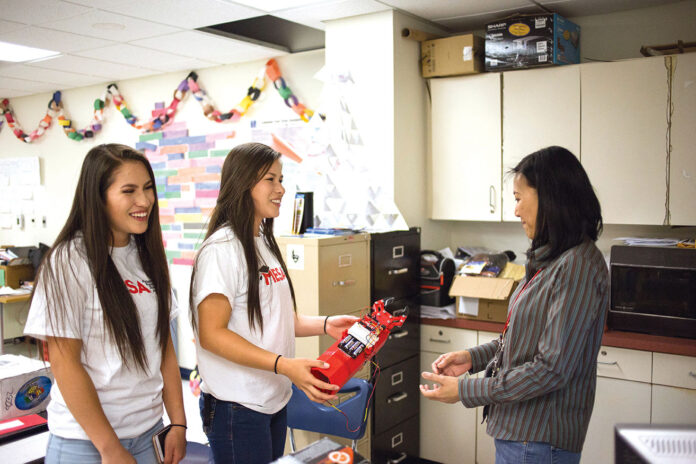
A couple of Española Valley High School students out-performed their peers in a statewide competition that judged the students’ burgeoning engineering skills.
High school juniors and twins, Leah and Therese Lujan, finished third in the March 18 Mathematics, Engineering and Science Achievement (MESA) Day, at the University of New Mexico. The girls built and designed a prosthetic arm, created an academic poster and wrote a technical paper.
The budding engineers’ third-place project was one of approximately 50, that students from across the state entered into the day-long contest. Judges evaluated the prosthetic arm’s dexterity by judging how well the twins were able to grab and toss various items like pencils and bean bags.
Deming High School students took first place with 420 points and Carlsbad High School students took second place by earning 354 points.
The Lujans received a medal and trophy for their accomplishments.
Both girls said although the skills portion of the competition didn’t go well for them, they were somewhat confident, that overall, they would have a nice showing, but were surprised to learn they placed third.
Leah Lujan attributes their success to the poster and technical paper.
“I would say (it was because of) how hard we worked on the technical paper, because we didn’t really score crazy amounts of points for the tasks,” she said. “We didn’t do too well. The academic paper and poster really pushed us up there and we did pretty well on our presentation.”
Therese Lujan attributed the victory to their collective ability to block out distractions and stay focused on the mission at hand.
“When we were competing, we really didn’t see other teams,” she said. “While all of the other teams were on the floor, we were occupied with our tasks.”
The girls said they received help from their uncle Dereck Benavidez, who happens to be the same Los Alamos National Laboratory Mechanical Engineer who coached the Española Middle School students that competed a day earlier. The students from that competition didn’t place in the event.
The Lujans said Benavidez’s help was essential to understanding the computer code they used to rewrite the template that controlled the prosthesis.
They said they hoped their strong performance would show people outside of the Valley, that Española is good at things besides sports.
“People should know that Española is not just about sports, and we are both athletes,” Leah Lujan said. “We have great teachers, like Ms. Mejia, and we can excel in both academics and sports.”
Both girls play on the school’s varsity softball and volleyball teams.
Española Valley High School’s Mathematics, Engineering and Science Achievement advisor, Maria Mejia, applauds the commitment of Los Alamos engineers such as Benavidez, and others who volunteer to help students learn the skills that will carry them into the future.
“It is good the LANL (Los Alamos National Laboratory) volunteers are willing to come here to help and inspire students from Española Valley High School to try doing STEM (Science, Technology, Engineering and Math) activities like coding or making things that work out of nothing,” she said.
In the five years since she’s been the Mathematics, Engineering and Science Achievement advisor, program enrollment has nearly doubled from 25 students in 2012, to the 45 enrolled this year.
Mejia attributes the growth to myriad factors, such as the field trips that expose students to a world outside of the Valley.
Originally, the program was scheduled to meet after school for about 30 minutes, once a week, but some students had difficulty getting home from the sessions, so Mejia started conducting the classes twice a week during her lunch break.
Like Leah Lujan, Mejia said she believes the High School is getting classified as a sports school and very little is getting out about its academic success.
“As math teacher, I am really into STEM and Española is only known for being good in sports,” she said. “I know I can attract students that would also be good in STEM, and you know STEM is the ‘in’ thing today. Maybe in five or 10 years, these students can graduate as a STEM professional.”
Five Española Valley High School teams attended the May 21 event, however, not all of the 20 students participated in the competition. Some students served on the Mathematics, Engineering and Science Achievement Leadership Council, which helped set up and break down the various evaluation stations.