Northern to Partner with UT-El Paso on Health Grant

Published:

    Northern New Mexico College received a National Institute Health grant, part of a $31 million initiative.

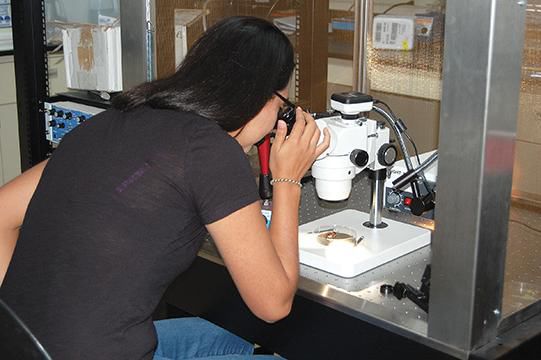
    The college will partner with the University of Texas-El Paso next spring, to offer students a new research course and the opportunity to conduct biomedical research with an emphasis on neurophysiology — the field of study dealing with the nervous system.

    Northern Biology Professor and Grant Director Ulises Ricoy, said since joining the faculty at Northern in 2010, he has been working hard to provide undergraduate research experiences.

    “A year ago, some of my colleagues down at the University of Texas-El Paso invited me to be part of a very large nationwide initiative, the NIH (Northern Initiative of Health) BUILD program, building infrastructure leading to diversity,” he said. “The overall goal of that initiative is to increase the diversity of the work force in the biomedical sciences, which essentially is a very broad range of disciplines.”

    He said these include nursing, engineers, sociology and traditional disciplines like biology and chemistry. Ricoy said he stepped down from his post as chair of the biology department to work on developing these types of programs.

    “This is something that we have definitely worked really hard for,” Ricoy said. “What’s really exciting about this is that, this is really unprecedented for Northern New Mexico College. The fact that we are part of a national network, is essentially providing a huge amount of visibility. The reason we got to be a part of this partnership is because we are sending students to prestigious universities.”

Visiting professor

    Eddie Castañeda, professor of psychology at the University of Texas-El Paso, specializes in behavioral neuroscience and will join Ricoy and Northern Mathematics Chair David Torres in teaching the research course.

    “I plan to go to Northern New Mexico and contribute with mini lectures for the course, as will a few other University of Texas-El Paso faculty members,” Castañeda said.

     He said the program will give students the opportunity to come into his lab to do research on animals related to biomedicine. He said the program gives students an opportunity to conduct scientific research as well as receive hands-on technical experience, while raising their cultural awareness.

    “It’s an inoculation, by bringing the students down to El Paso, we hope to get them to see that they can take advantage of being in other places and opens them up to a longer move away from the Española and Santa Fe area,” Castañeda said. “We hope to spark an interest in a research environment so they can walk away thinking they can do it. If you don’t know what peanut better tastes like, then you can’t really describe it.”

    Students like Matthew Medina, a former Northern student, who this year started a doctorate program at the University of Michigan, are the type of students the program hopes to attract and who Ricoy feels can be personally impacted by participating in the initiative.

     Medina was one of two students who traveled with Ricoy to the Argonne National Laboratory in Chicago in the summer of 2011, to conduct research in nanotechnology.

    Ricoy said he hopes the new grant will similarly inspire a new generation of students and spark their interest in the biomedical industry.

    The industry encompasses a broad range of careers and disciplines including nursing, psychology, sociology, hospital management and public and environmental health.

     “Something like this can essentially change their lives,” he said.

Students attracted

    Bridget Ortiz, 25, is majoring in biology and will take the research course next semester. She is hoping to see what it’s like to work in a state-of-the-art research lab. Her main interests include biology and forensic science. She said she wants to work in a crime lab in the future and wants to get a better feel for different science topics. She started as a criminal justice major and has an associates degree in it.

    Gabriella Trujillo, 22, is also majoring in biology and signed up for the research class.

    “I think it’s a really good program,” She said. “It’s going to offer students a lot more opportunities to gain research experience.”

    Trujillo is thinking about becoming a pediatrician or going into veterinarian medicine. She said she’s interested in microbiology and hopefully will finish medical school in the next few years.

    Ricoy said there’s about 10 universities in the United States, including Portland State, San Francisco State, the University of Texas-El Paso, Northern and California State-Long Beach, which are considered pipeline institutions, feeding into bigger academic programs. He said the role of Northern is to provide students and faculty members with an opportunity to get involved in what people are doing across the country, in terms of research.

    “The beautiful thing about the BUILD program is the type of research partners it provides,” Ricoy said. “We’re talking about Arizona State University, University of Texas at Austin, University of New Mexico Health Science Center, New Mexico State. It is making it easier for students to get into these institutions who normally would not have access to them. The reality is that the vast majority of the students here don’t have that as an option.”

     Ricoy said the grant also gives opportunities to faculty members like him, to submit competitive proposals.

    “I am going to get money to build new a curriculum in the field of neurophysiology, which is something that students don’t have access to because of the cost,” he said.

    The grant will also provide the funding needed to create a new course. The students will get the chance to visit the Behavioral Neurosience laboratory at the University of Texas-El Paso twice during the semester.

    “We are going to be essentially exposed to a cutting-edge laboratory,” Ricoy said. “Students are actually going to be engaged in experiments and faculty is going to be engaged in professional development.

    He said there will be opportunities for enhancing presentation skills and networking skills, but the bigger goal is to make contact with the University of Texas-El Paso, for summer and winter opportunities for graduate and professional school students.

    Ricoy said the experimental methods in biomedical research and statistics courses offered at the college in the spring, will be traditional classroom courses with a field trip component, which will allow students to have access to the lab where they will do basic experiments with rats to generate and analyze data.

     Ricoy said the goal is to use the data to teach about statistics, hypothesis-driven research and experimental design. He will be joined by Torres and Castañeda.

    “We are hoping that by bringing students down there, they will want to go down there for the summer, where they will be able to be hosted in a lab and have housing available to them,” he said.

     The class is not just open to biology students. As part of a multi-discipline program, the course is open to students in a wide range of studies including math, environmental science, even students from the Humanities can take part in it.

    “It’s not just your traditional science, technology, engineering and mathematics program, it’s open to everybody who fits the qualifications,” Ricoy said.

Related articles

Recent articles

Weave a Mug Rug