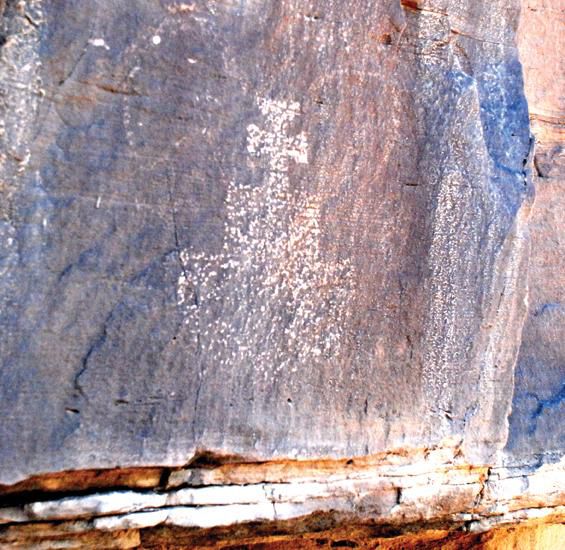
While poking around Cañones Creek just before it enters Abiquiú Lake, I stumbled upon a group of crosses carved into the side of a small rock wall. These rock carvings posed a mystery to me, and unfortunately, these old rock inscriptions had been extensively defaced by modern graffiti artists.
My curiosity aroused, I explored farther down the Creek and was rewarded with another discovery of an inscription carved in the rock. This one, another cross, more elaborate than the others depicting a cross upon a dome, had not been defaced and just deepened the mystery of what it represented.
Opening the Recreational Atlas of New Mexico, I found that the Old Spanish Trail had run close by Cañones, but I could find no reference to any incident that may have led to the inscriptions on the canyon wall.
“Depending on the look of them, they are likely earlier descansos, where someone died,” Hilario Romero, historian at Northern New Mexico College, said.
The area around Cañones was also frequently the scene of clashes with the Southern Ute tribe in the 1700s, according to Rio Arriba County manager Lorenzo Valdez. Since the location nearest State Road 96 has several crosses carved in it, perhaps several people met their fate here due to a raid by Native Americans.
A book, “Canones” by Paul Kutsche and John R. Van Ness, covers the history of the village of Cañones, which is nearby, but fails to mention the inscriptions or any incidents that may have led to them.
The other inscription, a single cross atop a dome, would signify a grotto, according to Romero.
“They would have placed different objects, such as old milagros, that had been carried by the person there,” Romero said.
There is a natural grotto in the cliff face beneath this inscription, but other than rocks, nothing is there now.
The land is owned by Cornelio Salazar, who was not available for comment Monday,
Still, the discovery prompted an increased interest in the history of the Old Spanish Trail. After writing a story on the Continental Divide Trail, a scenic trail that runs through portions of Rio Arriba County, I had found that a national historic trail, the Old Spanish Trail, runs through a large portion of Rio Arriba County, as well.
The Old Spanish Trail was a trade route between Santa Fe and Los Angeles, Calif. It became part of the National Trails System in 2002 under a bill introduced by Sen. Ben Nighthorse Campbell (R-CO). It was the 15th of 19 historic trails included in the system. The trail was roughly 1,200 miles long and originated in Santa Fe, crossing portions of New Mexico , Arizona , Utah, Nevada and California, where it terminated at San Gabriel Mission in Los Angeles.
The route was established 1n 1829 when was it is now Northern New Mexico was part of Mexico. A Santa Fe trader named Antonio Armijo is credited with making the first complete roundtrip journey on a new route he pioneered that took a more southerly route than previous attempts to blaze a trade route between Santa Fe and the Pacific coast.,
“Really, initially, they were just Indian trails,” Romero said. “Armijo took the southernmost route.”
Armijo’s route turned to the west just above Abiquiü, where earlier attempts had continued north south of Tierra Amarilla and through Dulce to the Gunnison River in Colorado. Armijo’s route would be the one closest to Cañones. It continued through Coyote and Gallina, following the natural contour of the land between the high mountains and mesas that flank the Trail to the south and north, the same route that State Road 96 now follows.
The Trail headed north and near what is now Lindrith enters Largo Canyon, a 30-mile-long canyon well-used by Navajo traders and raiders. In the 1930s homesteaders in the Lindrith area still used Largo Canyon as a route to the orchards along the San Juan River, where they canned fruit for the winter. The Canyon now serves a more modern purpose since the area around it has been heavily developed as a natural gas and oil drilling area. There are compressor stations and pumping stations along the length of Largo.
Armijo route crossed the San Juan at what is now Blanco at the mouth of Largo Canyon in San Juan County, avoiding a difficult crossing at what is now Navajo Dam further upstream It continued to Aztec, where it crossed the Animas River and headed into Colorado.
On its way west, the Trail hugged what is now the border between Arizona and Utah, avoiding the rugged Grand Canyon country. It crossed into Nevada at Mesquite, then entered California near Tecopa, avoiding the scorching heat of the Mojave Desert to the south and Death Valley to the north before finishing in Los Angeles.
According to the Old Spanish Trail Association, the primary trade goods coming from Santa Fe were blankets and other goods packed on mules. Horses and mules were the primary commodity brought back from California to Santa Fe, where they would be sold..
“Traders from Santa Fe would often leave their stock in California and make the return trip with new stock,” Romero said.
The Trail was heavily used from 1830 to 1848, when the United States and Mexico entered into a war, with the Mexican territory of what is now California, Utah, New Mexico and Arizona becoming part of the United States after its victory. The trail ceased to be used shortly thereafter shortly thereafter as easier wagon routes replaced the old mule trails.
The development of the Trail as a historical route has been limited in New Mexico, The route has been marked extensively in Colorado and California. There are no hiking areas developed in New Mexico along the Trail and much of the route travels through private land
“It’s now beginning to be marked.” Romero said.
A map of the Old Spanish Trail can be obtained by visiting the www.oldspanishtrail.org