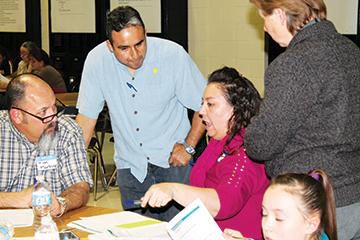
Parents add input to master plan

Published:

    Emotions were high at the Feb. 10 facilities master plan update meeting for the Española School District.

    Jeers, taunts, protests and arguments were all part of a meeting intended to help determine the future of Española schools by soliciting insight and opinions from parents, students, teachers and District community members.

    Superintendent Danny Trujillo welcomed the guests into the Española Valley High School cafeteria. Last year, the District created a five-year facilities master plan, but there was a main flaw in the plan, Trujillo said — community input was missing.

    “We’re here to legitimize the process,” Trujillo said. “That’s what this is about tonight.”

    The method and process of collecting public input was to be orderly and simple. Pasted around the lockers of the cafeteria were 19 poster boards, each stating one question from the survey. Each table was given a copy of the survey to fill out individually, as well as large Post-it notes to write the most important goals and objectives for the District.

    However, the bottled water and store-bought cookies were not enough to soothe anxiety and worry in the crowd of 100, caused by the prospect of their child’s school being closed.

    It was two hours before facilitator and District-hired facilities master planner Marilyn Strube could instruct the crowd to fill out the survey, which became a point of contention. The last question presented five options for school consolidation and District reorganization and requests.    

    The survey read, “Review each option and select the option that, in your opinion, will allow EPS to utilize its elementary schools efficiently and effectively and better serve the needs of ALL EPS elementary students.”

    All five options mentioned the closure of Hernandez Elementary School.

    “I don’t understand why Hernandez (Elementary) is at the point of being shutdown,” Española School Board member Pablo Lujan said at the meeting.

    Trujillo also was confused by how Hernandez being closed was repetitively mentioned.

    “Strube took the lead on that and put that (survey) together and that’s a point of contention that needs to be addressed,” Trujillo said in a Feb. 12 interview.

    In a later interview, Strube said the last question on the survey was not worded properly and she apologized for the unintended implications.

    “The question doesn’t bear any weight,” Strube said. “It’s not saying these schools will be closed. I was just trying to show the number of seats which could be eliminated, and how many empty seats there are in (District) schools.”

    Strube said the number of empty seats in District elementary schools is enough to close three facilities, which could be done if elementary schools were reconfigured.

    “I apologize. I was trying to emphasize the grade configuration,” Strube said. 

Empty Seats

    The New Mexico Public Schools Facilities Authority master planner Bill Sprick said the District’s loss of 875 students in the past decade is not a unique problem. Districts across the state are dealing with the same problem.

    When enrollment was at a peak, the district grew to accommodate the surge of students.

    The students have now declined and with them, the funding from the state has also declined. Sprick said this leaves districts like Española paying for an infrastructure too large for the current student body with funding the District can’t afford to spend.

    The District receives $7,629 per year from the state for each student. Currently, within the bounds of the District, 2,020 students are attending charter schools, private schools outlying school districts — Taos, Peñasco, Pojoaque and Los Alamos school districts. Strube said for the current school year, 540 students are attending McCurdy and 324 students attend Los Alamos School District. However, the facilities in the elementary schools alone are built for 3,231 students. Right now, there are 885 empty seats. The elementary school facilities are built at 440,743-square-feet. The Authority recommends Española’s elementaries be built at only 324,098-square-feet, Sprick said. This means the District is paying $699,870 a year in maintenance and utilities for superfluous space.

    Not everyone in the audience agreed with the Authority’s analysis of the empty space in the District’s schools. Los Niños Kindergarten teacher Alexandra Naranjo has been teaching at the school for the past 14 years.

    “I have to disagree with that,” Naranjo said. “Every classroom is occupied. We don’t even have a bilingual classroom. I don’t understand where we could have an occupancy of an additional 177 students today. We are full to capacity.”

    The number of empty seats according to state criteria is 177 seats, Sprick said. In the past several weeks, he has been inside Los Niños and has seen how the classrooms are being used.

    “You’re not using every general classroom as a classroom,” Sprick said.

    One general classroom is being used as a special education room, another is being used as a small conference room, he said. When the Authority does a walk-through of each facility, the total student capacity is determined by the originally-intended use of each room. Every general classroom could potentially hold 20 kindergarten students, thus Los Niños could have up to 324 students.

    No common ground was found between the two, but Strube carried on with her presentation.

    In addition to the extra cost, the state Public School Capital Outlay Council will only fund state-approved projects at 62 percent.

    Trujillo said this left the District to come up with 38 percent of the funding for any major, state-approved project.

    In 2017, Trujillo said he hopes the state will approve the building of a new high school, which he estimates will cost $30 million. As of now, because the District is bonded to capacity, it is unable to raise this much money, Trujillo said.

    “We need to think more efficiently,” Trujillo said. “We need to look where we can spend our money to get the biggest zip back.”

Poor history of

        spending   

    Many people in the audience, though, did not think the Board and District’s history of spending had been responsible. Velarde resident and parent John Vigil III questioned why a previous Board approved building Alcalde Elementary School for a capacity of 378. Currently, Alcalde has 139 students enrolled. If it had been constructed on a smaller scale, the Authority would have paid for 62 percent of the entire construction, saving the District $3 million. 

    “Going back to the cost of building Alcalde Elementary,” Vigil said. “So the District chose to spend $3 million more to build Alcalde than they should have. They could have used that $3 million to reinvest into Velarde Elementary for renovation. Is that true?”

    “I’ll answer that. The answer’s yes,” Trujillo said. “Yeah, two or three years ago when the decision was made. That was the decision that was made three years ago. Folks, we can’t go back on changing decisions. We can only do the best we can do tonight. We can only stand here and go forward. That’s the best we can do.”

    Later in the presentation, Vigil had another question to raise with the superintendent regarding funding.

    “We’re talking about the budget and trying to be efficient, what about a bus barn?” Vigil asked. “Why are you looking at spending $1.5 million to build a bus barn?”

    Trujillo did not back away from the question, however, the atmosphere in the cafeteria had become so heated, it was difficult for Vigil and Trujillo to speak their minds.

    “Bear in mind, what the money is used for,” Trujillo said.

    “Bear in mind, it’s $1.5 million,” Vigil said.

    Trujillo said the general obligation bond money can only be used for infrastructure, capital projects and technology, but it could not be used for operational funding, such as teachers’ salaries. 

     “We just can’t do it,” Trujillo said.

    “You’re not answering my question,” Vigil said. “The question is, why spend $1.5 million on a bus barn when you can put that money to any one of the other schools?”

    After a pause, Strube recommended Vigil write down the idea on his survey and turn it in at the end of the night.

    “Yeah, write that down. That’s a good idea,” Trujillo said.

    The questions, however, did not end. District Advisory Committee President Jeremy Maestas also questioned Trujillo for previous fiscal management decisions.

    “We just spent over $20,000 on a school board room, but yet we’re talking about closing down schools,” Maestas said.

    “I wish $20,000 could build a facility, guys,” Trujillo said. “But $20,000 out of a $55 million budget ain’t a whole lot of money.”

    “But it could have been used to buy books,” Maestas said. “Yet we spent $11,000 on drapes.”

    The audience erupted in supportive cheers and applause.

    The board approved in a 3-2 vote on Oct. 16 to spend $11,214.67 on furniture and $7,174.25 on drapery for a board room in Central Office. The District also spent $11,399.59 on painting, $2,673.24 on sanding and $260.28 on miscellaneous heating, ventilation and air conditioning repairs, bringing the total money spent on the board room to $32,722.03.

    Trujillo once again reiterated how the general obligation bond monies could be spent — salaries cannot be paid with the bond monies.

    “So you’ve got to think in terms of the budget. That’s why we need to educate people like Mr. Jeremy Maestas here, so they can learn how to read the budget to identify how the money is spent,” Trujillo said.

    “Maybe we should also work on educating our superintendent so that he can make proper recommendations on where to spend that money better,” Maestas said.

    After two hours of back-and-forth between the audience and the superintendent, Strube instructed people to fill out the survey and the Post-it notes in the center of their table. However, the audience continued to heatedly discuss and shout out sentiments to the Authority representatives, the facilitator and the superintendent.

     There will be one more community meeting for the discussion of the facilities master plan update, Strube said. By May, Strube will compile all the information received from the facilities master plan advisory committee and the community and condense it into a recommendation for either reorganization or consolidation to make before the Board. Strube emphasized the importance of putting all input in writing. One way to do this is by filling out the survey, which can be picked up at any of the elementary schools or online at www.k12espanola.org.

Related articles

Recent articles