Power Outages Traced to Delay in Replacing Broken Transformer

Published:

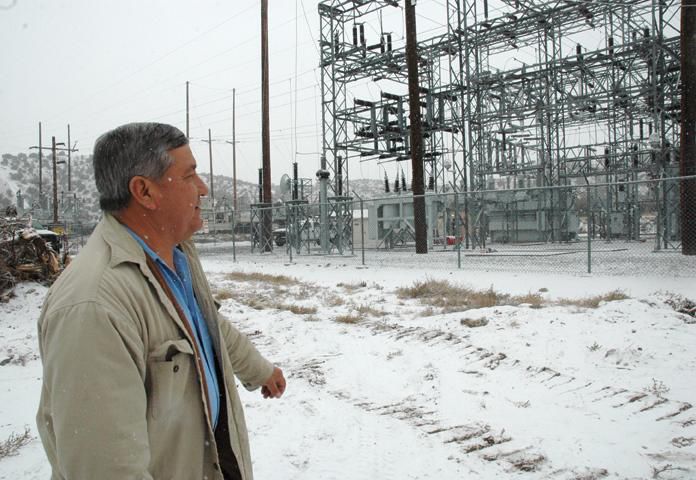
    Repeated power outages over the past 10 days across Rio Arriba and northern Santa Fe counties were largely the result of faulty equipment at the Hernandez station in Española, where the Tri-State Generation and Transmission Association delivers electricity to the Jemez Mountains Electric Cooperative, according to Tri-State and Co-op officials.

    Widespread power outages have struck the Española Valley and other parts of Rio Arriba County three times since Dec. 9. At least indirectly the three power outages can be traced to the station, which has been relying on a less powerful mobile transformer for four months since a defective voltage regulator disabled one of the two permanent transformers, according to Tri-State spokesman Jim Van Someren. A new permanent transformer has been on back order since August and is not due to be delivered until January 2009.

    “(The voltage regulator) is at the heart of what the substation does,” he explained. “It steps down the voltage from the transmission lines to the lower voltage distributed by the Co-op.”

    The problem was first detected months ago.

    “Tri-State detected a problem with one of the transformers during routine maintenance at the Hernandez station a couple of months ago,” Co-op Operations Manager Johnny Lujan said.

    Van Someren was unable to name the company from which Tri-State had ordered the replacement voltage regulator.

    “I don’t know who we ordered the part from,” he said. “There’s no collusion or secretiveness here.”

    Tri-State placed a temporary-use mobile transformer at the substation in August, Van Someren said. The mobile transformer’s capacity was much lower than the disabled permanent transformer — 25 megavolts compared with 56 megavolts.

    Normally, Van Someren said that would not pose a problem for the electrical loads delivered to Hernandez. But Dec. 9, Tri-State was doing maintenance work on transmission lines near Cuba. Electricity normally carried via those lines, known as the “Lahara line,” to the Northern Ria Arriba Cooperative (NORA) system was temporarily re-routed through the Hernandez station, Van Someren said.

    “NORA is not normally served through Hernandez,” he said. “Then, boom—tree contact created a fault on the line, a Hernandez breaker failed, overloading the mobile unit, and it took out Hernandez and NORA.”

    NORA Executive Vice President Ben Leyba said that Co-op’s entire system went down for almost three hours due to the Tri-State malfunction and affected about 4,000 meters. Kit Carson Electric Cooperative Chief Executive Officer Luis Reyes said his Co-op’s line from the Hernandez substation was also affected, but it serves as a secondary line and is not put into use unless the primary line, which runs through Ojo Caliente, goes down, so Kit Carson customers did not lose power Dec. 9.

    The resulting regional power outage also affected 25,000 Jemez customers from Pojoaque to Chama and from Truchas to Cuba, Lujan said. Power was not restored in some areas until 8:45 p.m. that same night, according to Jemez.

    “The normal, permanent transformer could’ve handled that load,” Van Someren said. “But the extra load overwhelmed the mobile unit.”

    Rerouting electricity for maintenance work on the Lahara line overloaded the Hernandez station’s mobile transformer, Lujan agreed. Normally, a breaker would have switched the power off and protected the transformers from damage, he said. But the breaker failed, crippling the Hernandez station’s remaining permanent transformer as well as the mobile unit.

    “I don’t know why (the breaker failed),” Lujan said. “(The arrangement with the mobile unit) worked for months. It was fine until (Dec. 9). If they hadn’t put that extra load on us, we’d have been fine.”

    The Co-op did not mention the faulty regulator or breaker in a press release sent out after the Dec. 9 outage. Instead the Co-op emphasized other aspects of what went wrong: the power overload, weather and a tree falling on transmission lines near Chimayó.

    Tri-State rushed a second 25 megavolt-capacity mobile transformer Dec. 9 from Rio Rancho to Hernandez station.

    But two days later, at 7:05 a.m. Dec. 11, that mobile unit was temporarily overloaded as well, causing an outage in Alcalde, Chamita, Okay Owingeh, Velarde, Dixon, Abiquiu, Cuba, Chimayo, Cordova, Truchas and parts of Española. At that point, power to the NORA had also been rerouted, so its customers were not affected. Power had been restored by 5:30 p.m, to Jemez customers, according to Jemez employee Andrew Chavez.

    The mobile unit was overloaded yet again Dec. 14, causing another limited power outage affecting parts of Española, the Pojoaque Valley, Santa Clara, Chili and along Highway 84/285, Chavez said.

    “There was an overload at 5:50 p.m. Sunday, and it was restored around 8:30,” Lujan said. “This one they’re installing now is a lot bigger — 40 megavolts — and it should take care of all our problems.”

    Van Someren orignally blamed casinos for the problem.

    “We don’t know exactly what happened on Sunday (Dec. 14), except that there was a spike in demand in the Española area,” Van Someren said. “One possibility is that the Indian casino turned on their Christmas lights at that time.”

    “That’s not true,” said Ron Lovato of the Ohkay Owingeh Pueblo’s Tsay company. “We’ve had our Christmas lights on for weeks.”

    The other area casinos have also had their Christmas lights on since the week after Thanksgiving, casino officials and employees said.

    “They’re just looking for a scapegoat,” said Calvin Tafoya of the Santa Clara Development Corporation. “This has been a long time coming. There are infrastructure issues (with the power grid).”

    On Tuesday afternoon, Van Someren backed away from speculation that casino lights may have contributed to the outages. Tri-State attributes both of the latter two outages on “unusual spikes in demand by residents and businesses” in the Española Valley, Van Somersen said.

    “The load at peak time on December 14 was 28.8 megavolts, overwhelming the 25-megavolt mobile unit,” Van Someren said.

    Van Someren said Tri-State  did not anticipate the surge in electricity despite customers normally using more electricty in December.

    This third, larger, mobile unit — and a new breaker — arrived at the Hernandez station Monday and were being installed Tuesday, Lujan said. 

    “With the new breaker and mobile unit, that will give us sufficient capacity to make it until the (permanent) transformer is repaired next month,” said Co-op Financial Director Ernesto Gonzales.

    Tuesday night another outage hit Española but only lasted about five minutes. Van Someren said this was a planned outage necessary to install the third mobile unit.

    Jemez Board member Ralph Garcia represents the Co-op on Tri-State’s board of directors. He said the outages were out of the Board’s hands.

    “I don’t know what the Board would have been able to do,” he said.

    Garcia directed specific questions about the outages to Lujan.

    “He is the one who understands the system,” Garcia said. “The Board is just a policy-setting board and hires someone else to do the day-to-day work.”

    The Jemez Board is scheduled to meet Thursday (12/18) at 9:30 a.m. at the Co-op’s main office in Hernandez.

Related articles

Recent articles