Española School District administrators are bracing for what could be a huge revenue shortfall, when compared to what it costs to run the District.
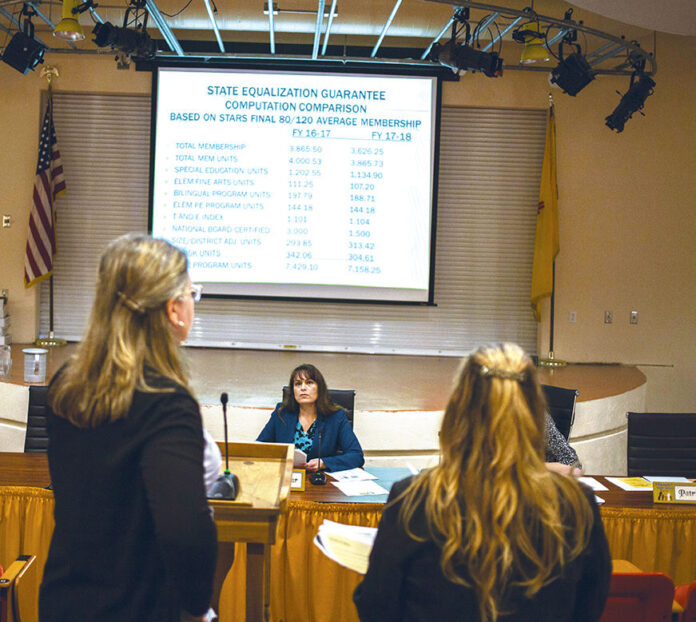
Administrators and Board members, met April 27, to discuss ways to lessen the impact of a projected $808,941 revenue shortfall precipitated by declining student enrollment and a statewide budget crisis.
The deficit could shrink once school officials finish reconciling the District’s bank accounts. Those reconciliations will help them determine how much cash they have on hand, that will carry over to next year.
The District’s Public Education Department-mandated Business Manager Maria Fildalgo told the Board she would prefer to wait until the final numbers are in, as opposed to taking a guess at the remaining cash balance.
“At this point, we don’t know how much we will have,” she said. “That (the final cash balance) will include a rollover of this year’s revenue. We are waiting for the auditors to finish the audit.”
Fildalgo has been with the District ever since the Department ordered Española School District officials to hire a state licensed Level II business manager to oversee the District’s finances in November, after they stripped the Board’s of its financial authority. She is supervising the District’s in-house Business Manager Myrna Garcia, who also has a Level II business license.
Her pro-rated salary will cost the District approximately $100,000 per year. This makes her one of the highest paid employees, behind the superintendent.
The mandated position is an example of one of the cost-saving measures recommended by the District’s Budget Development Committee, which emphasized the importance of making sure contractors aren’t doing work that could be done in-house.
Overall, it has cost about $30,912,511 to run the District this year and if expenses keep pace, the projected $30,103,579 in revenue will leave the administrators scrambling to fill budget holes.
A portion of the revenue decline can be attributed to a decrease in student enrollment.
Based on the counts taken during the 80th and 120th days of the school year, the District saw its student population drop from 3,865 to 3,626. District finance officials estimate the 239-student decline represents a loss of some $505,725 in revenue.
The largest portion of the tentative budget, 49 percent, or about $14,750,753, would go to fund direct instruction, including teacher’s salaries.
Approximately $6,020,715, or 20 percent, would be allocated toward operations, maintenance and capital upgrades; 15 percent, or $4,515,536, would pay for educational support services and administration; 14 percent, or $4,214,501, would pay for student support services and special education; and the remaining two percent, totaling $602,072, would be used to pay for food service.
Fildalgo suggested the District could save money by not filling certain positions after an employee retires, or hire replacements at the position’s entry-level salary.
Board Vice President Yolanda Salazar asked Fildalgo to compile a report that explains the potential cost savings of not replacing those that retire.
To date, District Human Resources officials have received about 25 letters from employees, in all departments, notifying them of their plans to retire.
Española Valley High School teacher John Sena cautioned the Board and administration about being quick to eliminate positions.
“At the high school level, for example, we have an elective teacher retire and we can’t find someone to fill that position, or in order to save money, we cut that position,” he said. “Then that program is gone forever. I think we need to be careful.”
All four Board members in attendance agreed to refrain from proposing cuts to the District’s instruction allocations. Board President Ruben Archuleta didn’t attend the meeting.
Board Secretary Gilbert Serrano said the cuts should come from the administration.
“This Board would like to see that we don’t take anything from instruction,” he said. “We can take it from administration by not filling those positions.”
However, Sena said he would also like to see the Board work harder to avoid cuts to the administrative staff. He said retaining administrators and support staff is an important component for effective teaching.
The educator said cuts to the administration could lead to further reductions to support for the District’s more than 200 teachers.
“One of the reasons we might lose staff, and hence, quality, is that services aren’t as good when we request things from central office, or not as quick,” he said. “You start cutting people from the administration and it is a ripple effect.”
Former Board President Pablo Lujan said considering the news reports that some school districts around the state have considered closing schools and other drastic measures to navigate revenue shortfalls, the District isn’t doing so bad.
“When you look at the other Districts’ finances, we are doing OK,” he said. “That is why I was surprised with the takeover.”
However, he said his colleagues’ focus on cutting administrative positions has to do more with politics than saving money.
“This is a political move of the new Board,” he said. “They can’t attack any other way, so they use the budget as an excuse to target certain administrators.
Associate Superintendent Myra Martinez, at the request of acting superintendent Denise Johnston, compiled a report showing the District could eliminate positions at the Española Middle and high school and add teachers for the elementary schools.
Although Martinez explained her report was based on actual enrollment data, it was met with skepticism by Board member Patrick Herrera.
“What’s on paper and real-world practical are two different things,” he said. “Let’s double-check our math before we think of cutting a teacher.”
Herrera wife’s is a special education teacher with the District.
Martinez emphasized the proposed eliminations would be taken from the 25 or so employees scheduled to retire and not translate to job losses for those currently employed.
The Committee, comprised of administrators, teachers and community members, compiled a list of how they thought the District could save money during the upcoming fiscal year.
Those suggestions ranged from reducing attorney fees, classroom consolidation and as a last resort, considering closing some schools.