It is no secret many people believe that in order for America to compete on a global level, students should focus their educations toward careers in the science, technology and engineering fields.
As a result, there has been a concentrated effort to get young students, especially girls, interested in those fields.
One Española Middle School eighth-grader and her classmates won’t have to be pushed very hard.
Evanyssa Baros was one the middle school students that traveled to Albuquerque, March 17, to showcase their skills at the Math Engineering Science Achievement (MESA) middle school competition. The University of New Mexico hosted the event at Johnson Gym.
Baros said she got involved in the program because she likes figuring out how things work.
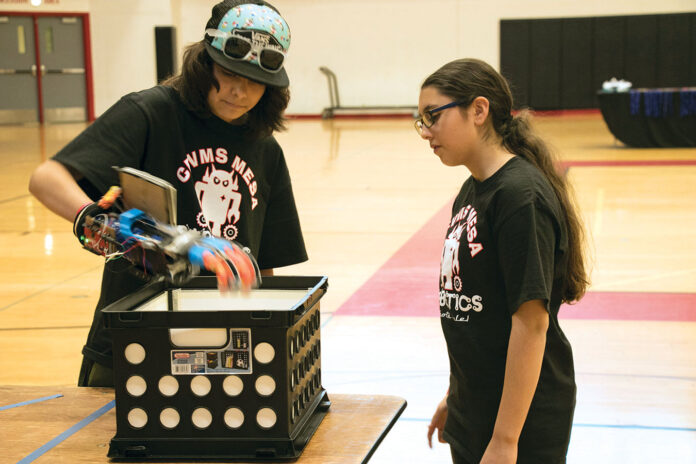
“It is cool to learn how to build things,” she said. “I like engineering – mechanical is what I am going to go to school for. I mean, I want to learn and basically build stuff like this (mechanical arm).”
Northern New Mexico College Professor and Española Valley High School STEM Advisor Steve Cox said, in recent years, there has been a push to get more women interested in pursuing careers in science and technology.
“Although half the bachelors degrees go to females, it is still way less than half for STEM,” Cox said. “As STEM fields pay more, this leads to pay inequities for females, and so less economic growth for our country.”
The project
Students, with the help of their advisors, Middle School teachers Mignon Peñalosa and Mariejune Abergos, as well as Los Alamos National Laboratory Mechanical Engineer Dereck Benavidez, worked for months on building the mechanical arms for the competition.
Northern New Mexico’s MESA Regional Director Nick Kunz said the students competed against their peers from 60 New Mexico schools, in two exercises, to gauge how well the arms function.
During the first competition, the students tested their mechanical hand’s dexterity by picking up several items with varying degrees of thickness, such as a dollar bill. They then put them back in the box in less than a minute. The second test involved tossing a bean bag and hitting a target on the floor.
Kunz said the organization adopted the prosthetic limb theme a few years ago and has stuck with it ever since.
Before the students set out to design and build their prosthesis, they were given a set of criteria they had to follow.
They were told, “Your classmate needs a prosthetic arm and you have to make it low-cost,” Kunz said. “It (the arm) has to be under $80.”
Kunz said besides learning how to turn an idea into something functional, MESA could play a much more vital role in the lives of some of the participating students.
“Adolescents need a place to go and something to be passionate and engaged about,” he said. “It is a way for them to use their time positively and get on the path to a bright future.”
None of the middle school students placed or won awards, but that doesn’t seem to bother Peñalosa. This is her eighth year working with the MESA program and her fourth year serving as the middle school’s advisor. She also served as an advisor for four years with a Maryland MESA organization.
“My students did pretty well,” she said. “Their prosthetic arms were fully functional. However, they did not get any awards, but still, for me, they are already winners.”
Peñalosa said just like her students, she finds the work engaging.
“I like the challenge because every year, it is something new,” she said. “As a teacher, the students expect me to know everything, but I don’t. There is always something to learn.”
However, Peñalosa said she doesn’t mind being stumped by her seventh- and eighth-grade students.
“When I work with kids who are as brilliant and amazing as the ones I have right now, I go home very happy,” she said.
Baros’s eighth-grade classmates, Jose Olivas, 13, and Frankie Gonzales, 14, also competed in the Albuquerque competition. Olivas said he believes he achieved his number one goal.
“We made our robotic arm to pick up hacky sacks and move things like a ruler, a DVD and a pencil,” he said. “But the actual purpose was to make it move.”
Gonzales said, although he finds both, building the arm and competing in the dexterity exercises challenging, he likes participating in MESA.
Benavidez, the students’ Los Alamos advisor, credits MESA for developing the interest that led to his current career as a mechanical engineer.
He said he came on as an advisor with the program a few months ago and is still amazed at the work the students are doing.
“I always tell them they are doing far cooler things than what I was doing when I was in high school,” Benavidez said.