At the fourth annual Osprey Fest July 10-12, eager visitors jostled to get pictures of the large raptors in the 20 nests they’ve made within Heron and El Vado Lake state parks.
Attendees were also educated on the history and habits of the birds.
“The whole idea is we want the public to come out and enjoy the fresh air, see the environment in its natural state and promote healthier lifestyles,” New Mexico State Parks graphic designer Chris Martinez said.
Ospreys can have wingspans up to six feet. They feed primarily on fish and the lakes provide them with ideal hunting grounds. They nest atop tall trees or other structures that provide them with a view.
Unfortunately, they are also attracted to telephone poles. The birds are sometimes electrocuted when they touch the lines with their large wings, and sticks from the nest can spark electrical fires. It’s a major cause of osprey mortality, Wildlife Center Director Kathleen Ramsay said.
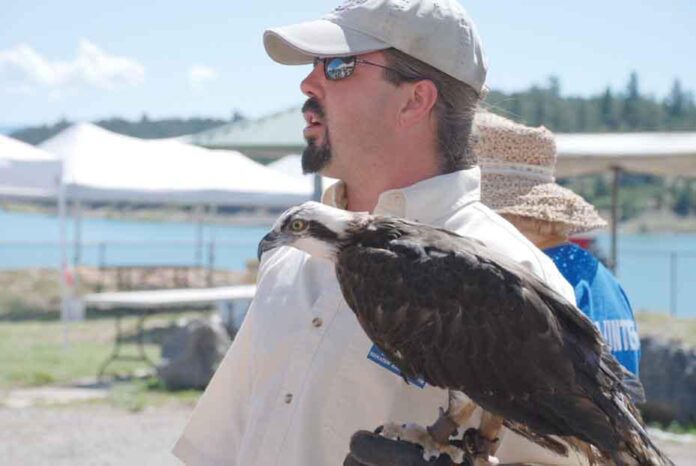
The Center rehabilitates injured birds of prey at its facility in Arroyo Seco. At the Fest it displayed Electra, a three-year-old female osprey who was severely burned as a chick in a flash fire.
“We were unable to heal her to where she could be released into the wild,” Ramsay said. “She’s an absolutely incredible educational animal and the mascot of the Fest.”
Electra was displayed along with other raptors, including a red-tailed hawk, at a series of booths at Ridge Rock recreation area. Ramsay explained how the Center and a local electric cooperative have worked to help solve the problem of ospreys nesting in telephone poles.
“We worked closely with NORA (Northern Rio Arriba Electric Cooperative),” Ramsay said. “They erected extra nest sites a little higher than the telephone poles and that keeps the telephone poles from killing the birds.”
NORA has erected 20 such nest poles at El Vado and Heron lakes. They are topped with a box and the ospreys are utilizing them as nest sites. The Co-op benefits because it has fewer shorted lines and burned-out transformers, Ramsay said.
“We have 17 nests at Heron alone,” Ramsay said. “In eight of the nests, we have three chicks, which is phenomenal.”
Although ospreys were the focus of the festival, visitors also had access to boat rides, an archery range, birdhouse construction, photography workshops and traditional crafts.
Robert Taylor and his wife Margaret, of Denver, took a weeklong vacation to visit Osprey Fest and the Cumbres and Toltec Railroad.
“We’ve been here since (July 6),” Taylor said. “We took the train ride.”
At one booth, Mary Weahkee, of Santa Clara Pueblo, demonstrated how Native Americans utilized the leaves of the yucca plant to make sandals, baskets and ropes.
“We’re demonstrating the different forms of yucca manufacture,” Weahkee said as she tied a small bracelet around the wrist of Sara Ransom, of Durango, Colo.
The Jicarilla Apache Nation participated in the Fest for the first time. Vernon Patago, Rod Velarde and dancers from the Nation performed for the crowd. Velarde led the final friendship dance, inviting members of the crowd to participate.
As ospreys soared overhead, young men and women jumped from cliffs at the lake and visitors from different states shook hands.