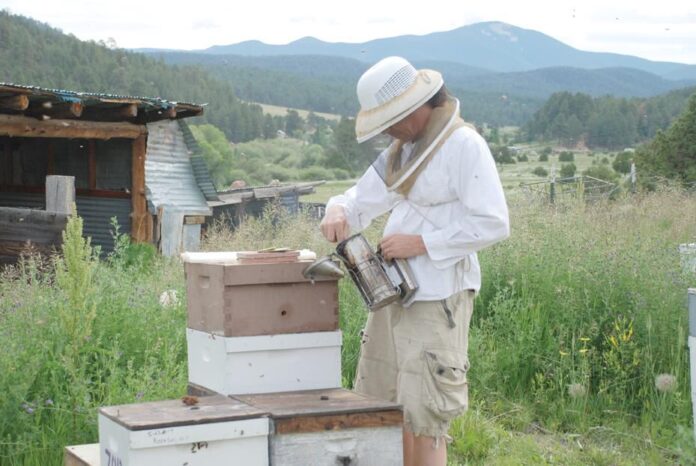
Bees swarmed over the hive as Mark Spitzig took it apart July 4, but he didn’t feel threatened and suffered no stings.
He finally spotted a queen in the third frame. Sticking his finger into the middle of a bunch of bees, he pointed her out. The queen was noticeably larger than the surrounding bees.
“Who says bees are mean?” Spitzig said.
Spitzig and his partner, Melanie Kirby, own Zia Queen Bees and Superior Honey Farm in Truchas. They specialize in raising queen bees, which are essential to a bee colony. Queen bees are the only bees that can lay eggs — without one, the hive dies.
When a colony loses its queen, it becomes agitated and more aggressive. When Spitzig opens a hive without a queen, he has to wear protective gear. One colony he examined last weekend was in the process of raising a new queen, which the bees do in a specially constructed cell. By segregating a group of queenless bees, Spitzig and Kirby can induce queen production.
“We utilize the natural cycle to mimic a queenless situation,” Kirby said. “We make a mini colony and we can get several cycles out of each hive.”
There are three castes within a bee colony: workers, which are all females; drones, who are stingless and whose sole purpose is to mate with the queen; and one queen, who lays all the eggs for the colony.
Zia raises and sells about 3,000 queens a year at $23 each, and they also sell the special cells that provoke queen production. They maintain 350 hives in New Mexico, and are the state’s only commercial company specializing in the raising of queen bees. There are only 35 queen bee suppliers nationwide, according to Kirby.
“There’s a shortage of suppliers,” Spitzig said. “Every queen bee we can produce is sold.”
Zia produces naturally hardy and healthy stock, and does not use chemicals, Kirby said.
“We’re a survivor stock producer,” Kirby said. “Bees are a form of livestock and susceptible to various pests and diseases.”
The most serious complication currently affecting bees across the nation is Colony Collapse Disorder (CCD). The disorder kills entire colonies and has caused significant losses within both wild and commercial colonies. No single source of the disorder has been identified.
“It’s very complex,” Kirby said. “They think there are a multitude of factors.”
So far, New Mexico has been spared the ravages of the disorder.
“It hasn’t been seen here, at least not confirmed,” Kirby said. “That doesn’t mean we’re safe.”
In addition to supplying queen bees, Zia provides whole hives to farmers to pollinate their fruit trees and vegetable crops. Honeybees pollinate 33 percent of the agricultural species in the United States, Spitzig said.
In the winter off-season, from October to March, the company can concentrate on honey production. But during the spring and summer months, it’s theirs to keep, he said.
“When producing queens, we let the bees keep the majority of the honey,” Spitzig said.
Kirby, a Las Cruces native, said she learned beekeeping while serving in the Peace Corps in Paraguay. Spitzig grew up on Michigan’s Upper Peninsula and took up beekeeping 10 years ago. The two met in Florida five years ago, and their daughter Isis Rose Blossom was born last year.