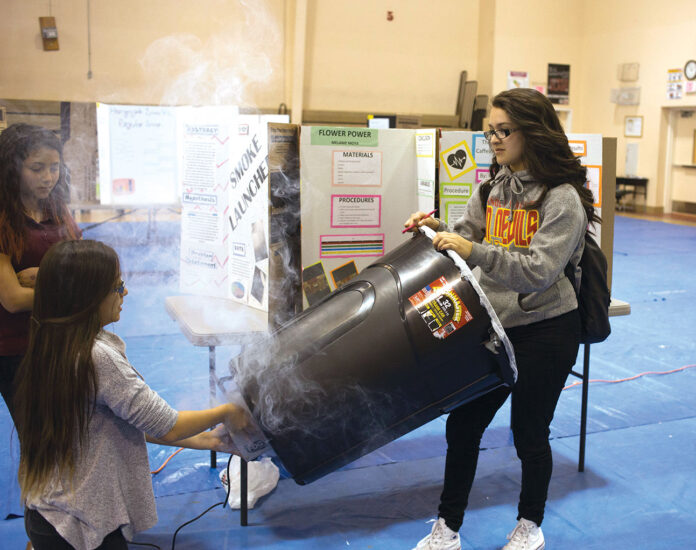
Española Middle School students put on their thinking caps to plan, design and build projects to enter into this year’s science fair.
Altogether, 550 students entered exhibits into the Middle School’s Science Fair, April 5, that saw students take home first, second and third place ribbons for a variety of projects such as the “Biomechanics of Pitching” and “Warming Up Under the Sun.”
The students started planning their projects some time around the middle of October and worked on them until the last week of March.
The projects
Eighth-graders Miranda Salazar and Luigi Salcedo shared first place in their division for their “Warming Up Under the Sun” and “Measuring Data Spacing” projects.
Salazar said when she is finished with high school, she plans to go to college to become a pediatrician.
She chose her project because she liked the idea of seeing how long it would take to warm water, oil and soil under direct sunlight.
After making a couple of changes to accommodate Mother Nature, Salazar learned oil heats the fastest.
“I didn’t do it under direct sunlight because it was in the winter,” she said. “So it took me an hour under really, really hot lamps.”
Salazar said completing her project took the entire five-month time limit, but she would have finished sooner if it wasn’t for the timeline she had to follow.
Her classmate, eighth-grader Jordan Bell, drew on one of his favorite activities for his project, the “Biomechanics of Pitching.”
“Baseball is my favorite sports,” he said. “I wanted to do a project about what I am interested in and I am really interested in baseball.”
Bell wanted to learn how a change in a baseball pitcher’s stride would impact his power and efficiency on the mound.
He conducted his experiment by having one of his friends change their normal stride, for no stride at all, or an extended stride. No stride means the thrower releases the ball with little or no movement of his feet or legs and an extended stride means the pitcher extends his leg forward while releasing the ball.
He learned through the data, that change is not always good.
“The normal stride is better because you are comfortable with it,” he said. “It is easier to use than the extended stride or no stride. It produces the best results. The velocity of the pitch goes faster.”
Although seventh-graders Karla Rubio and Joni Martinez didn’t receive a ribbon for the project they worked on together, they were on hand to demonstrate their smoke launcher.
The pair said the idea behind the project was to see how far away the operator has to be from a target, before the launcher starts to lose pressure.
After a few tries, the girls were able to knock a water bottle off of their classmate, Garrett May’s head, at about 20 feet.
Española Middle School science teacher Marijune Ambergos said the students adhered to a strict timeline, from October to March. The timeline allowed the students to stay focused and on task.
The students started with an idea they got from watching television or surfing the internet. Then they worked out the scope of the project and devised a problem statement. The students used the problem statement as a beacon to guide them through the project.
A problem statement identifies the purpose of the students’ project and what the young scientists hoped to learn or explain.
Ambergos said after deciding on the projects, the seventh- and eighth-grade students received minimal input from the teaching staff.
“They just consulted us and asked questions like ‘What do you think of this idea or this project?’ or ‘Do you think this project is workable?’” he said. “Our job was to work with and beside, them.”
Ambergos and his colleague, science teacher Mignon Peñalosa, contacted the Los Alamos National Laboratory Community Partnership Office, which provided judges for the competition.
Office Director Kathy Keith said she hopes the Lab’s interaction with area schools will get students interested in pursuing science careers.
“We hope to spark students’ interest in STEM (Science, Technology, Engineering and Math) related fields early on,” she said. “Encourage them to pursue careers in STEM and gear them toward the workforce pipeline of the Laboratory.”
She said the interactions are perfect opportunities to let students get a glimpse of a life in science.