
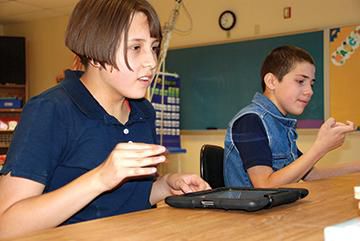

The Española School District spent $58,793.90 in June on iPads, iPad minis and Apple Care, a protection plan for the devices. These were not the first iPads the District purchased, and more than likely, they will not be the last. The District in June 2012 spent $41,220 on 90 iPads, along with specialized carts to store and charge the iPads for another $37,759.45.
Felicia Maestas, the District’s first technology curriculum coordinator, said the District had begun using iPads with a top-down approach. First, Maestas said, the superintendent and principals received the iPads and were allowed to become comfortable with the devices.
“Get it out to the principals first, then the teachers, and then the students,” Maestas said.
Two years ago, Maestas said, the principals received iPads and several kindergarten classrooms throughout the District had iPads. The goal, Maestas said, is to have every kindergarten classroom in the District supplied with iPads.
The majority of the iPads purchased by the District have used Title 1 Funds. Federal programs director Larry Deaguero said when Title 1 awards the District funds, the funds are then alloted to all school sites.
This year, Title 1 awarded the District $1.5 million. Deaguero said several schools this year and last year spent their Title 1 funding on iPads.
“The schools did it last year, starting with the kindergarten,” Deaguero said.
Los Niños Kindergarten Center purchased 13 iPads. Victory Christian purchases five iPads and nine iPad minis to be used by their special education students and staff. Ten iPad minis were purchased for private schools operating within the District. Sombrillo Elementary School purchased ten iPads. Hernandez Elementary School purchased 20 iPads.
Velarde Elementary School purchased 10 iPads. Española Elementary School, though, by far purchased the most iPads, purchasing 60 this year. During their summer school program, in July, Española Elementary School principal Jule Skoglund said 10 iPads were stolen. The 60 iPads, though, were not ordered by Skoglund, but by outgoing principal and current superintendent Danny Trujillo.
“The iPads are used for differentiated instruction,” Trujillo said. “They will be used for individual and small group intervention, and to expand STEM (science, technology, engineering and mathematics education) learning through technology,” he said.
Skoglund, Los Niños Kindergarten Center principal last year said the kindergarten received 23 iPads. In an email response, Skoglund said, iPads are used by classroom teachers for centers, where students can pass through the learning center with the iPads. Also, Skoglund said speech, occupational, and physical therapists use iPads for students on the autism spectrum.
This is perhaps the most intensive use the iPads receive in the District.
Special Education
The French theorist Jacques Derrida called the lack of the ability to formulate and execute emotions through use of language madness. Silence, Derrida claimed, was madness.
For a handful of students in the Española School District, verbal communication is beyond their physical capability. For these students, communicating to teachers, to students, to peers and family is one of the most frustrating and difficult parts of their lives; however, iPads have become a big help in enabling these students to verbally communicate.
Special Education director Christina Baca said currently the special education department uses around 50 iPads throughout the District. Each special education teacher has an iPad, Baca said, to use as reinforcement of lessons with students. Then, Baca said, 30 students have use of their own iPad for use at school for communication or instructional needs.
“We use them in a number of ways,” Baca said. “The most significant way is as a communication device for children on the autism spectrum who are non-communicative. The iPads are used for picture-exchange communication process,” she said.
At Española Middle School, special education teacher Reyna Guevara uses iPads with her students every day in class. Some students are non-verbal and use the iPad to form simple to complex sentences. Essentially, she said, the students will manipulate the iPad to be their voice, to express verbally what they are physically unable to communicate.
“The program helps our students to function better in everyday life,” Guevara said.
The computer program used at the middle school is AutisMate, and it is actually an app, available for download by anyone with an Apple product device, such as iPhone, iPod, or iPad.
For student Marcus Salazar-Peña, the iPad is attached to his wheel chair, and he manipulates the device on his own to act as his own voice.
“Hi,” Salazar-Pena said, by tapping a picture on his iPad which shows a stick figure waving. “What’s up? How are you today?” he said.
“Marcos is a wizard,” Guevara said.
Salazar-Peña is able to carry on conversations by tapping on different images loaded on his iPad.
Guevara said Salazar-Pena was the first student at the middle school to use AutisMate, so he now has the most extensive vocabulary programmed in the iPad. Since Salazar-Pena cannot verbally communicate, he takes his iPad home with him. At home, he has taken photos of his house, living area, kitchen, and bedroom. Each photo has a word or phrase programmed along with it, so Salazar-Pena will be to tap what he wants.
“AutisMate has really helped because it lets us know what he wants,” Guevara said.
However, the iPads are used for more than communication, Baca said. They are also used as a learning tool for students unable to write. Baca said speech-to-text programs allow students to speak into the iPad and thus complete their homework. In addition, the iPads are also used to teach life skills, Baca said.
Guevara said several of her students use iPads to learn basic skills necessary to live, such as cooking or brushing their teeth. Teachers will take videos of each other going through a skill step by step. Pick up the tooth brush, turn on the water, put the toothpaste on the toothbrush, and so forth. Guevara said this helps the students gain independence by not having the teacher right there, walking through each step with them. This way, the student can hit the play button, watch the video, and proceed at their own pace.
Baca said, the District does not have any plans to purchase additional iPads this year for the special education program.