NM Colleges Are Worst in the Nation

Published:

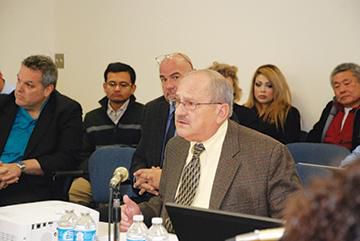
    Secretary of Higher Education Jose Garcia has a definite answer for anyone who has wondered how New Mexico is doing competitively, as a state in higher education. Not well.

    Garcia surprised Northern New Mexico College’s Board of Regents when he stopped by for an impromptu visit during the board’s Dec. 19 regular meeting. Regent Alfred Herrera said the Board had been asking Garcia to visit them for months, but it had not happened.

    “This is the first time since I’ve been on the Board that the secretary has stopped by,” Herrera said.

    Herrera first became a regent January 2009. 

    “Where are we? And where does Northern New Mexico College fit?” Garcia said.

    Garcia said from 1990 to 2010, the state has ranked last, 50 out of 50, in the improvement of the proportion of the population with a college degree. Garcia said while the state ranks last in higher education, it ranks first in state spending on higher education. He said the state spends 15.3 percent of their budget each year on higher education, compared to a national average of 6.8 percent. For this reason, the state had to turn to a performance-based funding formula, Garcia said. This happened in 2010. The new funding formula awards money to state institutions based on three main criteria: the number of degrees awarded, the number of science, technology, engineering and mechanical degrees and lastly, how many at-risk students are awarded degrees.

    “I think, given a little effort, you (Northern) could be very competitive in relationship to the funding formula,” Garcia said.

    In 2012, Northern awarded 19 one- or two-year certificates, 96 associate degrees and 68 bachelor’s degrees. For the 2014 fiscal year, the state allocated $10.7 million out of the $583 million higher education department. For the fiscal year 2015, Northern has been allocated an additional $67,302.

    “This funding formula is necessary to tell the colleges, ‘You need to get in there and perform,’” Garcia said.

    However, not all the regents agreed with Garcia’s remarks.

    “Will we be compared to colleges with the same abilities as us (Northern), as opposed to UNM (University of New Mexico)?” Regent Cecille Martinez-Wechsler asked.

    Garcia said the comparison was the same across the board and the funding formula would be applied to every college and university in the state.

    “It doesn’t seem fair when we don’t have the abilities to provide doctorates, or the budget, that we be compared to UNM. It would seem like it’s more reasonable if we were compared to other institutions that are like us,” Martinez-Wechsler said.

    However, Garcia did not budge on the value of the new system.

    “Institutions need to be competing against each other,” Garcia said.

    Northern President Rusty   Barceló said fundamentally, she has no problem with the formula, except in one area. Barceló said Northern has 70 percent of its enrollment categorized as developmental students.

    “I would argue in the same way that research is an additional cost factor, working with developmental students is also an additional cost factor,” Barcélo said.

    She said this makes her worry about a “level playing field.” The students coming into the college are not at the same level as students going into other colleges, Barcélo said. While this is what “Northern is all about,” it does not create an equal playing field in the competition for funding among the state’s colleges.

    Garcia, once again, was not swayed in his belief of the fairness and the benefit of the outcome-based funding formula.

    “I would say one thing in response to that. If I were teaching here, or if I were in the administration, I would look at the fact that you have 70 percent developmental students as huge opportunity, because the funding formula actually gives you subsidy every time you graduate one of those,” Garcia said.

    Garcia said the institution will eventually be rewarded, but it will be when the institution succeeds in graduating developmental students.

    He said this funding formula is necessary for the state to turn around the tide of falling higher education.

    Board President Michael Branch said he was aware of the rewards for graduating, but there was an additional up-front cost for the institution.

    “I would propose that this particular issue be something that we take to the technical committee, except that I would hope that you would initiate the technical committee at a regularly scheduled meeting throughout the year, so these types of things are in a form that can be discussed, instead of waiting for a meeting to happen,” Branch said.

    “Well, as a matter of fact, Mr. Branch, chairman, that’s exactly what we’ve been doing for three years in a row,” Garcia said.

    The secretary said a steering committee and a planning committee had been created. In addition, he said this performance-based funding formula was not developed in secret, but was openly discussed and agreed upon by parties involved.

    “Northern has a chance to make New Mexico look so good because of your metrics. We have two that we’re very strong in, we could really just blow it out of the water, but we need money,” Martinez-Wechsler said.

    “Well, let me tell you about money,” the secretary said.

    Garcia said for the first time in New Mexico’s history, the older generation was at a higher level of education than the younger generation.

    The lack of higher education is being accomplished with one of the most higher education systems in the country, Garcia said.

    “Start competing and start doing a more efficient job of converting students into degrees than you’ve done before,” Garcia said.

    Garcia said without this aggressive formula in place, the state’s higher education system would become a disaster.

Related articles

Recent articles